

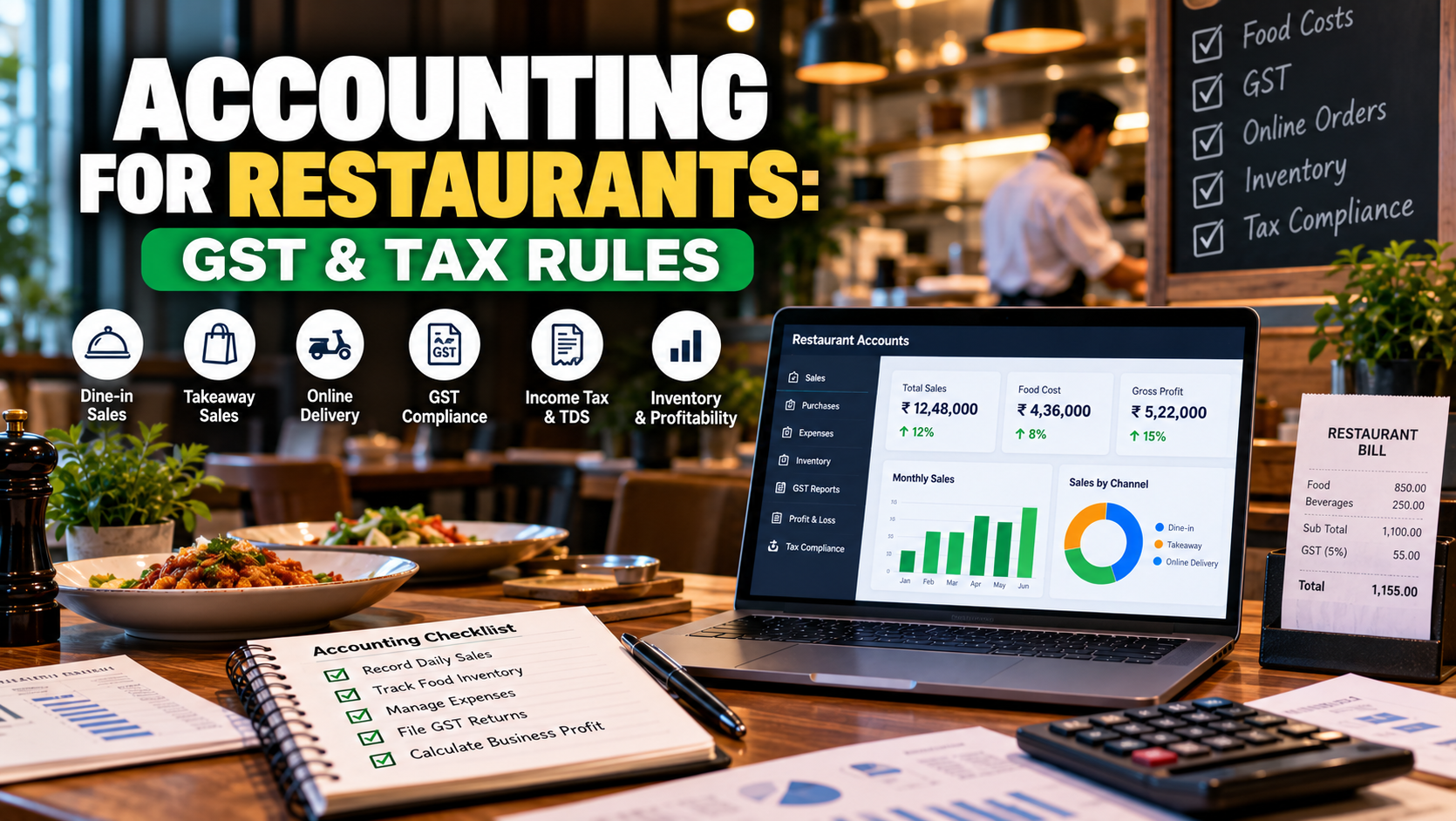
Running a restaurant is not just about food, customers and sales. Behind every successful restaurant is a strong accounting system that tracks daily sales, food costs, inventory, wastage, salaries, supplier payments, GST, income tax, online delivery commissions and cash flow.
Restaurant accounting can become complicated because a single business may have several types of transactions:
-
Dine-in sales
-
Takeaway sales
-
Online food-delivery sales
-
Catering
-
Beverages
-
Alcohol sales
-
Discounts and complimentary items
-
Service charges
-
Delivery-platform commissions
-
Supplier purchases
-
Employee expenses
-
Rent and utilities
On top of this, restaurants need to correctly handle GST and income-tax compliance.
This guide explains the major accounting, GST and tax rules for restaurants in India, along with practical accounting methods that restaurant owners can use to maintain accurate books.
Important: GST and income-tax treatment can depend on the restaurant's business model, location, entity type, turnover and nature of supply. Always verify the applicable rules for the relevant financial/tax year before filing returns.
What Is Restaurant Accounting?
Restaurant accounting is the process of recording, classifying and analysing all financial transactions related to a restaurant.
It includes:
-
Recording daily sales
-
Recording purchases
-
Tracking food inventory
-
Recording wastage
-
Recording staff salaries
-
Recording rent and utilities
-
Recording online-platform commissions
-
Reconciling cash and card payments
-
Recording GST
-
Preparing financial statements
-
Calculating taxable business income
-
Managing tax compliance
A restaurant should ideally maintain accounting records daily, rather than waiting until the end of the month.
The reason is simple: restaurants deal with a high volume of small transactions. Even a small daily discrepancy can become a significant amount over an entire year.
Why Proper Accounting Is Important for Restaurants
Restaurant businesses generally operate with relatively tight margins.
A restaurant can have high sales but still generate poor profits because of:
-
Food wastage
-
Excessive food costs
-
High delivery commissions
-
Poor inventory control
-
Staff costs
-
Rent
-
Electricity and gas
-
Discounts
-
Unrecorded cash expenses
-
Theft or leakage
-
Incorrect GST accounting
Proper accounting helps the owner understand not only how much the restaurant sells, but also how much it actually earns.
For example:
Restaurant A
Monthly sales: ₹15 lakh
Food cost: ₹5 lakh
Salary: ₹2.5 lakh
Rent: ₹1.5 lakh
Utilities: ₹70,000
Delivery commissions: ₹1 lakh
Other expenses: ₹80,000
The owner needs accurate accounting to determine the actual operating profit after considering all relevant expenses and taxes.
GST on Restaurant Services
GST is one of the most important tax areas for restaurant owners.
The current CBIC rate schedule provides 5% GST without input tax credit for restaurant service other than at specified premises. The rate schedule separately provides an 18% rate for restaurant service at specified premises, subject to the applicable conditions.
Therefore, restaurant owners should not simply assume that every food-related transaction has the same GST treatment.
The exact treatment can depend on:
-
Type of restaurant
-
Whether it is located at specified premises
-
Hotel-related status
-
Nature of catering activity
-
Nature of the particular supply
-
Whether alcohol is being supplied
-
Whether the business is under the composition scheme
5% GST on Regular Restaurant Services
For a typical restaurant operating outside specified premises, restaurant service is generally taxed at:
GST = 5%
This is generally:
-
CGST: 2.5%
-
SGST: 2.5%
for intra-State supplies.
The important condition is that the concessional 5% rate is without input tax credit.
Example
Suppose taxable restaurant sales are:
₹10,00,000
GST at 5%:
₹10,00,000 × 5% = ₹50,000
For an intra-State supply:
-
CGST = ₹25,000
-
SGST = ₹25,000
The restaurant's accounting system should separately track the output GST liability.
What Does "Without ITC" Mean?
ITC means Input Tax Credit.
Normally, a GST-registered business can use eligible GST paid on purchases and expenses to reduce its output GST liability.
However, where restaurant service is taxed at the applicable 5% rate without ITC, the restaurant cannot claim input tax credit on goods and services used for that restaurant service.
This is one of the most important points in restaurant accounting.
Example
Suppose a restaurant pays:
-
₹20,000 GST on equipment
-
₹10,000 GST on eligible services
-
₹30,000 GST on other business purchases
If the restaurant's outward restaurant service is under the 5% without-ITC category, it cannot simply deduct this ₹60,000 as ITC against its restaurant GST liability.
The accounting system therefore needs to correctly identify ITC eligibility instead of automatically treating every purchase GST amount as recoverable.
Restaurant GST and Hotel Restaurants
Restaurants operating within hotels require additional attention.
The current GST rate schedule distinguishes restaurant services at specified premises from restaurant services outside specified premises. The applicable rules for hotels also depend on the value of accommodation and the applicable option/conditions for the relevant financial year.
Therefore, a hotel restaurant should not automatically apply the same GST setup used by a standalone restaurant.
Before configuring the billing software, the business should determine:
-
Whether the premises qualifies as specified premises.
-
The applicable hotel accommodation conditions.
-
The GST rate applicable to the restaurant service.
-
Whether ITC is available.
-
Whether an applicable option needs to be exercised.
GST on Takeaway Food
Takeaway food supplied by a restaurant can generally fall within restaurant service when the transaction qualifies as such.
The GST Council has clarified that restaurant service includes relevant takeaway supplies, and current GST treatment should be determined according to the applicable rate notification and classification.
This means the POS system should not create inconsistent tax treatment merely because the customer consumes the food outside the restaurant.
GST on Food Delivery Apps
Online delivery has changed restaurant accounting significantly.
Restaurants commonly receive orders through platforms such as food-delivery applications.
For restaurant services supplied through an e-commerce operator, the GST mechanism under Section 9(5) applies: the e-commerce operator is liable to pay GST on the notified restaurant service supplied through the platform.
CBIC clarified that this mechanism applies from 1 January 2022 and that the e-commerce operator issues the invoice for the restaurant service.
However, the restaurant should still account for those sales in its books.
CBIC specifically clarified that restaurant supplies made through e-commerce operators are included in the restaurant's aggregate turnover for GST purposes.
Important accounting point
Suppose:
Online order value = ₹1,000
Delivery platform commission = ₹200
Amount settled to restaurant = ₹800
The restaurant should not simply record ₹800 as sales.
The accounting records should capture the appropriate gross sales, platform charges/commission, taxes and settlement based on the actual transaction and contractual documents.
This is important for:
-
Revenue reporting
-
Profit calculation
-
GST turnover
-
Reconciliation
-
Income-tax reporting
GST on Alcohol in Restaurants
Alcoholic liquor for human consumption is outside the GST levy.
CBIC explains that alcoholic liquor for human consumption is excluded from GST, and State taxation continues to apply.
Therefore, a restaurant selling alcohol can have two different tax treatments:
Food and other GST-taxable supplies
GST applies according to the relevant GST classification and rate.
Alcoholic liquor
GST does not apply to the alcohol itself; applicable State taxes such as VAT/excise-related requirements may apply.
This creates an important accounting requirement:
Do not combine GST-taxable restaurant sales and alcohol sales into one undifferentiated sales account.
The POS and accounting system should separately track:
-
Food
-
Non-alcoholic beverages
-
Alcohol
-
GST
-
State taxes where applicable
Restaurant Composition Scheme
Eligible small restaurant businesses may consider the GST composition scheme.
For restaurant service under the composition scheme, the GST Council's published guidance states that restaurants can pay GST at 5% of turnover, subject to the conditions of the scheme. The published guidance specifies an eligibility turnover limit of ₹1.5 crore, with a lower limit for specified special-category States.
Under composition:
-
GST is paid at the prescribed composition rate.
-
ITC cannot be claimed.
-
A tax invoice is not issued in the normal manner; a bill of supply is used.
-
GST cannot generally be collected separately from the customer.
-
Various eligibility restrictions apply.
A restaurant should therefore compare the composition scheme with regular GST registration before selecting the option.
Regular GST vs Composition Scheme
| Particular | Regular GST | Composition Scheme |
|---|---|---|
| Tax mechanism | Normal GST | Presumptive/concessional |
| Restaurant rate | Generally 5% outside specified premises, subject to applicable rules | 5% |
| ITC | Depends on applicable rate; 5% restaurant service is without ITC | Not available |
| Tax collected separately | Yes, where applicable | Generally no |
| Tax invoice | Yes | Bill of supply |
| Compliance | Higher | Generally simpler |
| Eligibility | Subject to GST registration/rules | Subject to composition conditions |
| Interstate restrictions | Depends on normal GST rules | Composition restrictions apply |
The composition scheme should not be selected solely because the rate appears attractive. The restaurant should consider its customers, purchasing pattern, business expansion plans and compliance requirements.
GST Registration for Restaurants
A restaurant must evaluate GST registration based on the applicable registration threshold and other compulsory-registration provisions.
The registration analysis should consider:
-
Aggregate turnover
-
State of operation
-
Nature of supplies
-
Inter-State transactions
-
E-commerce arrangements
-
Other mandatory-registration conditions
Restaurant owners should not confuse the GST registration threshold with the composition scheme turnover limit.
They are separate concepts.
GSTR-1 and GST Returns
A regular GST-registered restaurant needs to maintain accurate outward-supply records for GST reporting.
GSTR-1 is the statement of outward supplies filed electronically by registered taxpayers making taxable supplies, subject to the applicable exclusions and filing scheme.
For restaurant accounting, the underlying data should reconcile with:
-
POS sales
-
Cash sales
-
Card sales
-
UPI sales
-
Online delivery sales
-
Credit sales, if any
-
GST invoices
-
Credit notes
-
Debit notes
-
Discounts
A difference between POS sales and GST return figures can create compliance problems.
Restaurant Accounting for Cash, Card and UPI Sales
Restaurants often accept multiple payment methods.
Your accounting system should separately reconcile:
Cash
Daily physical cash should be compared with:
Opening cash + cash sales − cash expenses = expected closing cash
Card
Reconcile:
POS card sales → bank settlement → merchant charges
UPI
Reconcile:
UPI sales → bank statement → settlement amount
Online Delivery
Reconcile:
Platform order report → restaurant sales records → commission → taxes/adjustments → bank settlement
This reconciliation should be performed regularly.
Daily Sales Reconciliation
One of the most important restaurant accounting controls is a daily sales reconciliation.
A useful daily report can contain:
| Particular | Amount |
|---|---|
| Dine-in sales | ₹ |
| Takeaway sales | ₹ |
| Online delivery sales | ₹ |
| Cash sales | ₹ |
| Card sales | ₹ |
| UPI sales | ₹ |
| Discounts | ₹ |
| Refunds | ₹ |
| GST | ₹ |
| Other charges | ₹ |
| Net sales | ₹ |
The exact structure can be customised according to the restaurant's POS system.
The purpose is to make sure that every rupee appearing in the POS system is accounted for somewhere in the financial records.
Accounting for Food Purchases
Food ingredients are one of the largest expenses for most restaurants.
Purchases may include:
-
Rice
-
Flour
-
Vegetables
-
Fruits
-
Meat
-
Fish
-
Eggs
-
Dairy products
-
Cooking oil
-
Spices
-
Beverages
-
Packaging materials
These purchases should be properly classified and supported by invoices.
A restaurant should avoid recording every purchase directly as an expense without considering inventory.
For businesses maintaining inventory accounting, purchases should flow through the appropriate inventory and cost-of-sales system.
Food Inventory Management
Inventory control is critical because food is perishable.
Restaurants should track:
Opening stock + Purchases − Closing stock = Consumption
This can then be compared with sales and expected food usage.
For example:
Opening food inventory = ₹2,00,000
Purchases = ₹5,00,000
Closing inventory = ₹1,50,000
Estimated consumption:
₹2,00,000 + ₹5,00,000 − ₹1,50,000
= ₹5,50,000
This number can be compared with food sales to calculate the restaurant's food-cost ratio.
Accounting for Food Wastage
Food wastage is a major issue in restaurant businesses.
Wastage can occur because of:
-
Spoilage
-
Over-preparation
-
Expired stock
-
Kitchen mistakes
-
Damaged ingredients
-
Customer returns
-
Preparation loss
-
Poor inventory management
Restaurants should maintain a wastage record.
Example
| Date | Item | Quantity | Reason | Estimated Cost |
|---|---|---|---|---|
| 05 Sept | Chicken | 5 kg | Spoilage | ₹2,000 |
| 07 Sept | Vegetables | 8 kg | Excess purchase | ₹800 |
| 10 Sept | Prepared food | 15 portions | Overproduction | ₹1,200 |
This allows management to identify recurring problems.
Food Cost Percentage
One of the most useful restaurant accounting metrics is Food Cost %.
A simple calculation is:
Food Cost % = Food Cost ÷ Food Sales × 100
Example
Food cost = ₹4,00,000
Food sales = ₹10,00,000
Food Cost %:
₹4,00,000 ÷ ₹10,00,000 × 100
= 40%
The acceptable ratio varies by restaurant type, menu and business model, so there is no universal "correct" percentage.
The important point is to monitor the trend.
If food cost suddenly increases from 32% to 42%, the owner should investigate.
Restaurant Expenses That Should Be Tracked
A restaurant may have dozens of expense categories.
Common categories include:
Direct Costs
-
Food ingredients
-
Beverages
-
Packaging
-
Kitchen consumables
Employee Costs
-
Salaries
-
Wages
-
Overtime
-
Incentives
-
Employee benefits
Occupancy Costs
-
Rent
-
Maintenance
-
Common-area charges
Utilities
-
Electricity
-
Gas
-
Water
-
Internet
-
Telephone
Operating Costs
-
Cleaning materials
-
Pest control
-
Repairs
-
POS software
-
Accounting software
-
Marketing
-
Delivery-platform charges
Professional Costs
-
Accounting fees
-
Audit fees
-
Legal fees
-
Consultancy
Correct classification makes financial reporting much more useful.
Accounting for Online Delivery Commissions
Food-delivery platforms may charge:
-
Commission
-
Advertising charges
-
Platform fees
-
Delivery-related charges
-
Promotional adjustments
-
Other contractual charges
These should be separately tracked instead of simply reducing sales.
Example
Gross online sales: ₹3,00,000
Platform commission: ₹60,000
Other eligible platform charges: ₹10,000
Net settlement may be:
₹2,30,000
But accounting should distinguish the sales revenue from the platform expenses rather than treating the settlement amount as the restaurant's gross revenue.
This gives management a clearer picture of:
-
Sales
-
Platform dependency
-
Commission percentage
-
Net contribution from delivery orders
Accounting for Discounts and Offers
Restaurants frequently provide:
-
Coupon discounts
-
Loyalty discounts
-
Festival offers
-
Happy-hour discounts
-
Online-platform discounts
-
Complimentary meals
These should be recorded consistently.
The POS system should distinguish between:
Gross selling price → Discount → Taxable value → GST → Final amount
Do not allow staff to create arbitrary discounts without proper authorisation.
A strong restaurant POS should maintain an audit trail showing:
-
Original amount
-
Discount
-
Reason
-
Authorised employee
-
Final bill amount
Accounting for Complimentary Food
Restaurants sometimes provide complimentary food to:
-
Customers
-
Influencers
-
Staff
-
Business partners
-
VIP guests
-
Owners
Complimentary consumption should not disappear from the inventory records.
The business should maintain appropriate internal records so that the reduction in inventory can be explained.
A monthly complimentary-food report can be useful for management.
Service Charge and Restaurant Accounting
Service charge is often confused with GST.
The Central Consumer Protection Authority issued guidelines stating that restaurants and hotels should not automatically add service charge by default and that consumers should be informed that it is voluntary and optional. The guidelines also address the treatment of service charge and GST on the bill.
From an accounting perspective, a restaurant should clearly distinguish:
-
Food sales
-
GST
-
Service charge, where lawfully and voluntarily collected
-
Tips/gratuity
-
Other charges
Do not treat service charge as a government tax.
CBIC also states that service charge is not a statutory levy imposed by the Government.
Accounting for Tips and Gratuity
Tips paid voluntarily by customers should be handled separately from restaurant revenue where they are intended for employees.
A restaurant should have a documented policy for:
-
Collection
-
Distribution
-
Employee allocation
-
Accounting treatment
-
Payroll implications
The business should not casually mix employee tips with restaurant sales.
Income Tax for Restaurants
GST and income tax are two different tax systems.
GST primarily deals with the tax on supplies.
Income tax is concerned with the restaurant's taxable business income.
For regular accounting, the basic concept is:
Business Revenue − Allowable Business Expenses = Business Profit
The resulting taxable income is then determined under the applicable income-tax provisions.
The tax treatment depends on the legal structure of the restaurant.
For example:
-
Proprietorship
-
Partnership firm
-
LLP
-
Private Limited Company
-
Other eligible structures
The applicable tax rate and return form can therefore differ.
Presumptive Taxation Under Section 44AD
Eligible small restaurant businesses operated by a resident individual, HUF or resident partnership firm other than an LLP may potentially use the presumptive taxation scheme under Section 44AD, subject to the statutory conditions.
The Income Tax Department currently states that the Section 44AD turnover threshold is:
-
₹2 crore, or
-
₹3 crore where cash receipts do not exceed 5% of total gross receipts, subject to the applicable conditions.
Under Section 44AD, presumptive business income is generally calculated at:
-
6% for qualifying receipts received through specified banking/electronic modes
-
8% for other qualifying receipts
subject to the applicable provisions.
However, presumptive taxation is not automatically suitable for every restaurant.
A restaurant owner should compare:
Regular books and actual profit
against
Presumptive taxation
before choosing the appropriate method.
Tax Audit for Restaurant Businesses
Tax audit requirements depend on the applicable law and turnover/cash-transaction conditions.
The Income Tax Department states that the business tax-audit threshold is generally ₹1 crore, but it can increase to ₹10 crore where cash receipts and cash payments do not exceed 5% of total receipts and total payments, subject to the applicable conditions.
This is particularly relevant to restaurants because restaurants often receive a significant proportion of their sales through cash.
Therefore, restaurants should maintain accurate records of:
-
Cash sales
-
Cash purchases
-
Cash expenses
-
Bank receipts
-
Digital payments
A restaurant should not assume that the tax-audit threshold is simply based on total turnover.
TDS for Restaurants
Restaurants can also have Tax Deducted at Source (TDS) obligations depending on the nature of payments they make.
Potential areas include:
-
Employee salaries
-
Rent
-
Contractor payments
-
Professional fees
-
Certain other payments covered by the Income Tax Act
The applicable section, threshold, rate and timing depend on the nature of the payment and the recipient.
Therefore, restaurants should maintain a TDS payable ledger and review applicable TDS requirements before making significant payments.
E-Invoicing for Large Restaurants
Restaurants that cross the applicable e-invoicing threshold may need to comply with the e-invoicing system for covered transactions.
The current e-invoicing framework has been extended to taxpayers with aggregate turnover exceeding ₹5 crore, subject to the applicable rules and conditions.
However, an important point for restaurants is that B2C restaurant bills are not automatically the same thing as B2B e-invoices.
Restaurants should determine:
-
Whether e-invoicing applies to the entity
-
Which transactions are covered
-
Whether the customer is B2B
-
Whether the transaction is within the notified scope
The accounting/POS software should be configured accordingly.
Financial Statements for a Restaurant
A properly maintained restaurant accounting system should ultimately produce financial statements such as:
Profit & Loss Account
Shows:
-
Revenue
-
Food cost
-
Employee cost
-
Rent
-
Utilities
-
Delivery commissions
-
Marketing
-
Depreciation
-
Other expenses
-
Profit
Balance Sheet
May include:
-
Cash
-
Bank balances
-
Inventory
-
Receivables
-
Equipment
-
Furniture
-
Payables
-
Loans
-
Capital
Cash Flow
Shows where cash is:
-
Generated
-
Spent
-
Invested
-
Borrowed
A restaurant can be profitable on paper but still experience cash-flow problems, which is why cash-flow reporting is important.
Key Restaurant Accounting Ratios
Restaurant owners should monitor more than just monthly sales.
Important metrics include:
1. Food Cost %
Food Cost ÷ Food Sales × 100
2. Labour Cost %
Employee Cost ÷ Sales × 100
3. Prime Cost
A commonly used management metric:
Food & Beverage Cost + Labour Cost
4. Rent-to-Sales Ratio
Rent ÷ Sales × 100
5. Delivery Commission %
Platform Charges ÷ Online Sales × 100
6. Gross Margin
Gross Profit ÷ Sales × 100
7. Net Profit Margin
Net Profit ÷ Revenue × 100
Tracking these ratios helps restaurant owners identify problems before they become serious.
Restaurant Accounting Software
A restaurant's accounting system should ideally integrate with its POS system.
A useful workflow is:
Customer Order
↓
POS Billing
↓
Payment Collection
↓
Daily Sales Report
↓
Accounting Software
↓
GST & Tax Records
↓
Financial Statements
The accounting system should ideally integrate or reconcile:
-
POS sales
-
Inventory
-
Purchases
-
Payment gateways
-
Bank accounts
-
Online delivery platforms
-
Expenses
-
Payroll
-
GST data
Automation reduces manual data-entry errors.
Daily Restaurant Accounting Checklist
A restaurant owner can use the following daily checklist:
Sales
-
Verify POS sales
-
Reconcile cash
-
Reconcile card payments
-
Reconcile UPI
-
Reconcile online orders
-
Check discounts
-
Check refunds
-
Check complimentary bills
Inventory
-
Record purchases
-
Record wastage
-
Check high-value items
-
Review stock discrepancies
Expenses
-
Record cash expenses
-
Record supplier purchases
-
Record delivery-platform charges
-
Record utility expenses
Tax
-
Verify GST classification
-
Track GST liability
-
Check invoices
-
Track TDS where applicable
Monthly Restaurant Accounting Checklist
At the end of every month, management should review:
-
Total sales
-
Food cost
-
Labour cost
-
Rent
-
Utilities
-
Delivery commissions
-
Marketing expenses
-
Gross profit
-
Net profit
-
Inventory
-
Supplier balances
-
Customer receivables
-
Cash balance
-
Bank balance
-
GST payable
-
TDS payable
-
Loans and EMIs
-
Outstanding expenses
A monthly management report can reveal problems much earlier than an annual financial statement.
Common Accounting Mistakes in Restaurants
1. Recording Only Bank Settlements
A restaurant may receive net settlements from delivery platforms after deductions.
Recording only the settlement amount can distort sales and expense reporting.
2. Mixing Alcohol and Food Sales
Alcohol is outside GST while food may be subject to GST.
These should be separately tracked.
3. Claiming Ineligible ITC
Restaurants charging the applicable 5% rate without ITC should not claim input tax credit on those restaurant-service inputs merely because GST was paid on purchases.
4. Ignoring Wastage
Unrecorded wastage makes inventory reconciliation difficult and can hide operational problems.
5. Not Reconciling POS With Bank
The POS report, bank statement and accounting books should agree after considering timing differences and settlements.
6. Treating Delivery Settlements as Sales
The accounting system should separately identify gross sales and platform charges.
7. Ignoring Cash Transactions
Restaurants with significant cash sales need strong daily cash controls.
8. Recording Personal Expenses as Business Expenses
Owners should maintain a clear distinction between:
Business expenses
and
Personal expenses/drawings
9. Delaying Bookkeeping
Waiting until the end of the year makes it difficult to identify:
-
Missing invoices
-
Stock losses
-
Cash differences
-
Unpaid taxes
-
Incorrect classifications
How to Set Up a Proper Restaurant Accounting System
A practical implementation can follow these steps.
Step 1: Configure the POS
Create separate categories for:
-
Food
-
Beverages
-
Alcohol
-
Takeaway
-
Delivery
-
Discounts
-
Complimentary sales
Step 2: Create a Chart of Accounts
Create appropriate accounts for:
-
Sales
-
Purchases
-
Inventory
-
Salaries
-
Rent
-
Utilities
-
Marketing
-
Delivery commissions
-
Repairs
-
Professional fees
-
GST
-
TDS
-
Loans
Step 3: Integrate Payment Methods
Track:
-
Cash
-
Card
-
UPI
-
Payment gateways
-
Delivery platforms
Step 4: Implement Inventory Controls
Record:
Opening Stock + Purchases − Closing Stock = Consumption
Step 5: Reconcile Daily
Compare POS, cash and digital payments.
Step 6: Close Accounts Monthly
Prepare monthly:
-
P&L
-
Balance sheet
-
Cash flow
-
GST reconciliation
-
Inventory report
-
Expense report
Step 7: Review Tax Compliance
Check:
-
GST returns
-
TDS
-
Income tax
-
Tax audit applicability
-
E-invoicing
-
Other applicable registrations/compliances
Restaurant Accounting Example
Consider a restaurant with the following monthly figures:
| Particular | Amount |
|---|---|
| Food sales | ₹8,00,000 |
| Beverage sales | ₹2,00,000 |
| Online sales | ₹3,00,000 |
| Total sales | ₹13,00,000 |
| Food & beverage cost | ₹4,50,000 |
| Salaries | ₹2,50,000 |
| Rent | ₹1,20,000 |
| Utilities | ₹50,000 |
| Delivery/platform charges | ₹60,000 |
| Marketing | ₹30,000 |
| Other expenses | ₹40,000 |
The accounting system can then calculate operating profitability and key ratios.
But the restaurant should not stop at calculating profit.
Management should also ask:
-
Is food cost increasing?
-
Are online commissions too high?
-
Is wastage increasing?
-
Are cash sales being deposited correctly?
-
Are inventory records accurate?
-
Are GST records matching sales?
-
Are expenses properly supported?
-
Is there enough cash to meet upcoming liabilities?
This is where professional accounting becomes valuable.
How Technology Can Improve Restaurant Accounting
Modern restaurants can automate significant parts of accounting.
Useful technologies include:
-
Cloud accounting
-
POS integration
-
Inventory management
-
Digital payment reconciliation
-
Automated GST reports
-
Bank feeds
-
Payroll software
-
Expense management
-
Delivery-platform reconciliation
-
Dashboard reporting
A connected system can reduce repetitive manual work.
For example:
POS → Accounting → Inventory → Bank → GST → Management Dashboard
can provide management with a much clearer view of the business.
Final Restaurant GST & Tax Checklist
Before closing a financial year, restaurant owners should review:
GST
-
GST registration status
-
Correct GST rate
-
ITC eligibility
-
Composition scheme status, if applicable
-
GSTR-1 reconciliation
-
GSTR-3B reconciliation
-
Online delivery sales
-
Credit/debit notes
-
Hotel/specified-premises treatment, where applicable
Income Tax
-
Total turnover
-
Business expenses
-
Cash transactions
-
Presumptive-tax eligibility
-
Tax-audit applicability
-
Advance tax
-
TDS compliance
-
Financial statements
Accounting
-
Cash reconciliation
-
Bank reconciliation
-
POS reconciliation
-
Inventory reconciliation
-
Supplier reconciliation
-
Delivery-platform reconciliation
-
Wastage report
-
Monthly profit analysis
Frequently Asked Questions
Is GST applicable to restaurant food?
Yes, restaurant services can be subject to GST. The applicable rate depends on the nature and location of the restaurant and the relevant GST classification. The current CBIC rate schedule provides 5% without ITC for restaurant service other than at specified premises and a separate 18% entry for restaurant service at specified premises.
Can a restaurant claim GST input tax credit?
It depends on the applicable GST rate and conditions. Restaurant service taxed at the concessional 5% rate is subject to a no-ITC condition.
Is alcohol subject to GST?
Alcoholic liquor for human consumption is outside GST. State-level taxes and regulatory requirements apply instead.
Does a restaurant pay GST on food delivered through an app?
Restaurant services supplied through e-commerce operators are covered by the Section 9(5) mechanism under which the e-commerce operator pays the GST on the notified restaurant service. The restaurant's aggregate turnover still includes its restaurant supplies made through the platform.
Can a small restaurant use the composition scheme?
Eligible restaurant businesses can potentially opt for the composition scheme subject to the applicable turnover and other conditions. The GST Council's published guidance states a 5% composition rate for restaurant services and a ₹1.5 crore turnover limit, subject to the scheme's conditions.
Is food wastage an accounting issue?
Yes. Wastage directly affects food cost and inventory. Restaurants should maintain appropriate records of spoilage, preparation losses, expired items and other wastage.
What is the biggest accounting problem in restaurants?
There is no single problem for every restaurant, but common issues include poor POS reconciliation, inventory leakage, unrecorded wastage, incorrect GST treatment, delivery-platform reconciliation problems and weak cash controls.
Should restaurants maintain daily accounts?
Yes. Daily sales and payment reconciliation is strongly recommended because restaurants process a large number of transactions.
Restaurant accounting is much more than recording daily sales.
A professionally managed restaurant should have a system that connects:
Sales → POS → Payments → Inventory → Expenses → GST → Income Tax → Financial Reporting
The most important areas to control are:
-
Daily sales reconciliation
-
Cash and digital-payment reconciliation
-
Food inventory
-
Wastage
-
Food cost
-
Delivery-platform commissions
-
GST classification
-
ITC eligibility
-
Alcohol accounting
-
Income-tax records
-
TDS
-
Tax-audit requirements
-
Monthly profitability
For restaurant owners, accurate accounting provides more than tax compliance. It helps answer the questions that matter most to the business:
How much are we selling?
Where is the money going?
What is our actual profit?
Which costs are increasing?
Are we losing money through wastage or discounts?
Is our GST and tax compliance accurate?
A restaurant with reliable financial data can make better decisions about pricing, staffing, menu design, inventory, expansion and profitability.
Published on September 26, 2026