

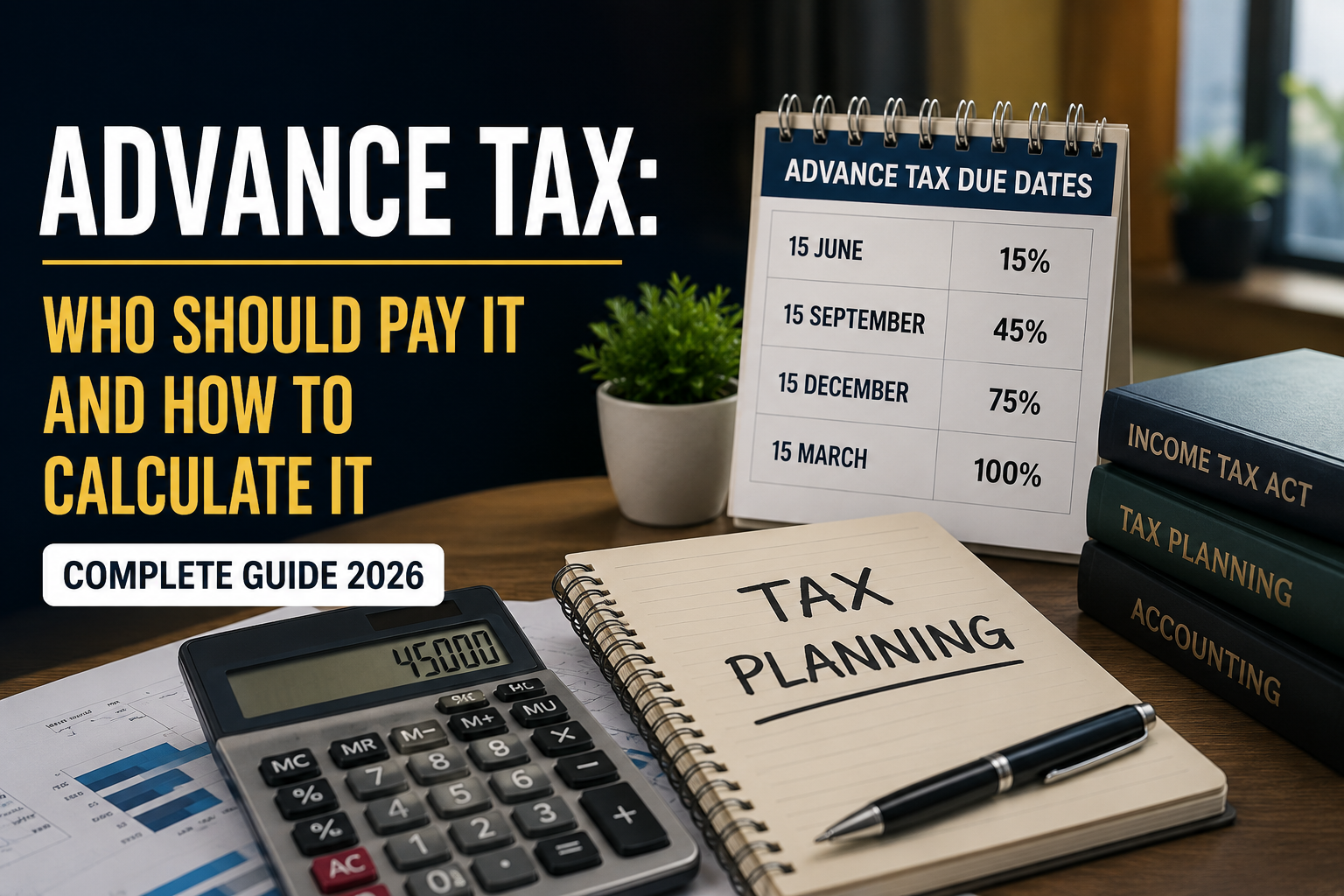
Many taxpayers believe income tax is paid only while filing the Income Tax Return (ITR). However, if your tax liability is significant, the Income Tax Department requires you to pay taxes throughout the financial year. This is known as Advance Tax.
Every quarter, thousands of business owners, freelancers, professionals, landlords, and investors search for answers to questions like:
- Who should pay advance tax?
- How is advance tax calculated?
- What are the due dates?
- What happens if I don't pay?
In this comprehensive guide, we'll answer all these questions.
What is Advance Tax?
Advance Tax is the income tax paid in installments during the financial year instead of paying the entire amount at the end of the year.
It is also known as the "Pay As You Earn" tax system.
Rather than paying one large amount while filing your ITR, you pay tax in quarterly installments based on your estimated annual income.
Who Should Pay Advance Tax?
You are required to pay advance tax if your total tax liability for the financial year is ₹10,000 or more after deducting:
- TDS (Tax Deducted at Source)
- TCS (Tax Collected at Source)
- Tax reliefs and credits
The following taxpayers generally need to pay advance tax:
1. Business Owners
- Sole Proprietors
- Partnership Firms
- LLPs
- Private Limited Companies
- OPCs
2. Freelancers
Professionals earning from:
- Digital Marketing
- Graphic Designing
- Software Development
- Consulting
- Content Writing
- Photography
- Influencers
3. Professionals
Including:
- Doctors
- Chartered Accountants
- Lawyers
- Architects
- Engineers
- Interior Designers
4. Individuals with Other Income
If you earn from:
- Rent
- Capital Gains
- Interest Income
- Dividends
- Commission
- Online Businesses
You may also have to pay advance tax.
Who is Exempt from Advance Tax?
The following individuals are generally exempt:
Senior Citizens
Resident senior citizens (aged 60 years or above) without income from business or profession are not required to pay advance tax.
Advance Tax Due Dates (Normal Taxpayers)
| Due Date | Minimum Tax to be Paid |
|---|---|
| 15 June | 15% |
| 15 September | 45% (cumulative) |
| 15 December | 75% (cumulative) |
| 15 March | 100% |
These percentages are cumulative, meaning each installment brings your total paid up to the required level.
Due Dates for Presumptive Taxation (Section 44AD & 44ADA)
Businesses and professionals opting for presumptive taxation generally pay:
- 100% of Advance Tax on or before 15 March
This simplifies compliance compared to quarterly installments.
How to Calculate Advance Tax
Follow these simple steps.
Step 1: Estimate Your Annual Income
Include income from:
- Business
- Salary (if applicable)
- Freelancing
- House Property
- Capital Gains
- Interest
- Other Sources
Step 2: Calculate Total Tax
Calculate tax according to the applicable tax regime.
Step 3: Deduct
Subtract:
- TDS
- TCS
- Foreign Tax Credit (if applicable)
- Other eligible tax credits
Step 4: Find Net Tax Liability
If the remaining tax is ₹10,000 or more, advance tax is payable.
Example Calculation
Suppose your estimated income is:
| Particular | Amount |
|---|---|
| Business Income | ₹18,00,000 |
| Interest Income | ₹50,000 |
| Total Income | ₹18,50,000 |
Estimated tax liability:
₹2,45,000
Less TDS:
₹30,000
Net Tax Payable:
₹2,15,000
Since it exceeds ₹10,000, advance tax must be paid.
Quarterly payment schedule:
| Due Date | Amount |
|---|---|
| 15 June | ₹32,250 |
| 15 September | ₹96,750 (cumulative) |
| 15 December | ₹1,61,250 (cumulative) |
| 15 March | ₹2,15,000 (full payment) |
What Happens If You Don't Pay Advance Tax?
Failure to pay advance tax may result in interest under the Income Tax Act.
Section 234B
Interest is charged when:
- Advance tax is not paid, or
- Less than 90% of assessed tax is paid.
Section 234C
Interest is charged if quarterly installments are delayed or short-paid.
Even if you pay the tax while filing your ITR, interest under these sections may still apply.
How to Pay Advance Tax Online
Advance tax can be paid online through the Income Tax Department portal.
Basic steps:
- Log in to the Income Tax e-Filing portal.
- Select e-Pay Tax.
- Choose Advance Tax (Challan ITNS 280).
- Enter the required details.
- Make payment through Net Banking, UPI, Debit Card, or other available methods.
- Save the payment receipt for future reference.
Tips to Avoid Interest and Penalties
- Estimate your income realistically.
- Review income every quarter.
- Don't ignore capital gains.
- Keep track of TDS deducted.
- Maintain proper books of accounts.
- Consult a tax professional if income fluctuates.
- Pay before the due dates.
Frequently Asked Questions (FAQs)
Is advance tax compulsory for freelancers?
Yes. If your net tax liability after TDS is ₹10,000 or more, advance tax is applicable.
Is advance tax applicable to salaried employees?
Yes, if they have additional taxable income and their net tax liability exceeds ₹10,000 after considering TDS.
Can advance tax be revised?
Yes. Since it is based on estimated income, you can revise the amount in later installments if your income changes during the year.
What if I miss one installment?
You should pay the shortfall as soon as possible. However, interest under Sections 234B and 234C may apply.
Is advance tax refundable?
Yes. If you pay more than your actual tax liability, the excess amount will generally be refunded after processing your Income Tax Return, subject to applicable provisions.
Advance tax is an important compliance requirement for business owners, freelancers, professionals, and individuals with substantial non-salary income. Paying taxes on time not only helps you avoid interest and penalties but also improves financial planning throughout the year.
If you're unsure about your advance tax liability or need assistance with tax calculation, filing, or compliance, consulting a qualified tax professional can help ensure accuracy and peace of mind.
Need Help with Advance Tax?
At Clockwell International LLP, we assist businesses, professionals, freelancers, LLPs, and companies with:
- Advance Tax Calculation
- Income Tax Planning
- Income Tax Return (ITR) Filing
- GST Compliance
- Business Tax Advisory
- TDS & TCS Compliance
- Accounting and Bookkeeping
Contact Clockwell International LLP today to ensure your advance tax is calculated accurately and paid before the quarterly due dates.
Published on July 31, 2026