
Raising external funding is an important milestone for many startups. Whether you are building a technology product, SaaS company, D2C brand, fintech platform or another high-growth business, choosing the right source of capital can have a major impact on your company's future.
Two of the most common sources of startup investment are angel investors and venture capital (VC) firms.
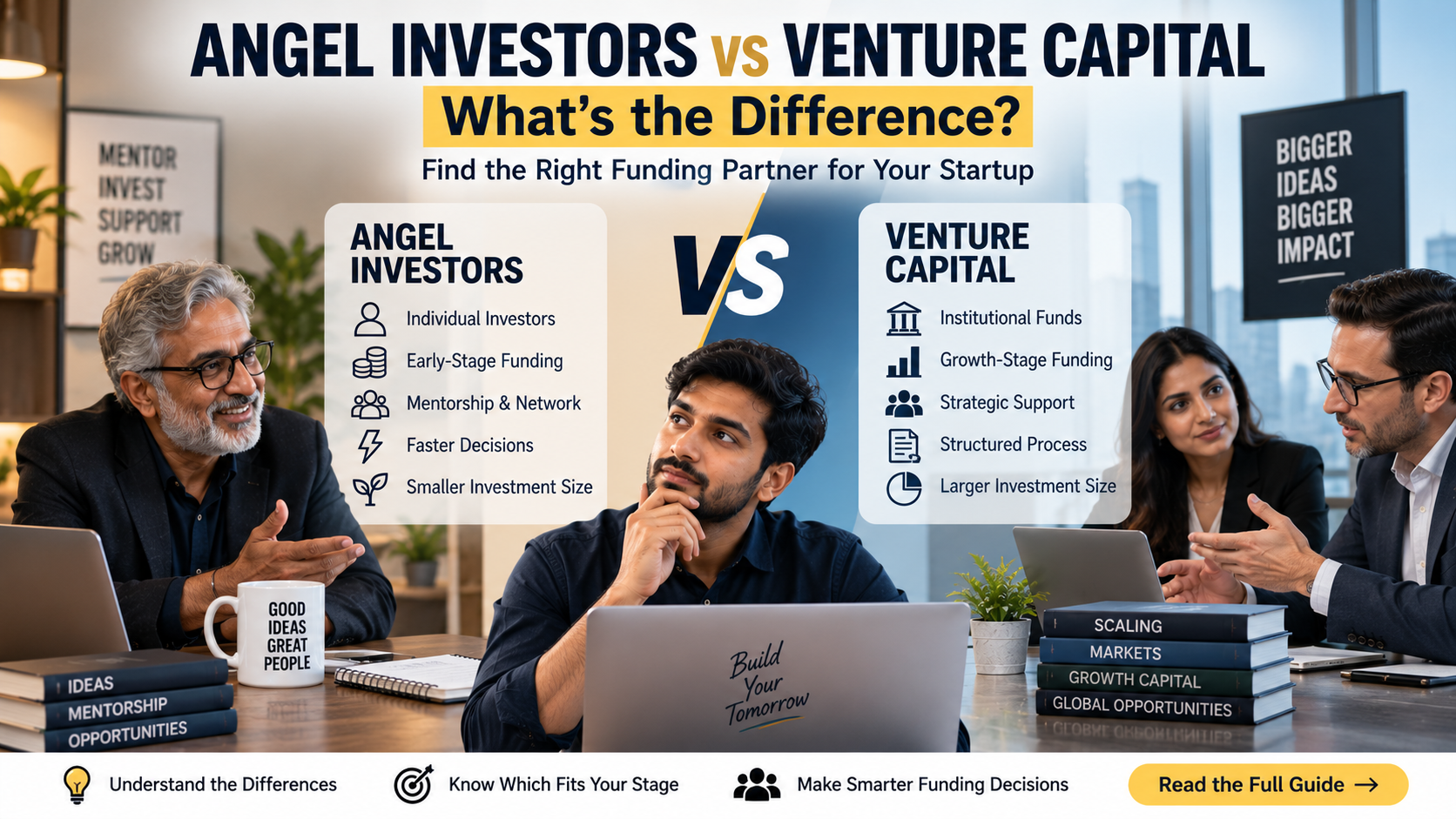
Although both provide capital in exchange for an ownership interest or investment instrument, they are very different in terms of who invests, how much they invest, what they expect from the startup, how decisions are made and how they support founders.
Understanding the difference between angel investors vs venture capital can help entrepreneurs choose the right fundraising strategy.
In this guide, we explain how angel investors and venture capital firms work, their advantages and disadvantages, investment sizes, decision-making processes, dilution, expectations and which option may be better for your startup.
What Is an Angel Investor?
An angel investor is an individual who invests their personal money into a startup.
Angel investors are often:
-
Successful entrepreneurs
-
Business owners
-
Executives
-
Industry professionals
-
High-net-worth individuals
-
Former startup founders
-
Experienced investors
Because they invest their own money, angel investors can sometimes make investment decisions more quickly than institutional funds.
An angel may invest because they believe in:
-
The founder
-
The business idea
-
The market opportunity
-
The technology
-
The founding team's experience
-
The startup's growth potential
Some angels also provide mentorship, industry connections and strategic advice in addition to capital.
What Is Venture Capital?
Venture capital is professional investment capital provided by a venture capital fund to startups with significant growth potential.
A VC firm generally manages money raised from investors such as:
-
Institutional investors
-
Family offices
-
Corporations
-
Pension funds
-
Endowments
-
High-net-worth investors
-
Other investment organisations
The VC firm invests this pooled capital into selected startups.
Unlike an angel investor, a VC typically invests on behalf of a fund and therefore has formal investment processes, investment committees and responsibilities to its fund investors.
Angel Investors vs Venture Capital: Key Difference
The simplest distinction is:
Angel investor = Individual investing personal money
Venture capital = Professional fund investing pooled investor capital
However, there are many other differences.
| Factor | Angel Investors | Venture Capital |
|---|---|---|
| Investor | Individual | Investment fund |
| Source of money | Personal wealth | Fund capital |
| Typical stage | Idea to early growth | Seed to growth, depending on fund |
| Investment size | Usually smaller | Usually larger |
| Decision process | Often faster | Usually more structured |
| Due diligence | Varies | Generally extensive |
| Mentorship | Often personal | More institutional |
| Ownership expectation | Varies | Often significant |
| Board involvement | Possible | More common at larger rounds |
| Follow-on capital | Depends on investor | Often available if fund strategy permits |
| Focus | Founder + opportunity | Scalable business + return potential |
| Fund life | Not applicable | Fund has a defined investment horizon |
These are general characteristics. Individual angels and VC funds can operate very differently.
How Angel Investors Work
Suppose you have built an MVP and need ₹50 lakh to launch your product.
You might approach an angel investor.
The angel may evaluate:
-
Your background
-
Business idea
-
Product
-
Market
-
Early traction
-
Revenue
-
Competitive landscape
-
Funding requirement
-
Valuation
If interested, the investor may offer ₹50 lakh in exchange for a percentage of the company or through another agreed investment structure.
For example:
Investment: ₹50 lakh
Pre-money valuation: ₹2 crore
Post-money valuation: ₹2.5 crore
The investor's ownership would be approximately:
₹50 lakh ÷ ₹2.5 crore = 20%
The actual ownership depends on the investment structure and final transaction documents.
How Venture Capital Works
The VC process is generally more structured.
Suppose your startup is generating revenue and has strong customer growth. You want to raise ₹5 crore to expand across India.
You may approach several VC firms.
A VC could evaluate:
-
Market size
-
Revenue
-
Growth rate
-
Gross margin
-
Customer acquisition
-
Retention
-
Competitive advantage
-
Technology
-
Founding team
-
Financial projections
-
Scalability
-
Exit potential
If the fund believes the opportunity fits its investment strategy, it may proceed through:
Initial Meeting → Partner Discussion → Due Diligence → Term Sheet → Legal Documentation → Investment
The exact process varies significantly between funds.
Angel Investors vs Venture Capital: Investment Size
One of the biggest differences is the amount of capital typically available.
Angel investments are generally smaller because an individual is investing their personal capital.
VC firms can invest substantially more because they manage institutional funds.
For example:
Angel Round
A startup might raise:
₹25 lakh – ₹1 crore
from one or multiple angels.
VC Round
A startup might raise:
₹2 crore – ₹10 crore or more
depending on its stage, sector, traction and investor.
These are only illustrative ranges. There is no universal minimum or maximum investment size for either category.
When Should You Approach an Angel Investor?
Angel investors can be particularly useful when your startup is still relatively early.
You might approach angels when you have:
-
A validated idea
-
MVP
-
Prototype
-
Early customers
-
Initial revenue
-
Strong founding team
-
Early market traction
For example, a founder developing a new SaaS platform may need ₹50 lakh to complete product development and acquire its first 100 customers.
An angel investor could be suitable at this stage.
When Should You Approach a VC Firm?
VC funding becomes more relevant when the startup demonstrates significant growth potential.
You may be ready to approach VCs when you have:
-
Strong product-market fit
-
Growing revenue
-
Increasing customer base
-
Repeatable acquisition channels
-
Strong unit economics
-
Large addressable market
-
Scalable business model
-
Experienced founding team
However, some VC firms invest extremely early—even before significant revenue—particularly in technology, deep-tech and other high-growth sectors.
The right timing depends on the fund's investment thesis.
What Do Angel Investors Look For?
Angels often place significant emphasis on the founder.
They may ask:
1. Why are you building this business?
2. Why are you the right person to solve this problem?
3. Is there a real customer problem?
4. What evidence do you have?
5. How large could the opportunity become?
6. How will the company make money?
7. What will you do with the investment?
A strong founder-market fit can be particularly compelling at the earliest stages.
What Do Venture Capital Firms Look For?
VCs generally evaluate the company through a broader investment lens.
They may examine:
Market Size
Can this become a very large company?
Growth
Is revenue or user growth accelerating?
Scalability
Can the company grow without costs increasing at the same rate?
Unit Economics
Can customers eventually generate attractive contribution margins?
Competitive Advantage
Why won't competitors easily copy the business?
Team
Can the founders execute at scale?
Exit Potential
Could the company eventually generate a sufficiently large return for the fund?
This last point is particularly important.
A VC fund typically invests with the expectation that a relatively small number of successful investments can generate substantial returns for the overall portfolio.
Angel Investor vs VC: Decision-Making Process
Angel Investor
An angel may be able to decide independently.
For example:
Pitch → Discussion → Due Diligence → Investment
The process can sometimes be completed relatively quickly.
VC Firm
A VC investment can involve several stages:
Application/Introduction → Initial Meeting → Partner Meeting → Due Diligence → Investment Committee → Term Sheet → Legal → Closing
The exact process varies by firm.
Because multiple stakeholders may be involved, VC fundraising can take longer.
Angel Investors May Offer More Personal Mentorship
An experienced angel can sometimes become a close advisor to a founder.
For example, an angel who previously built a successful logistics company may help a logistics startup with:
-
Customer introductions
-
Hiring
-
Pricing
-
Vendor relationships
-
Business strategy
-
Industry knowledge
This can be extremely valuable for first-time founders.
However, the level of involvement varies from investor to investor.
Some angels prefer to remain passive.
VCs Can Provide Institutional Support
VC firms can offer a broader professional network.
Depending on the fund, support may include:
-
Hiring
-
Follow-on fundraising
-
Strategic planning
-
Corporate partnerships
-
International expansion
-
Governance
-
Financial planning
-
Investor introductions
-
M&A opportunities
Some larger funds have dedicated teams supporting portfolio companies.
The quality of this support depends heavily on the particular VC firm.
Angel Investors vs VC: Dilution
Both angel and VC investment can dilute founder ownership when new equity is issued.
Suppose the founders own:
100%
An investor receives:
15%
The founders collectively own:
85%
If another investor later receives another 20%, the founders' ownership may fall further, depending on the structure and whether other shareholders participate.
This is why founders should think about the entire fundraising journey rather than focusing only on the current round.
Should You Choose the Investor Offering the Highest Valuation?
Not necessarily.
Suppose:
Investor A
Valuation: ₹10 crore
Investor B
Valuation: ₹8 crore
At first glance, Investor A appears better.
But Investor B may offer:
-
Strong industry connections
-
Better follow-on funding
-
International market access
-
Experienced startup support
-
Better founder references
-
More favourable investment terms
The lower valuation may potentially be the better overall deal.
Founders should compare the complete term sheet, not just valuation.
What Is a Term Sheet?
A term sheet outlines the major commercial terms of a proposed investment.
It may include:
-
Investment amount
-
Valuation
-
Equity percentage
-
Security type
-
Liquidation preference
-
Board rights
-
Voting rights
-
Anti-dilution provisions
-
Founder vesting
-
ESOP pool
-
Information rights
-
Reserved matters
-
Exit provisions
A term sheet may be partly or largely non-binding depending on the clause and jurisdiction, while certain provisions can be binding.
Always have qualified legal counsel review investment documents before signing.
Angel Investors vs VC: Due Diligence
Both types of investors can conduct due diligence.
However, VC due diligence is often more extensive.
Investors may examine:
Company
-
Incorporation documents
-
Shareholding
-
Board records
-
Previous investment agreements
Financial
-
Profit and loss statements
-
Balance sheets
-
Cash flow
-
Bank statements
-
Tax filings
-
Revenue data
Legal
-
Customer agreements
-
Vendor contracts
-
Employment agreements
-
Litigation
-
Intellectual property
Commercial
-
Customer acquisition
-
Retention
-
Churn
-
Sales pipeline
-
Customer concentration
Technology
-
Source-code ownership
-
Architecture
-
Security
-
Third-party software
-
IP ownership
Keeping your records organised can make the fundraising process much smoother.
Angel Investors vs Venture Capital: Advantages and Disadvantages
Advantages of Angel Investors
Faster Decision-Making
An individual investor may make decisions faster.
Early-Stage Friendly
Some angels are comfortable investing before significant revenue exists.
Personal Mentorship
Experienced angels can provide hands-on guidance.
Flexible Discussions
Deal structures can sometimes be more flexible.
Industry Connections
A well-connected angel can introduce customers, partners and employees.
Disadvantages of Angel Investors
Limited Capital
One individual may not be able to provide substantial follow-on funding.
Investor Dependence
A founder may become heavily dependent on one individual's advice.
Varying Experience
Not every wealthy individual is an experienced startup investor.
Potentially Complex Cap Table
Having many individual angel investors can make future fundraising and shareholder management more complicated.
Advantages of Venture Capital
Larger Funding Potential
VC funds can provide substantial capital.
Follow-On Funding
Some funds reserve capital for future rounds.
Strong Network
VCs may provide access to founders, executives, customers and strategic partners.
Institutional Expertise
Experienced funds can help with governance and scaling.
Credibility
A reputable VC investor can sometimes increase confidence among future investors, employees and partners.
Disadvantages of Venture Capital
More Dilution
Large investments may involve significant ownership transfer.
Higher Expectations
VC-backed startups are generally expected to pursue significant growth.
More Reporting
Investors may expect regular financial and operational reporting.
Board Involvement
VCs may seek board seats or other governance rights.
Pressure to Scale
Venture capital is generally suited to businesses with substantial growth potential.
A traditional business with steady but moderate growth may not be an ideal VC candidate.
Which Is Better for Your Startup?
There is no universally correct answer.
The better choice depends on your:
-
Startup stage
-
Capital requirement
-
Growth potential
-
Industry
-
Revenue
-
Traction
-
Business model
-
Founder preferences
-
Long-term objectives
Choose an Angel Investor When:
-
You are at an early stage
-
You need a relatively smaller amount
-
You want hands-on mentorship
-
You have limited traction
-
You need industry connections
-
You want a simpler initial fundraising process
Consider Venture Capital When:
-
You have significant traction
-
Your market is large
-
Your business can scale rapidly
-
You need substantial capital
-
You are building a venture-scale company
-
You need institutional support
-
You expect multiple funding rounds
What About Bootstrapping?
Before choosing between angels and VCs, founders should also consider bootstrapping.
Bootstrapping means building the business using:
-
Founder capital
-
Business revenue
-
Customer payments
-
Operating cash flow
For example, if you can launch a service business with ₹5 lakh and generate revenue immediately, raising external equity may not be necessary.
Bootstrapping can allow founders to:
-
Retain more ownership
-
Maintain greater control
-
Avoid investor pressure
-
Build at their own pace
However, it can also limit growth if significant capital is required.
What About Bank Loans?
Debt financing is another option.
Unlike equity investment, a loan generally does not require giving investors ownership in the company.
However, lenders may evaluate:
-
Revenue
-
Profitability
-
Cash flow
-
Credit history
-
Collateral
-
Repayment ability
-
Business track record
Early-stage startups without revenue or assets may find traditional debt more difficult to obtain.
Founders should compare the cost and risks of debt against equity before deciding.
How to Prepare for Angel or VC Funding
Regardless of the investor type, preparation is critical.
1. Build a Strong Pitch Deck
Include:
-
Problem
-
Solution
-
Product
-
Market
-
Business model
-
Competition
-
Traction
-
Team
-
Financials
-
Funding requirement
-
Use of funds
2. Understand Your Numbers
Know:
-
Revenue
-
Growth
-
Gross margin
-
Burn
-
Runway
-
CAC
-
LTV
-
Churn
-
Retention
3. Organise Your Legal Documents
Keep:
-
Incorporation documents
-
Cap table
-
Contracts
-
IP documents
-
Employment records
-
Previous funding documents
4. Know Your Funding Requirement
Don't say:
"We need ₹5 crore because we want to grow."
Instead explain:
"We are raising ₹5 crore to expand the sales team, enter three new markets and reach ₹X in annual revenue over the next 18 months."
5. Research Investors
Target investors based on:
-
Sector
-
Stage
-
Geography
-
Investment size
-
Portfolio
-
Expertise
Example: Angel vs VC for an Indian Startup
Imagine a Kerala-based SaaS startup.
The company has:
-
Working MVP
-
30 paying customers
-
₹3 lakh monthly revenue
-
Three founders
-
₹10 lakh monthly burn
The founders want ₹1 crore.
An experienced angel investor could potentially be suitable because the company is still relatively early and the funding requirement is moderate.
After achieving:
-
₹20 lakh monthly revenue
-
Strong customer retention
-
Predictable acquisition
-
Large pipeline
-
Proven business model
The startup may become more attractive to a VC fund seeking a larger opportunity.
The key lesson is:
Your ideal investor can change as your startup grows.
Questions Investors May Ask
Be prepared to answer questions such as:
Market
-
How large is your market?
-
Who is your ideal customer?
-
Why will the market grow?
Product
-
What makes your product different?
-
Why can't competitors copy it?
Traction
-
How many customers do you have?
-
How fast are you growing?
-
What is your retention?
Financials
-
What is your revenue?
-
What is your burn rate?
-
How much runway do you have?
Competition
-
Who are your biggest competitors?
-
Why are you better?
Team
-
Why is your team uniquely qualified?
Funding
-
How much are you raising?
-
What percentage are you offering?
-
How will you use the money?
-
What milestone will this round achieve?
Common Fundraising Mistakes
Mistake 1: Approaching Investors Too Early
Don't raise simply because you have an idea.
Validate the opportunity first whenever possible.
Mistake 2: Choosing Investors Only by Valuation
A strategic investor can be more valuable than a slightly higher valuation.
Mistake 3: Not Understanding Dilution
Know exactly how your ownership changes after each round.
Mistake 4: Poor Financial Records
Disorganised accounts can create problems during due diligence.
Mistake 5: Unrealistic Projections
Investors understand that forecasts are uncertain. They do not expect unsupported numbers.
Mistake 6: Targeting the Wrong Funds
A pre-revenue startup should not spend months pitching funds that only invest in Series B companies.
Mistake 7: Ignoring the Cap Table
Maintain an accurate record of:
-
Founders
-
Investors
-
ESOP pool
-
Convertible instruments
-
Other shareholders
Mistake 8: Taking Money Without Understanding the Terms
Read the complete investment documentation, not just the headline valuation.
Angel Investor vs VC: Quick Decision Guide
Ask yourself these questions:
Do I need a relatively small amount of capital?
Yes → Angel investors may be suitable.
Am I very early-stage?
Yes → Angels or early-stage VC funds may be suitable.
Do I have strong product-market fit?
Yes → Consider both angels and VC funds.
Do I need several crores for rapid expansion?
Yes → VC may be more appropriate.
Do I want a hands-on individual mentor?
Yes → Look for an experienced angel.
Do I need institutional support and future funding?
Yes → A suitable VC fund may be valuable.
Is my business designed for moderate, sustainable growth rather than venture-scale growth?
Yes → Bootstrapping, debt or strategic investment may be more appropriate than traditional VC.
Final Comparison
| Category | Angel Investor | Venture Capital |
|---|---|---|
| Capital source | Personal money | Fund/institutional capital |
| Investor type | Individual | Professional investment firm |
| Early-stage suitability | Very strong | Depends on fund |
| Typical process | More flexible | More structured |
| Investment size | Generally smaller | Generally larger |
| Mentorship | Often personal | Institutional/network-based |
| Due diligence | Varies | Usually detailed |
| Board involvement | Possible | More common |
| Growth expectation | Varies | Generally high |
| Follow-on funding | Depends on investor | Often possible |
| Best fit | Early-stage startups | Scalable, high-growth startups |
Final Thoughts
The choice between angel investors vs venture capital is not simply a choice between two sources of money.
It is a decision about ownership, control, growth expectations, expertise, networks and the future direction of your company.
Angel investors can be particularly valuable for founders who are still building their product, validating their market or generating early traction. The right angel can provide capital as well as practical experience and industry connections.
Venture capital can become more attractive when a startup has demonstrated strong traction and needs significant capital to pursue a large market opportunity. A good VC can provide funding, strategic support, hiring assistance, governance expertise and access to future investors.
However, external funding is not automatically the best option for every business.
Before raising money, ask:
"What does my company need to reach its next major milestone?"
Then choose the funding source that best matches that requirement.
The best investor is not necessarily the one who offers the largest cheque or highest valuation.
It is the investor whose capital, expertise, network and expectations align with your company's long-term goals.
Disclaimer: This article is for general educational purposes only and should not be considered investment, legal, tax or financial advice. Investment structures, valuations, regulatory requirements and transaction terms vary by company and jurisdiction. Founders should consult qualified legal, tax and financial professionals before entering into an investment transaction.
Published on September 15, 2026