

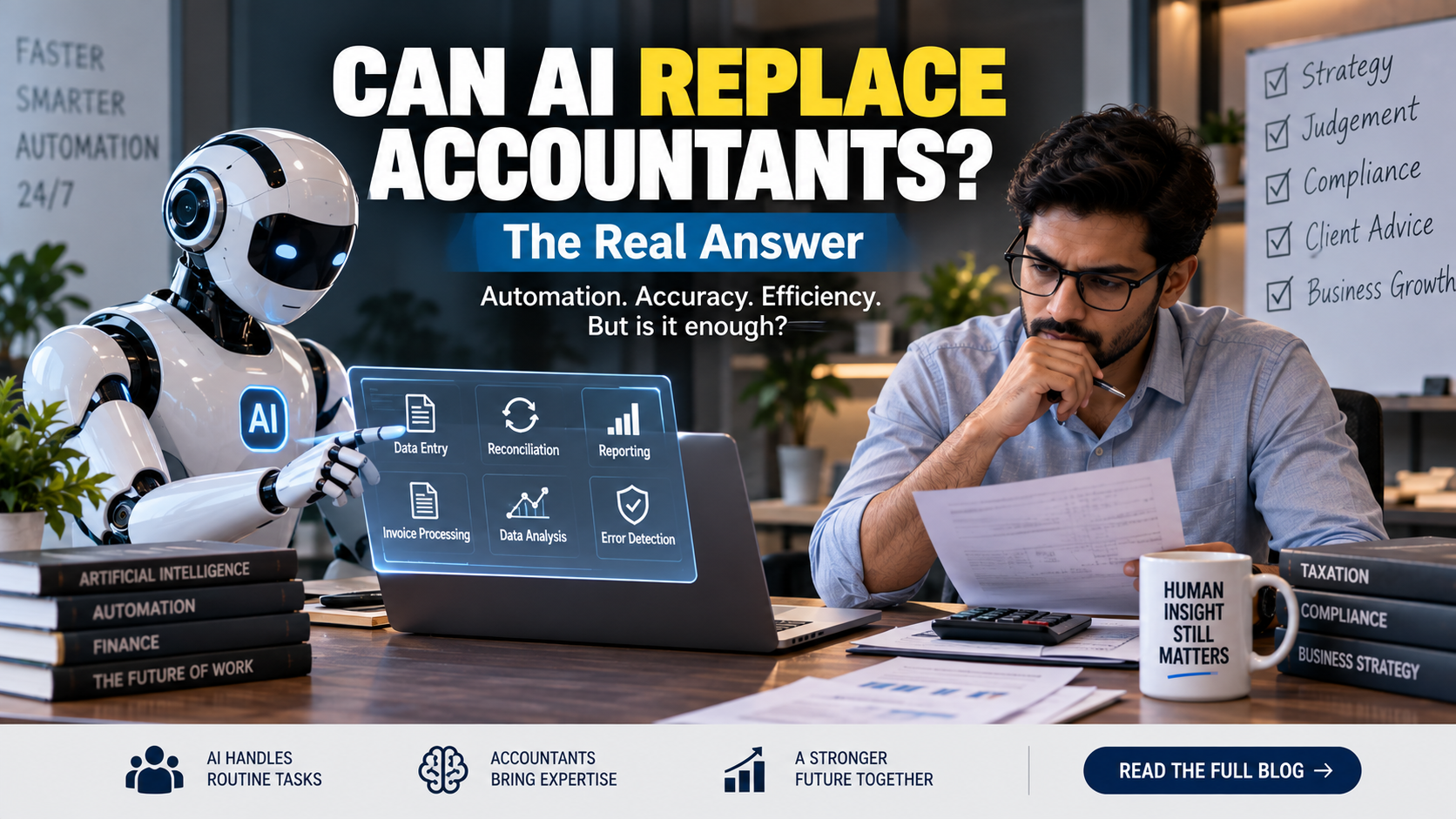
Artificial intelligence is changing the accounting profession faster than many businesses expected.
AI-powered accounting software can categorize transactions, extract information from invoices, identify unusual transactions, reconcile accounts, summarize financial data, draft reports, and assist with research. As these capabilities become more sophisticated, one question is becoming increasingly common:
Can AI replace accountants?
The short answer is more nuanced than a simple yes or no.
AI is increasingly capable of automating specific accounting tasks, particularly repetitive and rules-based work. At the same time, accounting involves professional judgment, interpretation, compliance, ethics, communication, risk management, and understanding the business context—areas where human expertise remains important.
Professional accounting organizations are already describing the profession as one that is being reshaped by AI rather than simply eliminated by it. AICPA & CIMA's 2026 work highlights automation, AI, data, and changing business models as major forces affecting the future of finance and accounting.
So the more useful question may not be:
“Will AI replace accountants?”
It may be:
“Which accounting tasks will AI automate, and how will accountants' roles change?”
Let's examine the real answer.
What Can AI Do in Accounting Today?
AI is already being used across accounting and finance workflows.
Depending on the software and implementation, AI can assist with:
-
Data entry
-
Invoice processing
-
Receipt extraction
-
Transaction categorization
-
Bank reconciliation
-
Anomaly detection
-
Accounts payable workflows
-
Accounts receivable follow-up
-
Financial data analysis
-
Forecasting
-
Accounting research
-
Document summarization
-
Report preparation
-
Client communication drafts
-
Audit support
-
Management reporting
ACCA notes that AI can automate routine and repetitive accounting activities and help professionals process large quantities of information, identify errors, and improve efficiency.
This means that some tasks traditionally performed manually by accountants are becoming increasingly automated.
But that does not mean the entire accounting profession can be automated.
AI Is Better at Tasks Than Entire Professions
This distinction is extremely important.
Consider a typical accounting workflow.
An employee receives an invoice.
Traditional Process
Invoice → Read document → Enter data → Categorize expense → Record transaction → Reconcile → Review
AI-enabled software may reduce several of these manual steps:
Invoice → AI extracts information → Suggests classification → Records transaction → Flags exceptions → Accountant reviews
The accountant's role changes from entering every piece of information to reviewing, interpreting, controlling, and resolving exceptions.
This is already influencing how accounting work is organized. AICPA & CIMA's 2026 guidance specifically describes AI as automating routine tasks while emphasizing the importance of scrutinizing AI outputs, professional judgment, ethics, transparency, and accountability.
Which Accounting Tasks Are Most Likely to Be Automated?
Not every accounting activity has the same level of automation potential.
1. Data Entry
Entering information from invoices, receipts, and bank statements is highly repetitive.
AI and automation can extract:
-
Invoice numbers
-
Dates
-
Supplier names
-
Tax amounts
-
Total amounts
-
Line items
-
Payment information
This can significantly reduce manual data entry.
2. Invoice Processing
AI-powered systems can help process large numbers of invoices.
For example:
Invoice received → Information extracted → Supplier identified → Expense account suggested → Tax information identified → Approval workflow → Accounting entry
An accountant may then review exceptions instead of manually entering every invoice.
3. Bank Reconciliation
AI can compare accounting records with bank transactions and identify potential matches.
For example:
Bank transaction: ₹25,000
AI may identify a corresponding:
Customer invoice: ₹25,000
The system can suggest the match, while an accountant reviews and approves it.
4. Expense Categorization
AI can learn from historical transaction patterns and suggest expense categories.
For example:
Adobe subscription → Software Expense
Office rent → Rent Expense
Business travel → Travel Expense
The accountant still needs to review unusual or ambiguous transactions.
5. Anomaly Detection
AI can analyze large amounts of financial data and identify unusual patterns.
For example, it might flag:
-
Unusually large expenses
-
Duplicate payments
-
Unexpected changes in spending
-
Unusual transaction timing
-
Suspicious patterns
-
Unusual revenue movements
This can help accountants focus their attention where it matters most.
What AI Cannot Reliably Replace
The biggest limitation of AI in accounting is not its ability to process information.
It is context and professional judgment.
Accounting decisions often depend on circumstances that cannot be understood simply by looking at numbers.
1. Professional Judgment
Accounting frequently involves judgment.
For example:
-
How should a complex transaction be classified?
-
What accounting treatment applies to an unusual arrangement?
-
How should a business interpret a complicated financial event?
-
What additional evidence is required?
-
Is a transaction commercially reasonable?
-
Does a particular treatment create a compliance risk?
AI can provide analysis or suggestions, but professional judgment remains important.
AICPA & CIMA specifically emphasizes that AI-generated analysis requires scrutiny and that professional judgment, ethics, transparency, and accountability remain central to finance work.
2. Understanding Business Context
Numbers alone do not tell the entire story.
Imagine a company reports that its expenses increased by 30%.
AI may identify the increase.
But management may need to understand why.
Perhaps:
-
The company opened a new branch.
-
It hired additional employees.
-
Marketing investment increased.
-
Raw material prices increased.
-
A one-time legal expense occurred.
-
The business acquired another company.
An accountant who understands the business can investigate the reason and explain its financial implications.
That context is extremely valuable.
3. Tax and Compliance Interpretation
Tax and regulatory requirements can involve detailed rules and exceptions.
AI can help accountants:
-
Research regulations
-
Summarize documents
-
Identify potentially relevant provisions
-
Prepare draft analyses
-
Organize compliance information
But blindly accepting AI-generated tax or accounting conclusions can create serious risks.
AI outputs can be inaccurate or incomplete. AICPA & CIMA's 2026 material on accounting research specifically warns about over-reliance on AI and emphasizes the need to evaluate its outputs.
The final professional review remains important.
4. Client Communication
Accounting is also a relationship-based profession.
Business owners often do not simply want a financial statement.
They want someone to explain:
“What does this mean for my business?”
An accountant may need to explain:
-
Why profit decreased
-
Why cash flow is weak
-
Why tax liability increased
-
Why working capital is important
-
Whether expenses are sustainable
-
What financial risks should be addressed
-
What information management should monitor
AI can help draft explanations, but human communication and business context remain valuable.
ACCA has similarly highlighted the continuing importance of human judgment, context, and the client-accountant relationship.
5. Strategic Financial Advice
The role of accountants is increasingly moving beyond bookkeeping.
Businesses may need help with:
-
Budgeting
-
Cash-flow planning
-
Business expansion
-
Investment decisions
-
Cost control
-
Pricing
-
Financial forecasting
-
Working capital management
-
Business restructuring
-
Risk management
AI can provide data and scenarios.
But management still needs informed professionals who can interpret those scenarios within the context of the actual business.
AICPA & CIMA's current work describes finance functions as evolving toward more strategic advisory roles, while AI and other technologies become part of the profession's digital journey.
AI vs Accountant: Who Does What?
The future is unlikely to be simply:
AI vs Accountant
A more realistic model is:
AI + Accountant
Consider the following comparison:
| Accounting Activity | AI Capability | Human Role |
|---|---|---|
| Data entry | High automation potential | Review exceptions |
| Invoice processing | High automation potential | Verify unusual cases |
| Bank reconciliation | Strong automation support | Investigate mismatches |
| Expense categorization | AI suggestions | Professional review |
| Anomaly detection | Strong | Investigate and interpret |
| Financial reporting | Automated preparation | Review and explain |
| Forecasting | Scenario generation | Evaluate assumptions |
| Tax research | Research assistance | Interpret and validate |
| Compliance | Workflow assistance | Professional responsibility |
| Business advice | Data and analysis | Judgment and recommendations |
| Client communication | Drafting assistance | Relationship and context |
| Strategic planning | Data-driven support | Human decision-making |
The exact capabilities vary by accounting software and AI system.
Will AI Reduce Accounting Jobs?
AI will almost certainly change the composition of accounting work.
The more vulnerable activities are generally repetitive, standardized, and rules-based.
Examples include:
-
Manual data entry
-
Basic transaction processing
-
Repetitive reconciliations
-
Routine document processing
-
Basic report preparation
-
Repetitive administrative communication
This does not automatically mean that accounting as a profession disappears.
Instead, entry-level and routine work can change significantly.
AICPA & CIMA reported in 2026 that automation and AI are reshaping the tasks through which early-career accounting professionals traditionally gained experience. The organization also emphasizes the growing importance of business context, communication, technology use, and adaptability.
That means future accountants may need a broader skill set than simply knowing how to record transactions.
The Accountant of the Future Will Look Different
The accountant of the future may spend less time asking:
“Where should I enter this transaction?”
And more time asking:
“Why did this transaction happen, what does it mean, and what should management do about it?”
This creates an opportunity for accountants to move toward roles such as:
-
Financial analyst
-
Business advisor
-
Virtual CFO
-
Management accountant
-
Tax advisor
-
Risk advisor
-
Compliance specialist
-
Financial controller
-
Strategic finance partner
The profession is therefore shifting from transaction processing toward analysis, interpretation, control, and decision support.
Why Human Oversight Is Still Important
AI systems depend on the quality of the information they receive.
Consider a simple principle:
Bad Data → Bad Analysis → Bad Decision
If an accounting system contains:
-
Incorrect transactions
-
Missing invoices
-
Duplicate entries
-
Incorrect classifications
-
Outdated customer balances
then even an advanced AI system can produce misleading conclusions.
A human professional can investigate the source of the problem and determine whether the underlying data makes sense.
This is one reason AI governance and data quality are becoming important parts of modern finance operations. AICPA & CIMA's 2026 materials emphasize data quality, governance, professional development, and careful review of AI outputs.
What Happens When AI Makes a Mistake?
AI is not infallible.
It can:
-
Misinterpret information
-
Produce incorrect conclusions
-
Miss relevant context
-
Generate unsupported answers
-
Misclassify transactions
-
Overlook exceptions
-
Reflect errors in the underlying data
This is particularly important in accounting because financial decisions can have tax, regulatory, contractual, and commercial consequences.
Therefore, businesses should not create an accounting process where:
AI → Automatically decides → Nobody reviews
A stronger approach is:
AI → Suggests/Processes → Accountant reviews → Exceptions investigated → Final decision
How Accountants Can Use AI Effectively
Accountants do not necessarily need to compete with AI.
They can learn to use it as a productivity tool.
1. Automate Routine Tasks
Use AI-enabled software for repetitive data processing.
2. Use AI for Research
AI can help locate, summarize, and organize information before professional verification.
3. Analyze Large Data Sets
AI can identify patterns, anomalies, and trends that might take humans much longer to discover manually.
4. Improve Reporting
AI can help convert financial data into draft management commentary and summaries.
5. Improve Client Service
Accountants can spend less time on repetitive administration and more time discussing business performance with clients.
6. Learn Data Analytics
Understanding financial data is becoming increasingly important.
7. Develop Communication Skills
The ability to explain complex financial information clearly can become even more valuable.
8. Strengthen Professional Judgment
As routine work becomes automated, judgment becomes more important—not less.
What Business Owners Should Do
Businesses should not adopt AI simply because competitors are using it.
Instead, identify repetitive accounting processes that consume significant time.
Start with areas such as:
-
Invoice processing
-
Expense management
-
Bank reconciliation
-
Receivables tracking
-
Report generation
-
Document processing
-
Financial data analysis
Then establish controls.
A Practical AI Accounting Workflow
Step 1: Identify repetitive accounting tasks.
Step 2: Determine which tasks can be safely automated.
Step 3: Select appropriate accounting or AI tools.
Step 4: Define user permissions and data-access rules.
Step 5: Establish review procedures.
Step 6: Test AI-generated results.
Step 7: Monitor errors and exceptions.
Step 8: Measure time saved and business impact.
Step 9: Train accounting staff.
Step 10: Continuously improve the workflow.
This approach allows businesses to gain the benefits of AI without removing necessary human controls.
AI Is Changing the Skills Accountants Need
Accounting professionals increasingly need a combination of traditional and digital skills.
Traditional Accounting Skills
-
Financial accounting
-
Taxation
-
Auditing
-
Financial reporting
-
Compliance
-
Internal controls
Digital Skills
-
AI tools
-
Cloud accounting
-
Data analytics
-
Automation
-
Financial dashboards
-
Digital security
-
Technology integration
Human Skills
-
Communication
-
Critical thinking
-
Business understanding
-
Professional judgment
-
Problem solving
-
Client relationship management
AICPA & CIMA's 2026 research on workforce readiness similarly points to technical accounting knowledge remaining essential while technology judgment, communication, business context, and adaptability become increasingly important.
Will AI Replace Entry-Level Accountants?
This is an important question for students and new accounting professionals.
Some traditional entry-level tasks may become less common because software can automate repetitive work.
For example, junior employees may spend less time on:
-
Manual data entry
-
Basic invoice processing
-
Simple reconciliations
-
Routine spreadsheet preparation
That means accounting education and training may need to focus more on:
-
Understanding accounting principles
-
Interpreting financial information
-
Using technology
-
Data analytics
-
Tax and compliance knowledge
-
Communication
-
Critical thinking
-
Professional judgment
The future challenge may therefore be less about learning how to enter data and more about learning how to understand and validate data.
AI and the Rise of the Virtual CFO
One particularly interesting development is the combination of cloud accounting, automation, AI, and professional advisory services.
A business may use:
Cloud Accounting → Automated Transactions → AI Analysis → Financial Dashboard → Accountant Review → Management Advice
This can give smaller businesses access to more sophisticated financial management without necessarily building a large internal finance department.
AI can help process information.
The accountant can interpret that information and help management make decisions.
What Does This Mean for Accounting Firms?
Accounting firms are also changing.
Instead of offering only:
Bookkeeping + Tax Filing
modern firms can increasingly provide:
Accounting + Compliance + Automation + Financial Analysis + Advisory
This can create opportunities to offer services such as:
-
Virtual CFO services
-
Cash-flow forecasting
-
Management reporting
-
Business dashboards
-
Financial planning
-
Process automation
-
AI-assisted accounting
-
Tax planning
-
Business performance analysis
The firms that adapt their service models can potentially deliver more value from the same financial data.
The Real Answer: Can AI Replace Accountants?
The evidence available in 2026 points toward substantial automation of accounting work rather than a simple replacement of the accounting profession.
AI is highly useful for processing large volumes of information, automating repetitive activities, identifying patterns, and assisting with analysis. Professional bodies including AICPA & CIMA and ACCA are actively addressing how accounting roles and skills are evolving around these capabilities.
At the same time, accounting requires:
-
Professional judgment
-
Context
-
Ethical considerations
-
Accountability
-
Interpretation
-
Communication
-
Compliance expertise
-
Business understanding
-
Human relationships
These factors mean that the future is better described as accountants working with increasingly capable AI systems rather than simply AI eliminating accountants.
The bigger risk may be different:
Accountants who refuse to adapt to AI may become less competitive than accountants who know how to use it effectively.
The Future: Accountant + AI
The accounting workflow of the future may look like this:
AI Handles
Collect → Extract → Categorize → Reconcile → Detect → Summarize → Forecast
Accountant Handles
Review → Interpret → Validate → Explain → Advise → Decide
Together:
AI + Accountant = Faster Processing + Better Analysis + Human Judgment
This is likely to be a more useful way to think about the future of accounting.
Final Thoughts
The question “Can AI replace accountants?” sounds like a question about technology.
In reality, it is a question about how work will change.
AI can automate many accounting tasks. It can process data faster, reduce repetitive administrative work, identify patterns, and support financial analysis.
But businesses still need professionals who can determine whether the information is reliable, understand the commercial context, interpret regulations, communicate with stakeholders, manage risk, and apply professional judgment.
The accountant of the future may therefore spend less time performing repetitive bookkeeping and more time acting as a financial analyst, business advisor, controller, tax specialist, or strategic finance partner.
The most valuable combination is not necessarily:
AI vs Accountant
It is:
AI + Accountant.
Businesses that combine technology with qualified human oversight can use AI to make accounting faster and more efficient while maintaining the judgment and accountability that financial management requires.
Frequently Asked Questions
1. Can AI completely replace accountants?
AI can automate many accounting tasks, particularly repetitive and rules-based activities, but accounting also requires professional judgment, interpretation, compliance knowledge, communication, and accountability.
2. What accounting tasks can AI automate?
Depending on the software, AI can assist with invoice processing, data extraction, transaction categorization, bank reconciliation, anomaly detection, reporting, research, and financial analysis.
3. Will AI reduce accounting jobs?
AI is likely to change the types of accounting work performed by humans. Routine tasks may require fewer manual hours, while demand can shift toward analysis, advisory work, technology skills, compliance, and judgment.
4. Should accountants learn AI?
Yes. Understanding AI-enabled accounting tools, data analytics, automation, cybersecurity, and responsible AI use can help accounting professionals adapt to changing workflows.
5. Is AI-generated accounting information always accurate?
No. AI outputs can contain errors or miss important context. Financial information generated or analyzed by AI should be subject to appropriate review and validation.
6. Will accountants still be needed for tax and compliance?
AI can assist with research, calculations, document processing, and compliance workflows, but businesses may still need qualified professionals to interpret requirements, review information, and exercise professional judgment.
7. What is the future of accounting?
Accounting is increasingly moving toward a combination of automation, AI, cloud technology, data analytics, professional judgment, and strategic financial advisory services.
8. Should small businesses start using AI in accounting?
Businesses should evaluate AI based on their transaction volume, accounting processes, data quality, security requirements, budget, and compliance needs. Starting with well-defined repetitive tasks can be a practical approach.
Published on September 22, 2026