Managing business finances is not just about tracking how much money comes in and goes out. It is also about understanding when income is earned, when expenses occur, and how these transactions affect the overall financial position of a business.
One important decision every business owner must make is choosing between cash and accrual accounting. Both methods help businesses record financial transactions, but they follow different approaches to recognising income and expenses.
Understanding Cash vs Accrual Accounting is particularly important for startups, small businesses, and growing companies. Choosing the right accounting method can improve financial reporting, support better budgeting, and help business owners make informed decisions.
But which method is better for your business? Let's explore both approaches, their differences, advantages, disadvantages, and how to choose the right one.
What Is Cash Basis Accounting?
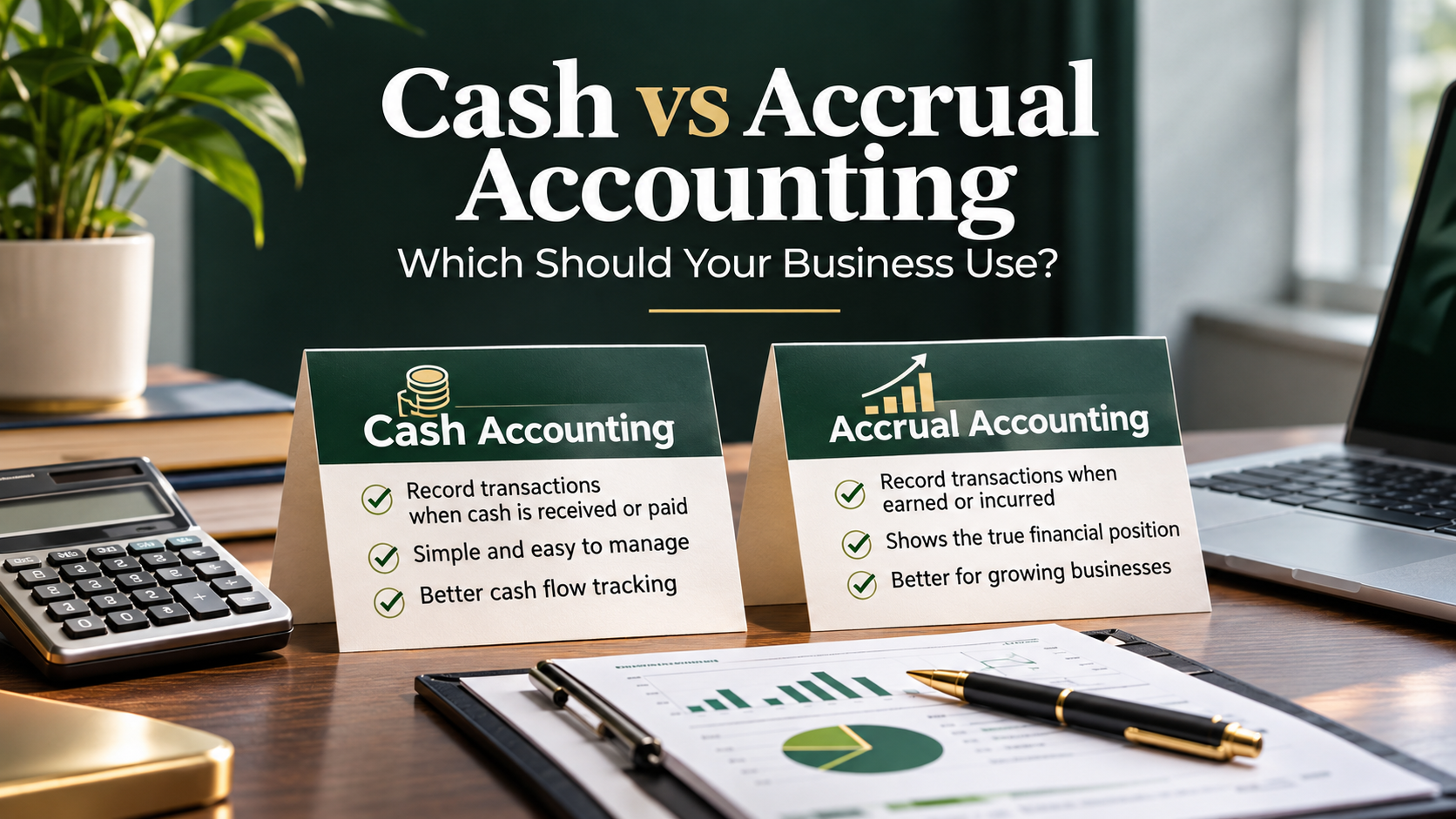
Cash basis accounting is a simple accounting method in which businesses record income when money is actually received and expenses when payments are made.
In other words, transactions are recorded based on the movement of cash rather than when income is earned or expenses are incurred.
For example, imagine a business provides consulting services worth ₹50,000 in January but receives the payment in February.
Under cash accounting, the business records the ₹50,000 income in February because that is when the payment is received.
Similarly, if a business receives an electricity bill in January but pays it in February, the expense is recorded in February.
Advantages of Cash Accounting
1. Simple to Understand
Cash accounting is easy to understand and manage, especially for small businesses and freelancers with limited transactions.
2. Easy Cash Flow Tracking
Since transactions are recorded when money enters or leaves the business, owners can easily understand their available cash balance.
3. Lower Administrative Complexity
Businesses with straightforward financial activities may find cash accounting easier to maintain without complicated accounting adjustments.
4. Suitable for Small Operations
Freelancers, independent professionals, and certain small businesses may find this method convenient, subject to applicable accounting and tax requirements.
Disadvantages of Cash Accounting
Despite its simplicity, cash accounting has some limitations.
-
It may not provide a complete picture of outstanding payments and receivables.
-
It can make monthly profitability difficult to evaluate.
-
Unpaid invoices and future liabilities may not be reflected immediately.
-
It may not be suitable for businesses with complex operations or inventory.
-
It may not meet applicable statutory accounting requirements.
What Is Accrual Basis Accounting?
Accrual accounting records income when it is earned and expenses when they are incurred, regardless of when the actual cash transaction takes place.
This approach provides a more comprehensive picture of a company's financial performance and position.
For example, suppose a company completes a project worth ₹1,00,000 in March but receives payment in April.
Under accrual accounting, the business records the revenue in March because that is when the service was completed and the income was earned.
Similarly, if a company receives professional services in March but pays the invoice in April, the expense is generally recorded in March.
Advantages of Accrual Accounting
1. Better Financial Visibility
Accrual accounting helps businesses understand their actual financial performance by recognising income and expenses in the periods to which they relate.
2. Accurate Profitability Measurement
It provides a clearer understanding of business profitability because revenue and related expenses are recorded in the appropriate accounting periods.
3. Better Business Planning
Business owners can use accrual-based financial statements to plan budgets, forecast revenue, and manage future financial commitments.
4. Improved Financial Reporting
Accrual accounting supports the preparation of comprehensive financial statements, including profit and loss statements and balance sheets.
5. Suitable for Growing Businesses
Companies with employees, inventory, credit transactions, and multiple revenue streams generally benefit from accrual accounting.
Disadvantages of Accrual Accounting
Accrual accounting also has certain challenges.
-
It requires more detailed bookkeeping.
-
Businesses may need professional accounting support.
-
It can be more complex to maintain.
-
Reported profits may not always reflect available cash.
-
Businesses must carefully monitor receivables and payables.
Cash vs Accrual Accounting: Key Differences
Although both methods help businesses maintain financial records, their approaches are different.
| Comparison | Cash Accounting | Accrual Accounting |
|---|---|---|
| Revenue recognition | When payment is received | When revenue is earned |
| Expense recognition | When payment is made | When expense is incurred |
| Complexity | Simple | More detailed |
| Cash flow visibility | Direct | Requires separate cash flow monitoring |
| Financial reporting | Limited view | Comprehensive view |
| Outstanding invoices | Not immediately recognised as revenue | Recognised as receivables |
| Business suitability | Simple operations | Growing and complex businesses |
Understanding these differences helps business owners identify the accounting approach that best matches their financial operations.
Real-Life Examples of Cash vs Accrual Accounting
Let's understand the difference through two practical business examples.
Example 1: Revenue Recognition
A digital marketing agency completes a marketing project worth ₹75,000 in January. The client pays the invoice in February.
Cash Accounting:
The agency records ₹75,000 as revenue in February when the payment is received.
Accrual Accounting:
The agency records ₹75,000 as revenue in January when the project is completed and the revenue is earned.
Example 2: Expense Recognition
A company receives a software subscription invoice of ₹12,000 for services used in March. The company pays the invoice in April.
Cash Accounting:
The expense is recorded in April when payment is made.
Accrual Accounting:
The expense is recorded in March because that is when the service was received.
These examples demonstrate how the timing of financial transactions can affect reported income and expenses under each accounting method.
Which Accounting Method Is Better for Small Businesses?
There is no single accounting method that is ideal for every business. The right choice depends on the company's size, financial activities, reporting requirements, and future growth plans.
When Should You Choose Cash Accounting?
Cash accounting may be suitable for businesses that:
-
Have a small number of financial transactions.
-
Receive payments immediately after providing services.
-
Have simple operating expenses.
-
Need straightforward cash tracking.
-
Are eligible to use this method under applicable rules.
For example, an independent consultant or freelancer with limited transactions may find cash accounting easier to manage.
When Should You Choose Accrual Accounting?
Accrual accounting may be more suitable for businesses that:
-
Regularly provide services on credit.
-
Have multiple customers and suppliers.
-
Maintain inventory.
-
Employ staff and manage recurring expenses.
-
Require detailed financial reporting.
-
Plan to expand business operations.
For example, a growing manufacturing company needs to monitor inventory, outstanding customer payments, supplier liabilities, and operating expenses. Accrual accounting can provide a more complete financial picture.
Cash vs Accrual Accounting in India
Businesses operating in India should understand that accounting methods are not simply a matter of personal preference.
The applicable accounting framework, statutory requirements, and tax provisions must be considered before choosing an accounting approach.
Under the Indian Income-tax Act, 1961, Section 145 provides for the method of accounting used to compute income under the heads Profits and Gains of Business or Profession and Income from Other Sources. Eligible taxpayers may generally follow either the cash or mercantile system, subject to the applicable provisions and notified accounting standards.
For companies, the Companies Act, 2013 and applicable Accounting Standards or Indian Accounting Standards (Ind AS) impose relevant financial reporting requirements. Accrual-based reporting is generally required for companies under the applicable framework.
Businesses should also distinguish between accounting records and GST compliance. GST registration, invoicing, return filing, and tax liability are governed by separate statutory provisions. Choosing cash accounting does not automatically change GST reporting or payment obligations.
Therefore, businesses should consult a qualified accounting professional before making decisions about their accounting method.
Common Mistakes Businesses Should Avoid
Choosing an accounting method is only the first step. Maintaining accurate financial records is equally important.
Here are some common mistakes businesses should avoid:
1. Mixing Personal and Business Transactions
Using personal bank accounts for business transactions can make financial reporting difficult. Maintain separate accounts wherever appropriate.
2. Ignoring Outstanding Invoices
Unpaid customer invoices should be monitored regularly to prevent cash flow problems.
3. Not Recording Expenses Properly
Every business expense should be supported by appropriate documentation and recorded in the correct accounting period.
4. Focusing Only on Profit
A business may report a profit but still experience cash shortages. Monitor both profitability and cash flow.
5. Delaying Financial Reconciliation
Regularly reconcile bank statements, invoices, and accounting records to identify errors and discrepancies.
How Professional Accounting Support Can Help
Managing business finances becomes more challenging as a company grows. Choosing an appropriate accounting method, maintaining records, preparing financial statements, and meeting statutory obligations require proper planning.
Professional accounting support can help businesses:
-
Maintain accurate financial records.
-
Prepare financial statements.
-
Monitor income and expenses.
-
Track outstanding receivables and payables.
-
Improve financial planning and budgeting.
-
Support tax and statutory compliance.
-
Understand business financial performance.
Working with experienced financial professionals allows business owners to focus more on operations while maintaining better control over their finances.
Understanding Cash vs Accrual Accounting is essential for making informed financial decisions. Cash accounting offers simplicity and makes it easier to track actual money received and paid. Accrual accounting provides a broader view of financial performance by recognising income and expenses when they are earned or incurred.
For small businesses with straightforward operations, cash accounting may be convenient where permitted. However, growing businesses with credit transactions, inventory, employees, and complex financial activities may benefit from accrual-based accounting.
The best accounting method is the one that meets your business needs while complying with applicable legal and financial reporting requirements.
At Clockwell International, we understand that effective financial management is essential for sustainable business growth. With the right accounting guidance and compliance support, businesses can build a stronger financial foundation and make confident decisions for the future.
Make smarter financial decisions. Build a stronger business with Clockwell International.
Published on November 11, 2026