

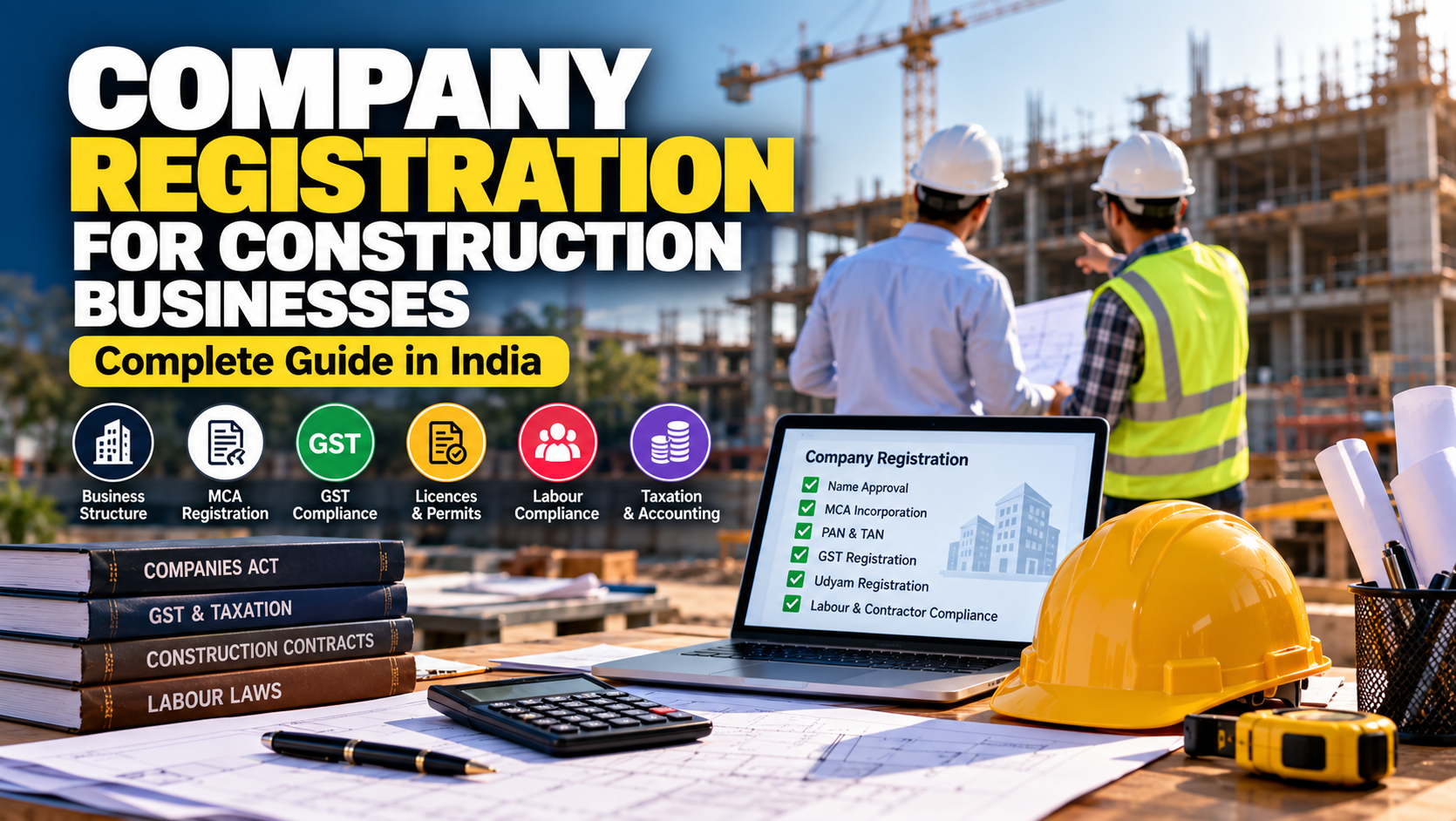
The construction industry is one of India's largest business sectors, covering residential buildings, commercial projects, infrastructure, renovation, civil works, interior construction, road works and specialised contracting.
If you are planning to start a construction business, choosing the right legal structure and completing the required registrations is an important first step.
A construction business may operate as a:
-
Proprietorship
-
Partnership firm
-
Limited Liability Partnership (LLP)
-
Private Limited Company
-
Public Limited Company
For businesses planning to work with corporate clients, participate in tenders, employ a larger workforce, raise investment or expand into multiple projects, a Private Limited Company or LLP may be considered depending on the business model.
However, company incorporation is only the beginning. A construction business may also need to address GST, income tax, TDS, labour compliance, contractor requirements, professional registrations, Udyam/MSME registration, project-specific approvals and RERA compliance where applicable.
This guide explains the major steps involved in company registration for construction businesses in India and the compliance areas construction entrepreneurs should understand before starting operations.
Why Register a Construction Business?
A construction business can technically operate through different legal structures. However, formal registration can provide several advantages for a growing business.
A properly structured business can make it easier to:
-
Open a business bank account
-
Sign contracts with clients
-
Participate in tenders
-
Obtain GST registration
-
Hire employees
-
Work with contractors and subcontractors
-
Maintain formal financial records
-
Apply for business loans
-
Build business credibility
-
Separate business and personal finances
-
Expand into multiple projects
-
Bring in investors or partners
-
Establish a long-term business identity
The appropriate structure depends on the founders, expected turnover, investment requirements, risk profile and future plans.
Which Business Structure Is Suitable for a Construction Business?
There is no single structure that is right for every construction company.
The main options are:
1. Proprietorship
A proprietorship is relatively simple to establish and operate.
It may be suitable for a small contractor working on limited projects.
However, the business and proprietor are not separate legal persons, which can become a consideration as the business grows.
2. Partnership Firm
A partnership can be useful when two or more individuals want to operate a construction business together.
The partners can define:
-
Capital contribution
-
Profit-sharing ratio
-
Responsibilities
-
Decision-making powers
-
Withdrawal rules
-
Admission/retirement of partners
A properly drafted partnership agreement is important.
3. Limited Liability Partnership
An LLP combines elements of partnership flexibility with limited liability protection.
It may be suitable for construction professionals who want to operate together while maintaining a separate legal entity.
An LLP can be particularly useful where the business is based around:
-
Civil contracting
-
Engineering services
-
Construction consultancy
-
Project management
-
Architecture-related business activities, subject to professional regulations
-
Multiple partners
4. Private Limited Company
A Private Limited Company is a popular structure for construction businesses planning to build a larger organisation.
It provides a separate legal identity and can be useful when the founders intend to:
-
Take larger contracts
-
Work with corporate clients
-
Participate in tenders
-
Raise capital
-
Add shareholders
-
Build a professional brand
-
Expand geographically
-
Create a scalable organisation
A company also has continuing statutory compliance requirements under the Companies Act.
5. Public Limited Company
A public company may be appropriate for much larger businesses with more complex funding and expansion plans.
For a new small or medium construction business, however, incorporation as a private limited company or LLP may often be more relevant than immediately forming a public company.
Private Limited Company vs LLP for Construction
| Feature | Private Limited Company | LLP |
|---|---|---|
| Separate legal identity | Yes | Yes |
| Limited liability | Yes | Yes |
| Ownership | Shareholders | Partners |
| Management | Directors | Partners/designated partners |
| Fundraising | More structured for equity investment | More limited |
| Compliance | Generally higher | Generally lower than company |
| Suitable for investors | Generally more suitable | Less suited to conventional equity investment |
| Expansion | Highly scalable | Scalable |
| Construction contracts | Can be suitable | Can be suitable |
The decision should be based on the long-term business plan rather than simply choosing the structure with the lowest incorporation cost.
What Is Required to Register a Construction Company?
For a Private Limited Company, the incorporation process is handled through the Ministry of Corporate Affairs (MCA).
MCA's incorporation system uses SPICe+ and linked forms for company incorporation. The MCA's V3 incorporation framework includes SPICe+ Part A and Part B and linked forms such as AGILE-PRO-S.
Generally, the promoters need to prepare:
-
Proposed company name
-
Main business activities
-
Registered office details
-
Director details
-
Subscriber/shareholder details
-
PAN/Aadhaar and identity information
-
Address proof
-
Digital Signature Certificates
-
Memorandum of Association
-
Articles of Association
-
Required declarations
The exact documentation depends on the promoters and circumstances.
Step-by-Step Company Registration for Construction Businesses
Step 1: Decide the Business Structure
First decide whether the business should operate as:
Proprietorship → Partnership → LLP → Private Limited Company
For a construction business intending to undertake larger contracts and expand, the legal structure should be considered carefully before incorporation.
Step 2: Decide the Business Activities
The proposed company should clearly define its business activities.
For example:
-
Building construction
-
Civil construction
-
Residential construction
-
Commercial construction
-
Infrastructure projects
-
Road construction
-
Renovation
-
Repair and maintenance
-
Interior construction
-
Structural works
-
Project management
-
Construction contracting
-
Subcontracting
The company's objects and business description should accurately reflect the activities it intends to conduct.
Step 3: Choose a Company Name
The name should be:
-
Unique
-
Legally acceptable
-
Consistent with the proposed business
-
Not confusingly similar to an existing company/LLP
-
Compliant with MCA naming rules
For example:
ABC Constructions Private Limited
XYZ Infra Projects Private Limited
Buildwell Engineering Private Limited
Before finalising a name, it is important to check existing company/LLP names and applicable trademark considerations.
Step 4: Obtain Digital Signature Certificates
Digital Signature Certificates are used by the relevant individuals for electronic filing with government portals.
Depending on the incorporation structure and filing, DSCs may be required for:
-
Proposed directors
-
Subscribers
-
Authorised professionals
The DSC should be obtained from an authorised Certifying Authority.
Step 5: Apply for DIN
A Director Identification Number is required for individuals who become directors of a company.
DIN-related incorporation processes are integrated into the MCA incorporation system for eligible first-time directors.
Step 6: File SPICe+
The incorporation application is submitted through the MCA's electronic incorporation system.
The SPICe+ process covers important incorporation information such as:
-
Company details
-
Registered office
-
Directors
-
Subscribers
-
Capital
-
Business activity
MCA's current V3 framework requires incorporation forms to be filed through the V3 system.
Step 7: Prepare MOA and AOA
The Memorandum of Association (MOA) defines the company's principal objects and scope.
The Articles of Association (AOA) contain rules governing the company's internal management.
For a construction company, the objects should be drafted carefully to cover the intended business activities without unnecessarily restricting future operations.
Step 8: Incorporation Approval
Once the MCA reviews and approves the application, the company receives its:
Certificate of Incorporation
The company also receives its corporate identification details, including its Corporate Identity Number (CIN).
At this stage, the business becomes a separate incorporated entity.
PAN and TAN for the Construction Company
PAN and TAN are important tax registrations.
The MCA incorporation process integrates PAN and TAN issuance with company incorporation.
MCA's incorporation documentation states that the SPICe+ process includes mandatory PAN and TAN issuance.
The company will need PAN for activities such as:
-
Opening bank accounts
-
Income-tax compliance
-
Financial transactions
-
Tax filings
TAN is required where the company has applicable tax-deduction obligations.
Opening a Current Account
After incorporation, the company should open a current account in the company's name.
This is important because construction businesses may handle:
-
Client advances
-
Project payments
-
Supplier payments
-
Labour payments
-
Contractor payments
-
Equipment purchases
-
Loan proceeds
-
Government/tender payments
Avoid mixing personal and company transactions.
A clean banking trail makes accounting, taxation and financial management significantly easier.
GST Registration for Construction Businesses
GST is an important compliance area for construction companies.
Whether GST registration is required depends on the nature of the business, turnover and applicable registration provisions.
Construction businesses can provide different types of supplies, including:
-
Construction services
-
Works contracts
-
Repair and maintenance
-
Engineering services
-
Project-related services
-
Construction material supplies
Therefore, the GST treatment must be determined based on the actual contract and nature of supply.
GST on Construction Services
Construction services are generally classified under Heading 9954, but GST rates depend on the exact type of construction service.
The CBIC rate schedule contains different entries for:
-
Residential apartments
-
Commercial apartments
-
Promoter-led real estate projects
-
Works contracts
-
Government projects
-
Certain specialised construction services
-
Other construction services
For example, the CBIC schedule provides an 18% entry for specified construction services under Heading 9954, while separate concessional rates apply to certain real-estate and government-related supplies subject to conditions.
Therefore, construction businesses should never assume that every construction invoice carries one universal GST rate.
What Is a Works Contract?
A works contract is particularly important in construction.
It can involve a combination of:
-
Labour
-
Materials
-
Construction
-
Installation
-
Erection
-
Repair
-
Maintenance
-
Renovation
GST treats a works contract involving immovable property as a supply of services under the GST framework.
This is important because the GST treatment of a construction contractor can differ from the treatment of a simple trader selling construction materials.
Construction Company Selling Materials
Some construction businesses also sell:
-
Cement
-
Steel
-
Tiles
-
Electrical materials
-
Plumbing materials
-
Sand
-
Aggregates
-
Hardware
-
Building products
The GST classification of these supplies can differ from construction-service contracts.
If the business provides both:
Construction services
and
Goods/material supplies
the accounting system should separately track them.
Input Tax Credit for Construction Businesses
A construction company may incur significant GST on:
-
Cement
-
Steel
-
Equipment
-
Professional services
-
Machinery
-
Renting
-
Transport
-
Subcontractor services
-
Office expenses
However, ITC eligibility is not automatic.
The company needs to examine:
-
Nature of the outward supply
-
Nature of the input
-
Applicable restrictions
-
Whether the expense relates to taxable or exempt supplies
-
Specific blocked-credit provisions
For construction businesses, ITC analysis is especially important because large project purchases can involve substantial tax amounts.
GST on Subcontractors
Construction companies frequently engage:
-
Civil contractors
-
Electrical contractors
-
Plumbing contractors
-
Painting contractors
-
Fabrication contractors
-
Labour contractors
-
Equipment contractors
Each subcontractor arrangement should be properly documented.
The main contractor should verify:
-
GST registration
-
Invoice
-
HSN/SAC
-
GST rate
-
Contract terms
-
Payment records
-
TDS requirements
-
GST reconciliation
Poor subcontractor documentation can create problems during tax reconciliation or assessment.
TDS on Contractor Payments
Construction companies frequently make payments to contractors and subcontractors.
Tax deduction at source can apply to qualifying contractor payments.
Importantly, India's income-tax framework changed from 1 April 2026 with the commencement of the Income Tax Act, 2025.
The Income Tax Department states that for transactions where the earlier of credit or payment occurs on or after 1 April 2026, the new Act's provisions apply. The contractor-payment TDS provision is now referenced through Section 393(1), Table Sl. No. 6(i) rather than the old Section 194C reference. The department also states that the underlying TDS rates and monetary thresholds remain unchanged.
Therefore, construction companies should ensure their accounting and TDS software has been updated for the new tax-law references.
Labour Compliance for Construction Companies
Construction businesses often employ or engage a large number of workers.
Depending on the business model, workforce and applicable law, a construction company may need to consider:
-
EPF
-
ESI
-
Contract labour requirements
-
Wage compliance
-
Worker records
-
Safety requirements
-
State labour registrations
-
Building and construction worker requirements
-
Employment-related registrations
For example, EPFO states that the EPF law applies to covered establishments employing 20 or more persons, subject to the applicable statutory conditions.
Construction companies should also distinguish between:
Direct employees
and
Contract labour
because their compliance responsibilities can differ.
Contract Labour Compliance
A construction business frequently works through contractors.
The labour-law framework contains specific requirements relating to contractors and contract labour.
Current Central rules provide for contractor licensing through the Shram Suvidha Portal and specify obligations relating to wages, working conditions and worker facilities in applicable cases.
Therefore, construction companies should maintain proper records of:
-
Contractor details
-
Work orders
-
Worker counts
-
Wage payments
-
Compliance documents
-
Licences
-
Attendance
-
Safety requirements
The exact requirements can vary depending on the applicable law, establishment and jurisdiction.
Udyam Registration for Construction Businesses
A construction business that qualifies as an MSME may consider Udyam Registration.
The official Udyam portal states that registration is:
-
Free
-
Online
-
Paperless
-
Based on self-declaration
-
Issued with a permanent Udyam Registration Number
-
Provided with an online certificate
There is no renewal requirement under the Udyam registration system.
The MSME classification thresholds were revised from 1 April 2025. The current thresholds are:
| MSME Category | Investment Limit | Turnover Limit |
|---|---|---|
| Micro | ₹2.5 crore | ₹10 crore |
| Small | ₹25 crore | ₹100 crore |
| Medium | ₹125 crore | ₹500 crore |
These thresholds are published on the official Udyam Registration portal.
A construction company should evaluate Udyam eligibility based on its actual investment and turnover.
Benefits of Udyam Registration for a Construction Company
Depending on eligibility and applicable schemes, MSME registration can support access to various government programmes and financial mechanisms.
It can also help formalise the business as an MSME.
Potential areas of relevance include:
-
Bank financing
-
Government schemes
-
MSME-related benefits
-
Tender opportunities where MSME provisions apply
-
Delayed-payment protection mechanisms
-
Business formalisation
Benefits are subject to the conditions of the particular scheme or law.
The Udyam registration itself is free through the official government portal.
RERA Compliance for Construction Businesses
Not every construction company is automatically subject to RERA in the same way.
A critical distinction is whether the company is acting as:
A contractor executing construction work for a client
or
A promoter/developer developing and selling a real estate project
The Real Estate (Regulation and Development) Act, 2016 regulates real estate projects and promoters.
Under Section 3, a promoter generally cannot advertise, market, book, sell or offer for sale a plot, apartment or building in a real estate project without registering the project with the relevant Real Estate Regulatory Authority, subject to statutory exemptions. The central Act includes an exemption for projects where the land area does not exceed 500 square metres or the number of apartments does not exceed eight, with scope for the appropriate government to reduce those thresholds.
State-specific rules and notifications also need to be considered.
Therefore, a construction company planning to become a developer should examine RERA requirements before marketing or selling a project.
Contractor vs Real Estate Developer
This distinction is important.
Construction Contractor
The contractor generally:
-
Executes construction work
-
Works under a contract
-
Receives consideration for construction services
-
May work for developers, companies, governments or individuals
Real Estate Developer/Promoter
The promoter may:
-
Acquire/develop land
-
Develop real estate projects
-
Market apartments
-
Sell units to buyers
-
Collect customer advances
-
Manage project-level regulatory compliance
A business can potentially perform both roles, but the compliance requirements can differ significantly.
Construction Licences and Government Tenders
Construction companies that intend to work on government projects may need to obtain registrations or contractor classifications from the relevant:
-
Central government department
-
State government department
-
Public Works Department
-
Local authority
-
Public-sector organisation
-
Government procurement platform
Requirements can vary by department and category.
Depending on the tender, the company may be required to demonstrate:
-
Experience
-
Financial capacity
-
Technical staff
-
Machinery
-
Past project records
-
GST registration
-
PAN
-
Income-tax filings
-
Audited financial statements
-
Bank solvency
-
Labour compliance
-
EMD/security requirements
Company incorporation alone does not automatically qualify a business for government contracts.
Construction Business and Government e-Procurement
If your construction company plans to participate in government tenders, it should establish a system for managing:
-
Tender registrations
-
Digital signatures
-
Technical documents
-
Financial documents
-
GST certificates
-
Experience certificates
-
Company incorporation documents
-
EMD
-
Performance guarantees
-
Contract documents
A Digital Signature Certificate is commonly required for electronic tender participation and other government e-procurement activities, depending on the platform.
Accounting for Construction Companies
Construction accounting is different from ordinary retail accounting because projects can continue for months or years.
A construction company should track accounts project by project.
For example:
Project A
Contract value: ₹50 lakh
Project B
Contract value: ₹1.2 crore
Project C
Contract value: ₹80 lakh
Each project should have separate tracking for:
-
Revenue
-
Materials
-
Labour
-
Subcontractors
-
Equipment
-
Transportation
-
Site expenses
-
Professional fees
-
Overheads
-
GST
-
TDS
-
Profit
Project-Wise Accounting
A useful structure is:
Project Revenue
minus
Material Cost
minus
Labour Cost
minus
Subcontractor Cost
minus
Equipment Cost
minus
Site Expenses
minus
Allocated Overheads
=
Project Profit
This gives the management a clearer understanding of which projects are profitable.
Construction Material Accounting
Construction businesses may purchase large quantities of:
-
Cement
-
Steel
-
Sand
-
Bricks
-
Blocks
-
Tiles
-
Electrical materials
-
Plumbing materials
-
Paint
-
Hardware
These purchases should be tracked by project wherever possible.
For example:
Cement Purchase → Project A
Steel Purchase → Project A
Electrical Materials → Project B
This helps prevent cost leakage between projects.
Labour Cost in Construction Accounting
Labour can be one of the largest project costs.
The accounting system should distinguish:
-
Permanent employees
-
Temporary workers
-
Contract labour
-
Subcontractors
-
Skilled labour
-
Unskilled labour
Project-level labour allocation can significantly improve profitability analysis.
Equipment and Machinery
Construction companies may own or rent:
-
Excavators
-
Cranes
-
Mixers
-
Trucks
-
Loaders
-
Generators
-
Scaffolding
-
Tools
Accounting should track:
-
Purchase cost
-
Depreciation
-
Repairs
-
Fuel
-
Insurance
-
Rental
-
Maintenance
Equipment utilisation is also an important management metric.
Construction Company Income Tax
A construction company's income-tax treatment depends on its legal structure.
For example:
Private Limited Company
Tax is assessed at the company level under the applicable corporate tax provisions.
LLP
Tax is generally assessed at the LLP level under the applicable provisions.
Proprietorship
Business income is generally included in the proprietor's individual tax computation.
Partnership Firm
Tax treatment applies at the firm level subject to the applicable provisions.
A construction business should maintain proper books of account and calculate taxable income according to the applicable tax rules.
Advance Tax for Construction Companies
Construction businesses can receive large project payments at different stages.
This can result in significant taxable income.
Businesses should therefore monitor:
-
Estimated annual profit
-
Taxable income
-
TDS credits
-
Advance-tax obligations
-
Cash flow
Do not wait until the end of the financial year to discover a large tax liability.
TDS Credits and Construction Companies
Construction companies often have TDS deducted by:
-
Corporate clients
-
Government departments
-
Other businesses
The company should reconcile TDS appearing in its tax records with:
-
Customer ledgers
-
Invoices
-
Payment receipts
-
Form 26AS/AIS or applicable tax information
Unreconciled TDS can result in unnecessary tax-payment issues or delays in claiming credit.
E-Invoicing for Construction Companies
Larger GST-registered construction businesses should examine whether they fall under the e-invoicing mandate.
The current e-invoice framework applies to eligible taxpayers based on the prescribed turnover threshold and transaction scope.
The accounting system should be capable of generating or integrating:
-
Invoice data
-
GST details
-
HSN/SAC
-
Customer GSTIN
-
IRN
-
QR code
-
Credit/debit notes
Construction companies working with large corporate clients should pay particular attention to B2B invoicing compliance.
Documents Required for Construction Company Registration
The exact documentation depends on the legal structure, but for a Private Limited Company, common requirements may include:
Directors
-
PAN
-
Identity proof
-
Address proof
-
Photograph
-
Mobile number
-
Email address
-
Digital Signature
Registered Office
-
Address proof
-
Ownership/rental document
-
Utility bill
-
Owner's NOC where applicable
Company
-
Proposed name
-
Business objects
-
Shareholding structure
-
Capital details
-
MOA
-
AOA
Additional documents may be required depending on the circumstances.
Post-Incorporation Compliance
Getting the Certificate of Incorporation does not mean compliance is finished.
A new construction company should consider:
-
Current account
-
GST registration
-
Udyam registration
-
Professional tax, where applicable
-
Shops and Establishments requirements, where applicable
-
EPFO/ESI, where applicable
-
TDS registration/compliance
-
Accounting system
-
Digital Signature
-
Tender registrations
-
Labour compliance
-
Project-specific licences
-
RERA, where applicable
MCA's AGILE-PRO-S process can also facilitate certain registrations and services during company incorporation, including GSTIN, EPFO, ESIC, profession tax in specified jurisdictions, bank account opening and Shops & Establishment registration where applicable.
Annual Compliance for a Private Limited Construction Company
A Private Limited Company must maintain its statutory compliance even if the company has low turnover or no major projects.
Typical areas include:
-
Board meetings
-
Statutory registers
-
Financial statements
-
Annual return
-
Income-tax return
-
GST returns, where registered
-
TDS compliance
-
Auditor-related compliance
-
Director-related filings
-
MCA filings
The exact forms and deadlines depend on the company and financial year.
Construction Company Compliance Calendar
A practical compliance system can be divided into:
Daily
-
Record project expenses
-
Record material purchases
-
Record labour
-
Record customer receipts
-
Record subcontractor payments
Weekly
-
Review project costs
-
Reconcile site expenses
-
Check material consumption
-
Review outstanding invoices
Monthly
-
Bank reconciliation
-
GST reconciliation
-
TDS reconciliation
-
Payroll compliance
-
Project profitability
-
Supplier reconciliation
Quarterly
-
Tax planning
-
TDS returns
-
Project review
-
Cash-flow forecasting
Annually
-
Financial statements
-
Income-tax return
-
MCA annual compliance
-
Audit, where applicable
-
Statutory review
-
Project-wise profitability analysis
Common Mistakes When Starting a Construction Company
1. Choosing the Structure Only Based on Registration Cost
The cheapest structure is not necessarily the best structure for a growing construction business.
Consider:
-
Liability
-
Investment
-
Contracts
-
Taxation
-
Compliance
-
Expansion
2. Using Personal Bank Accounts
Business transactions should be separated from personal finances.
3. Not Tracking Projects Separately
A construction company can show overall profit while losing money on individual projects.
4. Poor Material Control
Uncontrolled cement, steel, fuel and other material usage can significantly affect project profitability.
5. Ignoring Subcontractor Documentation
Every major subcontractor should have proper:
-
Agreement
-
Work order
-
Invoice
-
Payment record
-
Tax documentation
6. Applying the Wrong GST Rate
Construction GST depends on the specific nature of the supply and applicable conditions.
7. Missing TDS
Contractor and subcontractor payments require careful TDS review.
8. Ignoring Labour Compliance
Construction businesses can have large workforces and contract labour arrangements.
9. Confusing Contractor and Developer Compliance
A contractor executing work for another party is not automatically subject to every developer-specific requirement.
10. Starting Projects Without Proper Contracts
A construction company should clearly document:
-
Scope of work
-
Contract value
-
Payment schedule
-
Completion period
-
Materials responsibility
-
Variation orders
-
Delay clauses
-
Defect liability
-
Retention
-
Dispute resolution
A strong contract can prevent many future disputes.
Construction Company Registration Checklist
Before starting operations, review the following:
Company
-
Choose legal structure
-
Select company name
-
Define business objects
-
Obtain DSC
-
Obtain DIN where applicable
-
File incorporation forms
-
Receive Certificate of Incorporation
-
Obtain PAN/TAN
Tax
-
GST registration, where applicable
-
TDS compliance
-
Income-tax compliance
-
E-invoicing, where applicable
-
Project-wise GST treatment
MSME
-
Check Udyam eligibility
-
Complete Udyam registration if appropriate
Labour
-
EPFO applicability
-
ESI applicability
-
Contract labour compliance
-
Wage compliance
-
Worker records
-
Safety compliance
Construction-Specific
-
Contractor registrations
-
Tender registrations
-
Government approvals
-
Local authority requirements
-
RERA assessment for developer projects
-
Project permissions
Accounting
-
Accounting software
-
Project-wise ledgers
-
Inventory tracking
-
Labour accounting
-
Subcontractor accounting
-
Bank reconciliation
-
Cash-flow management
How Much Does It Cost to Register a Construction Company?
There is no single fixed cost for registering a construction company.
The overall cost can depend on:
-
Legal structure
-
Government fees
-
Stamp duty
-
Authorised capital
-
Professional fees
-
DSC costs
-
State-specific requirements
-
Additional registrations
For example, the cost of forming a Private Limited Company can differ from forming an LLP or partnership.
Businesses should therefore obtain a detailed cost estimate based on:
State + Entity Type + Capital + Number of Directors/Partners + Additional Registrations
How Long Does Company Registration Take?
The incorporation timeline can vary depending on:
-
Name approval
-
Documentation
-
DSC availability
-
MCA processing
-
Resubmissions
-
Registered-office documentation
-
Government approvals
A clean application with complete documents can generally move faster than an application requiring repeated corrections.
Therefore, entrepreneurs should prepare the documents carefully before submitting the incorporation application.
Should a Construction Business Register as a Private Limited Company?
A Private Limited Company can be considered when the founders want to build a formal, scalable construction organisation.
It may be particularly relevant where the business plans to:
-
Work with corporate clients
-
Participate in larger tenders
-
Bring in shareholders
-
Raise external capital
-
Build multiple project teams
-
Expand to multiple locations
-
Establish a long-term brand
However, incorporation should be based on the business plan, not simply because a company sounds more professional.
Frequently Asked Questions
Is company registration mandatory for every construction business?
No. A construction business can operate through different legal structures depending on its activities and circumstances. However, formal incorporation may be appropriate for businesses seeking limited liability, investment, larger contracts or structured expansion.
Which company is best for a construction business?
There is no universally suitable structure. A Private Limited Company, LLP, partnership or proprietorship may each be appropriate in different circumstances.
Is GST mandatory for a construction company?
GST registration depends on turnover, nature of supply and other compulsory-registration provisions. A construction company should evaluate its specific activities rather than assuming registration is always or never required.
What is the GST rate on construction services?
There is no single GST rate for every construction activity. The CBIC rate schedule contains different entries for construction services, works contracts, real-estate projects and other activities. Certain construction services are listed at 18%, while specified categories have different rates and conditions.
Does a construction company need RERA registration?
Not necessarily. RERA requirements depend on whether the business is acting as a promoter/developer and whether the project falls within the Act and applicable State rules. The central Act provides exemptions for certain smaller projects, including projects not exceeding 500 square metres or eight apartments, subject to the statutory framework and possible State-level changes.
Is Udyam registration useful for a construction company?
An eligible construction business can obtain Udyam Registration. The official portal states that Udyam registration is free, paperless and does not require renewal.
Does a construction company need EPF registration?
EPF applicability depends on the establishment and workforce conditions under the applicable law. EPFO states that covered establishments employing 20 or more persons generally fall within the EPF framework, subject to the statutory conditions.
Is TDS applicable to construction contractors?
TDS can apply to qualifying contractor payments. For transactions from 1 April 2026 onward, the relevant provisions are under the Income Tax Act, 2025, and the Income Tax Department states that the TDS rates and thresholds remain unchanged from the earlier framework.
Can a construction company participate in government tenders after incorporation?
Incorporation alone does not automatically qualify a business for tenders. The company may need department-specific contractor registrations, technical qualifications, experience, financial capacity, GST and other documents.
Should construction accounting be project-wise?
Yes. Project-wise accounting is strongly useful because construction businesses can have multiple projects with different costs, margins, payment schedules and completion timelines.
Final Thoughts
Starting a construction business involves much more than obtaining a Certificate of Incorporation.
A successful construction company needs a structured approach covering:
Company Registration
↓
GST & Tax Compliance
↓
Udyam/MSME
↓
Labour Compliance
↓
Contractor/Tender Registrations
↓
Project Accounting
↓
RERA, Where Applicable
↓
Financial & Statutory Compliance
The first step is to choose the appropriate legal structure based on the business's expected size, contracts, investment requirements, liability considerations and expansion plans.
For a growing construction business, professional accounting and compliance management are equally important. Proper project-wise accounting can help management understand where money is being spent, which projects are profitable and whether customer collections are sufficient to fund ongoing construction work.
A well-structured construction company is better positioned to work with corporate clients, participate in eligible tenders, obtain financing, manage multiple projects and build a long-term business.
If you are planning to start a construction company, prepare the legal structure, tax registrations, contracts, labour compliance and accounting system before taking on major projects.
Published on September 29, 2026