Running a medical shop or pharmacy involves more than purchasing medicines and selling them to customers. A pharmacy owner must manage GST, purchase invoices, input tax credit, HSN classification, billing, stock records, GST returns, exempt products, taxable products and other business compliances.
GST treatment can also vary between medicines, medical devices, cosmetics, health supplements and other products commonly sold through pharmacies.
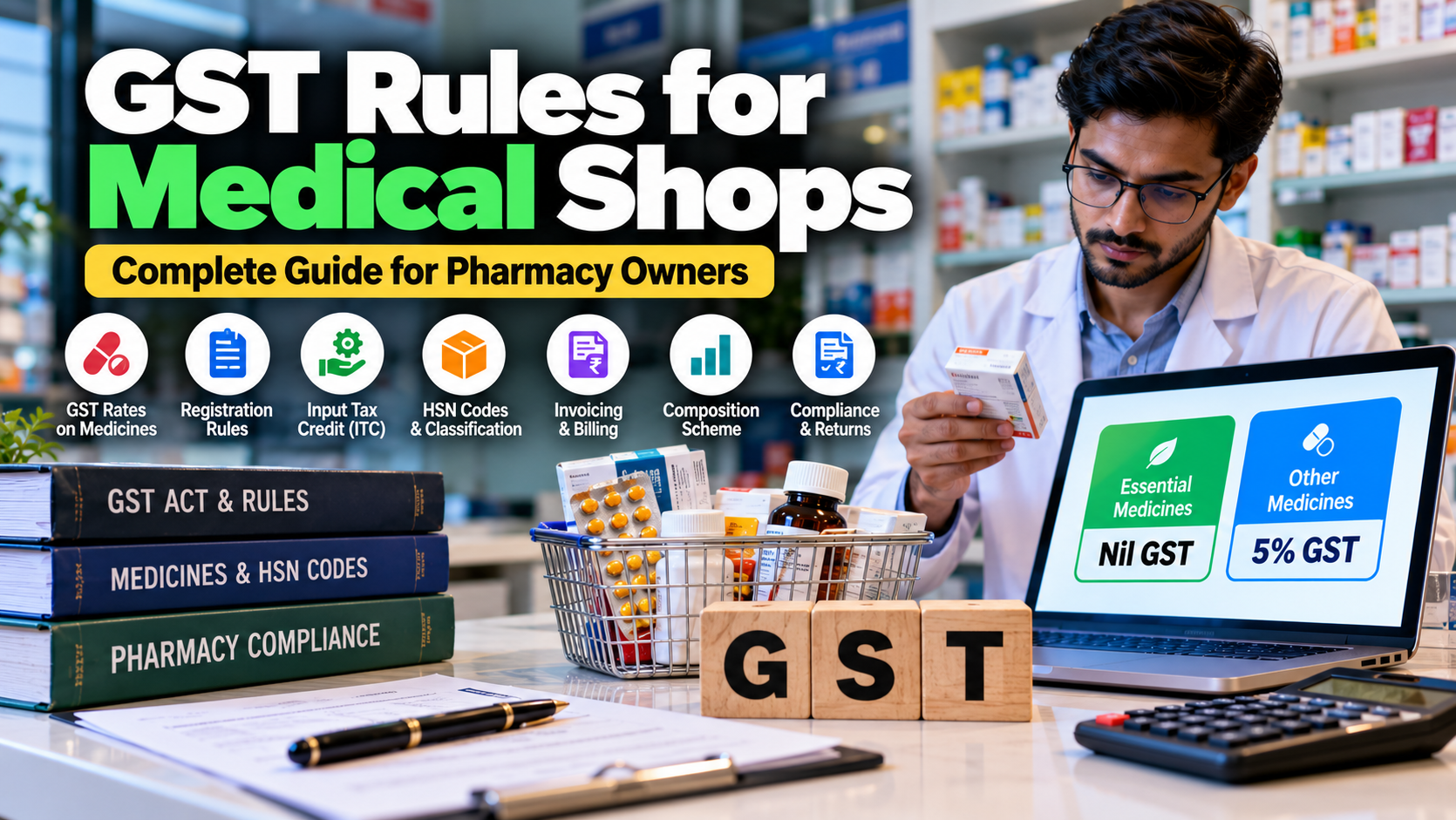
Recent GST changes have also affected the taxation of medicines. From September 2025, the GST Council announced a reduction of GST on all other drugs and medicines from 12% to 5%, while specified lifesaving medicines were moved to the nil-rate category.
Therefore, medical shops should ensure that their billing and accounting systems reflect the current applicable GST rate for each product, rather than relying on older rate charts.
This guide explains the major GST rules for medical shops in India, including registration, medicine GST rates, ITC, invoices, composition scheme, medical devices, exempt medicines, e-invoicing and common compliance mistakes.
What Is GST for a Medical Shop?
GST, or Goods and Services Tax, is an indirect tax applicable to the supply of goods and services in India.
A medical shop generally operates primarily as a trader of goods. Its GST obligations depend on the products it sells and the applicable GST classification.
A pharmacy may sell:
-
Prescription medicines
-
OTC medicines
-
Ayurvedic medicines
-
Homeopathic medicines
-
Medical devices
-
Surgical products
-
Bandages
-
Diagnostic kits
-
Cosmetics
-
Health supplements
-
Personal-care products
-
Baby-care products
-
Other healthcare products
These products do not necessarily have the same GST rate.
Therefore, a pharmacy should maintain product-level tax classification rather than applying one GST rate to every item.
GST Rate on Medicines in India
One of the most important recent developments for medical shops is the reduction in GST on medicines.
The GST Council's September 2025 release states that:
-
Specified lifesaving drugs and medicines were reduced from 12% to Nil
-
Other drugs and medicines were reduced from 12% to 5%
-
Certain medicines that were already at 5% were also moved to Nil where specifically notified.
This means the commonly used older statement that "medicines are generally taxed at 12%" is no longer appropriate as a blanket description of the current position.
Important
Not every product sold in a medical shop is automatically a "medicine."
A pharmacy may also sell:
-
Cosmetics
-
Food products
-
Nutritional supplements
-
Personal-care products
-
Medical equipment
-
Surgical goods
Each product must be classified according to its applicable HSN and GST notification.
5% GST on Drugs and Medicines
Following the 2025 GST rate changes, the GST Council stated that all other drugs and medicines are subject to a concessional 5% GST rate, except specified medicines moved to the nil-rate category.
For an intra-State sale, a 5% GST rate normally consists of:
-
2.5% CGST
-
2.5% SGST
For an inter-State taxable supply:
-
5% IGST
Example
Suppose a taxable medicine has a pre-GST value of:
₹1,000
GST at 5%:
₹50
For an intra-State sale:
-
CGST = ₹25
-
SGST = ₹25
Total invoice value:
₹1,050
The exact tax treatment should always be verified against the product's current classification.
Nil-Rated Medicines
Some medicines have been specifically moved to the Nil GST rate.
The September 2025 GST Council announcement states that 33 lifesaving drugs and medicines were reduced from 12% to Nil, while 3 specified lifesaving medicines were reduced from 5% to Nil.
This is important for pharmacy accounting because a medical shop may sell both:
5% GST medicines
and
Nil-rated medicines
within the same business.
These should be separately identified in the accounting and billing system.
Is Every Product in a Medical Shop Taxed at 5%?
No.
This is one of the biggest mistakes pharmacy owners can make.
The 5% rate applies to the relevant category of drugs and medicines as specified under the GST rate notifications.
A medical shop may also sell products falling under different HSN classifications.
For example:
| Product Category | GST Treatment |
|---|---|
| Specified medicines | May be Nil |
| Other drugs/medicines | Generally 5% under current framework |
| Certain medical devices | Check applicable HSN/rate |
| Cosmetics | Separate classification/rate |
| Health supplements | Depends on classification |
| Surgical products | Depends on HSN and notification |
| Diagnostic products | Depends on specific classification |
| Other retail products | Applicable HSN rate |
The current CBIC rate schedule itself contains product-specific classifications and rates, so pharmacies should not use a single tax rate for all inventory.
GST on Medical Devices and Equipment
Medical shops frequently sell items that are not medicines.
Examples include:
-
Blood glucose meters
-
Thermometers
-
BP monitors
-
Nebulisers
-
Medical equipment
-
Surgical instruments
-
Mobility aids
-
Diagnostic products
GST treatment depends on the applicable HSN classification and notification.
The September 2025 GST Council release announced reductions on various medical apparatus and devices, including certain medical, surgical, dental and veterinary devices, as well as medical supplies such as gauze, bandages, diagnostic kits and glucose-monitoring devices.
Therefore, pharmacy owners should update their product master whenever GST rates change.
GST Registration for a Medical Shop
A medical shop needs to evaluate GST registration based on its aggregate turnover and the applicable compulsory-registration provisions.
For suppliers exclusively engaged in goods, the GST framework provides a ₹40 lakh registration threshold in most States, subject to the conditions and exclusions in the relevant notification. Kerala is among the States that adopted the higher threshold for eligible suppliers of goods.
However, turnover alone is not always enough to determine whether registration is required.
The business should also consider:
-
Nature of supplies
-
Inter-State supplies
-
Compulsory-registration provisions
-
E-commerce transactions
-
Other activities carried out by the business
A pharmacy should therefore check the applicable GST registration provisions before deciding that registration is unnecessary.
What Is Aggregate Turnover?
Aggregate turnover is a PAN-based concept under GST.
It generally considers the value of relevant:
-
Taxable supplies
-
Exempt supplies
-
Zero-rated supplies
-
Inter-State supplies
across India under the same PAN, subject to the statutory definition.
This is important for pharmacy owners operating:
-
Multiple branches
-
Multiple shops
-
Warehouses
-
Wholesale and retail operations
A business should not assume that the turnover of each individual shop can always be considered separately.
GST Registration for Multiple Pharmacy Branches
Suppose a business operates:
-
Pharmacy A
-
Pharmacy B
-
Pharmacy C
within the same State.
The GST registration and reporting structure needs to be considered based on the business's registrations and applicable GST provisions.
Where the same PAN operates businesses across different States, separate GST registrations are generally required for the relevant States.
A proper branch-wise accounting system can help track:
-
Sales
-
Purchases
-
Stock
-
GST
-
Expenses
-
Inter-branch transactions
GST Invoice for Medical Shops
A GST-registered pharmacy should issue appropriate invoices for taxable supplies.
A tax invoice generally contains details such as:
-
Supplier name
-
GSTIN
-
Invoice number
-
Invoice date
-
Customer details where required
-
Product description
-
HSN
-
Quantity
-
Rate
-
Taxable value
-
CGST
-
SGST
-
IGST, where applicable
-
Total invoice value
The billing software should be configured to apply the correct GST rate to each SKU.
HSN Code for Medicines
HSN classification is extremely important for medical shops.
Medicines commonly fall under Chapter 30, but not every healthcare-related product belongs to Chapter 30.
For example, the current CBIC rate schedule includes:
-
Chapter 30 medicaments
-
Heading 3005 for certain dressings and related products
-
Heading 3006 for specified pharmaceutical goods
-
Other chapters for different healthcare products.
Therefore, the pharmacy should not classify every item simply as "medicine."
The correct HSN should be determined based on the actual product and applicable classification rules.
Why Correct HSN Classification Matters
Incorrect HSN classification can lead to:
-
Wrong GST rate
-
Incorrect invoices
-
Incorrect GST returns
-
ITC disputes
-
Tax demands
-
Interest
-
Penalties
-
Reconciliation problems
For a pharmacy with thousands of SKUs, even a small classification error can affect a large number of transactions.
Input Tax Credit for Medical Shops
Input Tax Credit, or ITC, allows eligible GST-registered businesses to claim credit for GST paid on qualifying business purchases, subject to the conditions of the GST law.
For a regular GST-registered pharmacy, eligible purchases may include:
-
Medicines
-
Medical products
-
Packaging materials
-
Business equipment
-
Certain professional services
-
Other eligible business inputs and input services
However, ITC is subject to statutory conditions.
The pharmacy should maintain:
-
Valid purchase invoices
-
Supplier GST details
-
Proper accounting records
-
GST return reconciliation
-
Evidence of receipt of goods/services
-
Appropriate payment records
ITC and Nil-Rated Medicines
This is an important accounting area.
A pharmacy may sell:
-
Taxable medicines
-
Nil-rated medicines
-
Other exempt supplies
Where a business makes both taxable and exempt supplies, the ITC attributable to exempt supplies may need to be reversed or restricted under the applicable GST rules.
Therefore, the pharmacy should not simply claim 100% of all purchase ITC without analysing the nature of its outward supplies.
A proper accounting system should identify:
Taxable purchases
Exempt-related purchases
Common inputs/input services
and calculate any required restriction or reversal.
Example of ITC Reconciliation
Suppose a pharmacy purchases taxable goods with:
Input GST = ₹50,000
During the month, it sells:
-
Taxable medicines = ₹8 lakh
-
Nil/exempt supplies = ₹2 lakh
The business cannot automatically assume that the entire ₹50,000 is always available for unrestricted credit.
The exact treatment depends on the nature of the purchases and the applicable GST provisions.
This is why pharmacies with mixed taxable and exempt sales should perform regular ITC analysis.
GST on Prescription Medicines
The fact that a medicine is sold against a doctor's prescription does not by itself determine whether GST applies.
GST treatment depends on:
-
Product classification
-
HSN
-
Applicable notification
-
Rate schedule
-
Whether the product falls under a specified exemption/nil-rate entry
Therefore:
Prescription medicine ≠ automatically GST exempt
and
OTC medicine ≠ automatically one fixed GST rate
The tax treatment should be determined product by product.
GST on Ayurvedic and Homeopathic Medicines
Medical shops may sell:
-
Ayurvedic medicines
-
Unani medicines
-
Siddha medicines
-
Homeopathic medicines
-
Bio-chemic medicines
GST classification can depend on the product's nature, formulation, packaging and applicable HSN.
The GST rate schedule specifically contains entries covering medicaments under Chapter 30, including Ayurvedic, Unani, Siddha and Homeopathic systems.
Therefore, these products should also be properly mapped in the pharmacy's product master.
GST on Cosmetics Sold by Medical Shops
Many pharmacies also sell:
-
Face creams
-
Sunscreen
-
Shampoo
-
Hair products
-
Skin-care products
-
Beauty products
-
Personal-care products
These are not automatically treated as medicines.
For example, the CBIC rate schedule contains separate classifications for beauty and skin-care preparations and other cosmetic products.
Therefore, pharmacy billing software should distinguish:
Medicines
from
Cosmetics/personal-care products
rather than applying the medicine GST rate to both.
GST on Health Supplements and Nutritional Products
Health supplements can create classification challenges.
Products such as:
-
Protein supplements
-
Vitamins
-
Nutritional powders
-
Health drinks
-
Dietary products
must be classified based on their actual composition, intended use, packaging and relevant HSN provisions.
The fact that a product is sold inside a pharmacy does not automatically make it a pharmaceutical product.
This is why product classification should be reviewed carefully before assigning GST rates.
GST on Medical Shop Discounts
Pharmacies frequently offer discounts.
Examples include:
-
MRP discounts
-
Customer discounts
-
Membership discounts
-
Manufacturer schemes
-
Promotional discounts
The accounting and GST treatment depends on the nature and timing of the discount and how it is documented.
The pharmacy should ensure that the billing system correctly reflects:
MRP/Listed Price → Discount → Taxable Value → GST → Final Price
The treatment of discounts should also be consistent with the GST provisions applicable to discounts and the supporting documentation.
MRP and GST
GST is generally included in the retail price displayed on packaged medicines where the Legal Metrology requirements require an inclusive retail sale price.
The pharmacy should therefore understand the difference between:
MRP
and
Taxable value + GST
A customer should not be charged GST over and above the displayed MRP merely because GST exists.
For packaged goods, the applicable Legal Metrology rules concerning MRP and declarations must also be followed.
GST Returns for Medical Shops
A regular GST-registered medical shop needs to maintain records required for GST return filing.
Depending on the taxpayer's filing structure, this can include information relating to:
-
Outward supplies
-
B2B invoices
-
B2C sales
-
Credit notes
-
Debit notes
-
HSN-wise reporting
-
Input tax credit
-
Tax liability
GSTR-1 contains reporting tables for outward supplies, including B2B invoices and specified B2C transactions. GST Portal guidance also provides HSN-wise reporting functionality.
GSTR-3B for Medical Shops
GSTR-3B is a summary return used to report GST liability and eligible ITC, subject to the applicable filing requirements.
Before filing, a pharmacy should reconcile:
Sales Register
↓
GST Output Tax
↓
Purchase Register
↓
Eligible ITC
↓
GSTR-1
↓
GSTR-3B
The figures should be logically consistent.
GST Reconciliation for Pharmacies
A good pharmacy accounting system should perform at least three important reconciliations.
1. Sales Reconciliation
POS Sales ↔ Sales Register ↔ GSTR-1
2. Purchase Reconciliation
Purchase Register ↔ Supplier Invoices ↔ GSTR Data
3. ITC Reconciliation
Books ITC ↔ GST Records ↔ Eligible ITC
These checks can identify:
-
Missing invoices
-
Duplicate invoices
-
Incorrect GSTIN
-
Wrong GST rates
-
Wrong HSN
-
Missing credit notes
-
Ineligible ITC
Composition Scheme for Medical Shops
Small eligible traders may consider the GST composition scheme.
The composition scheme for eligible traders has a turnover limit of ₹1.5 crore in most States, subject to the applicable rules and conditions. The composition rate for traders is generally 1% of turnover, subject to the scheme's provisions.
However, a medical shop should not choose composition solely because of the lower compliance burden.
The business should first evaluate:
-
Customer profile
-
B2B vs B2C sales
-
ITC requirements
-
Inter-State supplies
-
Business expansion
-
E-commerce activity
-
Product mix
-
Composition eligibility
Important Restrictions Under Composition
A composition taxpayer generally:
-
Cannot collect GST separately from customers
-
Cannot claim regular ITC
-
Issues a bill of supply rather than a normal tax invoice
-
Must comply with composition conditions
-
Has restrictions relating to certain supplies, including applicable inter-State outward supplies
The composition rules contain specific conditions and restrictions, so the pharmacy should verify eligibility before opting for the scheme.
Regular GST vs Composition for a Medical Shop
| Feature | Regular GST | Composition |
|---|---|---|
| GST collection | Yes, as applicable | GST generally cannot be collected separately |
| ITC | Available subject to conditions | Not available |
| Tax invoice | Yes | Bill of supply |
| Compliance | Higher | Generally simpler |
| B2B customers | More suitable where ITC matters | Can be less attractive |
| Inter-State outward supply | Permitted subject to GST rules | Restricted |
| Turnover eligibility | No composition ceiling | Subject to composition limit |
The right option depends on the pharmacy's business model.
E-Invoicing for Medical Shops
E-invoicing is relevant to larger GST-registered businesses.
The e-invoice system currently applies to eligible taxpayers with Aggregate Annual Turnover of ₹5 crore or more, based on the prescribed criteria and preceding financial years. The mandate primarily covers specified transactions such as B2B invoices and other notified documents.
Therefore, a large pharmacy or pharmaceutical distributor should check whether it falls within the e-invoicing mandate.
A medical shop should not assume that crossing ₹5 crore automatically means every retail B2C bill needs to be generated as a normal e-invoice. The exact transaction scope and applicable exemptions should be checked.
GST and Online Pharmacy Sales
Medical businesses increasingly receive orders through:
-
Their own websites
-
Mobile applications
-
Online marketplaces
-
E-commerce platforms
-
WhatsApp/business ordering systems
Online sales require careful consideration of:
-
Place of supply
-
Customer location
-
GST registration
-
Inter-State supplies
-
E-commerce provisions
-
Invoice requirements
-
Payment reconciliation
A pharmacy should configure its accounting system before expanding into online sales.
GST on Wholesale and Retail Pharmacy Businesses
Some businesses operate both:
Wholesale pharmacy
and
Retail pharmacy
under the same business.
This can create significant accounting complexity.
Wholesale transactions may include:
-
B2B sales
-
GST invoices
-
Distributor discounts
-
Credit notes
-
Volume-based schemes
-
Input tax credit
Retail sales may primarily involve:
-
B2C customers
-
POS billing
-
Cash
-
UPI
-
Cards
-
Discounts
These sales channels should be separately analysed in management reports.
Credit Notes in Medical Shop Accounting
Pharmaceutical businesses frequently receive or issue adjustments relating to:
-
Expiry
-
Product returns
-
Rate differences
-
Sales returns
-
Damaged stock
-
Promotional schemes
Where GST credit/debit notes are applicable, they should be properly recorded and reconciled.
A pharmacy should ensure that its:
Purchase Return
Supplier Credit Note
Stock Adjustment
and
GST Adjustment
are properly matched.
Expired Medicines and Stock Returns
Expired medicines are a major accounting issue for pharmacies.
A pharmacy should maintain records for:
-
Expired stock
-
Near-expiry stock
-
Returned medicines
-
Damaged medicines
-
Supplier replacements
-
Credit notes
The accounting treatment and GST implications can vary depending on whether the goods are returned, destroyed, replaced or adjusted through credit notes.
Do not simply delete expired stock from the inventory system.
There should be an audit trail.
Inventory Accounting for Medical Shops
A pharmacy can have thousands of SKUs.
Inventory should ideally be tracked using:
-
Product name
-
Batch number
-
Expiry date
-
Quantity
-
Purchase price
-
Selling price/MRP
-
HSN
-
GST rate
-
Supplier
-
Invoice number
Example
| Medicine | Batch | Expiry | Qty | GST |
|---|---|---|---|---|
| Medicine A | A123 | 06/2027 | 100 | 5% |
| Medicine B | B321 | 02/2027 | 50 | Nil |
| Product C | C456 | 11/2026 | 25 | Check HSN |
This makes stock reconciliation much easier.
FIFO and Expiry Management
Medical shops should pay particular attention to inventory rotation.
A useful operational approach is:
FEFO — First Expiry, First Out
Products with earlier expiry dates should generally be prioritised for sale where appropriate.
This helps reduce:
-
Expiry losses
-
Dead stock
-
Working-capital blockage
-
Inventory write-offs
Accounting and inventory software can support batch-level tracking.
Cash and Digital Payment Reconciliation
A pharmacy may receive payments through:
-
Cash
-
UPI
-
Debit cards
-
Credit cards
-
Payment gateways
-
Online platforms
The daily reconciliation should compare:
POS sales
with
actual cash + bank/UPI/card settlements
For example:
POS sales = ₹2,00,000
Expected:
Cash = ₹40,000
UPI = ₹80,000
Card = ₹60,000
Other = ₹20,000
Total = ₹2,00,000
Any difference should be investigated.
Common GST Mistakes Made by Medical Shops
1. Applying One GST Rate to Every Product
A pharmacy may sell medicines, cosmetics, supplements and devices.
They may have different classifications.
2. Using an Outdated GST Rate
This is particularly important after the 2025 GST changes to medicines.
The GST Council announced that all other drugs and medicines were reduced from 12% to 5%, while specified lifesaving medicines were moved to Nil.
3. Incorrect HSN
Incorrect HSN can result in incorrect GST.
4. Claiming All Purchase ITC
If the pharmacy has taxable and exempt/nil-rated supplies, ITC treatment needs proper analysis.
5. Ignoring Expired Stock
Expired medicines should be properly recorded and reconciled.
6. Not Reconciling Supplier Credit Notes
Pharmaceutical suppliers frequently issue adjustments.
These should be matched against purchase and GST records.
7. Incorrect B2B/B2C Classification
Customer GSTIN and invoice details should be correctly recorded where required.
8. Ignoring E-Invoicing
Larger eligible pharmacies should check whether they fall within the e-invoice mandate.
GST Compliance Checklist for Medical Shops
Registration
-
Check GST registration requirement
-
Verify GSTIN
-
Maintain registration details
-
Review additional branches
Product Classification
-
Verify HSN
-
Verify GST rate
-
Identify nil-rated products
-
Separate medicines from cosmetics
-
Review medical devices
-
Review supplements
Billing
-
Correct GST rate
-
Correct HSN
-
Correct GSTIN for B2B customers
-
Proper invoice numbering
-
Correct tax calculation
-
Proper credit/debit notes
Purchases
-
Collect valid supplier invoices
-
Verify supplier GSTIN
-
Reconcile purchase register
-
Match credit notes
-
Track expired/returned stock
GST Returns
-
Reconcile sales
-
Reconcile purchases
-
Verify ITC
-
Reconcile GSTR-1
-
Reconcile GSTR-3B
-
Review HSN reporting
How Accounting Software Helps Medical Shops
A modern pharmacy accounting system can automate much of the compliance workflow.
An ideal system should support:
-
Batch tracking
-
Expiry tracking
-
HSN mapping
-
GST-rate mapping
-
POS billing
-
Purchase accounting
-
Sales accounting
-
Inventory management
-
Credit notes
-
Supplier reconciliation
-
GST reports
-
Bank reconciliation
A connected workflow can look like:
Purchase Invoice
↓
Inventory
↓
POS Billing
↓
GST Calculation
↓
Sales Register
↓
GST Returns
↓
Financial Statements
This reduces repetitive data entry and makes discrepancies easier to identify.
Monthly GST Checklist for a Pharmacy
At the end of each month, the accounts team should review:
Sales
-
Total sales
-
Taxable sales
-
Nil/exempt sales
-
B2B sales
-
B2C sales
-
Credit notes
-
Sales returns
Purchases
-
Total purchases
-
Taxable purchases
-
Eligible ITC
-
Supplier invoices
-
Credit notes
-
Purchase returns
Inventory
-
Opening stock
-
Purchases
-
Sales
-
Expired stock
-
Damaged stock
-
Closing stock
GST
-
Output GST
-
Input GST
-
ITC reversals, if applicable
-
GSTR-1
-
GSTR-3B
-
HSN summary
-
E-invoice compliance, where applicable
Example of Medical Shop GST Accounting
Suppose a pharmacy makes the following monthly sales:
| Category | Sales |
|---|---|
| 5% GST medicines | ₹8,00,000 |
| Nil-rated medicines | ₹1,00,000 |
| Other taxable products | ₹2,00,000 |
| Total | ₹11,00,000 |
The accounting system should not simply calculate 5% on ₹11 lakh.
Instead, it should identify the applicable tax treatment for each category.
For example:
5% category
₹8,00,000 × 5% = ₹40,000
The other ₹3 lakh must be taxed according to the classification of those products.
This illustrates why product-level GST configuration is important.
GST Audit Preparation for Medical Shops
Even when a business is not subject to a formal audit requirement, it is useful to maintain audit-ready records.
Keep:
-
Purchase invoices
-
Sales invoices
-
GST returns
-
Bank statements
-
Cash book
-
Stock reports
-
Expiry reports
-
Credit notes
-
Debit notes
-
Supplier statements
-
Customer statements
-
GST reconciliation
-
ITC reconciliation
Good records make it easier to respond to:
-
GST notices
-
Department queries
-
Supplier mismatches
-
Tax audits
-
Income-tax scrutiny
Frequently Asked Questions
Is GST applicable to medicines?
Yes, taxable medicines are subject to GST according to their applicable classification. Following the September 2025 rate changes, the GST Council announced 5% GST for other drugs and medicines, while specified lifesaving medicines were moved to Nil.
What is the current GST rate on medicines?
The current framework provides 5% GST for other drugs and medicines, with specified lifesaving medicines at Nil, subject to the exact product classification and applicable notification.
Is every product sold by a pharmacy taxed at 5%?
No. Cosmetics, supplements, medical devices and other products may fall under different HSN classifications and GST rates.
Can a pharmacy claim ITC?
A regular GST-registered pharmacy may claim eligible ITC subject to the GST law and applicable conditions. However, ITC related to exempt/nil-rated supplies may require restriction or reversal under the applicable rules.
Is GST registration mandatory for every medical shop?
No. Registration depends on turnover and other compulsory-registration provisions. Eligible suppliers exclusively dealing in goods can generally benefit from the ₹40 lakh threshold in most States, subject to conditions.
Can a medical shop opt for the composition scheme?
An eligible pharmacy operating as a trader may potentially opt for the composition scheme, subject to the turnover limit and other conditions. The composition scheme for eligible traders generally carries a 1% rate and a ₹1.5 crore turnover limit in most States.
Is GST charged on MRP?
For packaged goods where the displayed retail price is required to be inclusive of taxes, the customer generally should not be charged GST over and above the applicable MRP.
Is GST applicable to Ayurvedic medicines?
Ayurvedic medicines can be taxable under GST, with the applicable rate depending on their classification and the relevant notification. Chapter 30 includes specific entries for several categories of medicaments.
Do medical shops need e-invoicing?
Eligible registered taxpayers with aggregate annual turnover of ₹5 crore or more can fall under the e-invoicing mandate for covered transactions, subject to the applicable rules and exemptions.
How should expired medicines be accounted for?
Expired medicines should be separately identified, documented and reconciled with inventory. The GST and accounting treatment depends on how the stock is returned, destroyed, replaced or adjusted.
Final Thoughts
GST compliance for a medical shop is not simply about adding tax to a medicine bill.
A pharmacy needs to correctly manage:
-
GST registration
-
HSN classification
-
Product-wise GST rates
-
Nil-rated medicines
-
Taxable medicines
-
Medical devices
-
Cosmetics
-
Health supplements
-
Input tax credit
-
Purchase invoices
-
Sales invoices
-
Credit notes
-
Expired stock
-
GST returns
-
E-invoicing
-
Inventory reconciliation
The 2025 GST changes to medicines make accurate product classification even more important, because the broad GST treatment of drugs and medicines has changed significantly. The GST Council announced that other drugs and medicines moved from 12% to 5%, while specified lifesaving medicines moved to Nil.
For a medical shop, the best approach is to maintain a product-wise GST master, reconcile sales and purchases regularly, monitor inventory and expiry dates, and review GST rates whenever new notifications or rate changes are announced.
A properly managed accounting system can help a pharmacy remain compliant while also giving the owner a clearer picture of sales, margins, inventory, working capital and profitability.
Remember: GST treatment depends on the exact product, HSN classification, nature of supply and applicable notification. Before changing your billing rates or claiming ITC, verify the current official GST notification or consult a qualified tax professional.
Published on September 28, 2026