

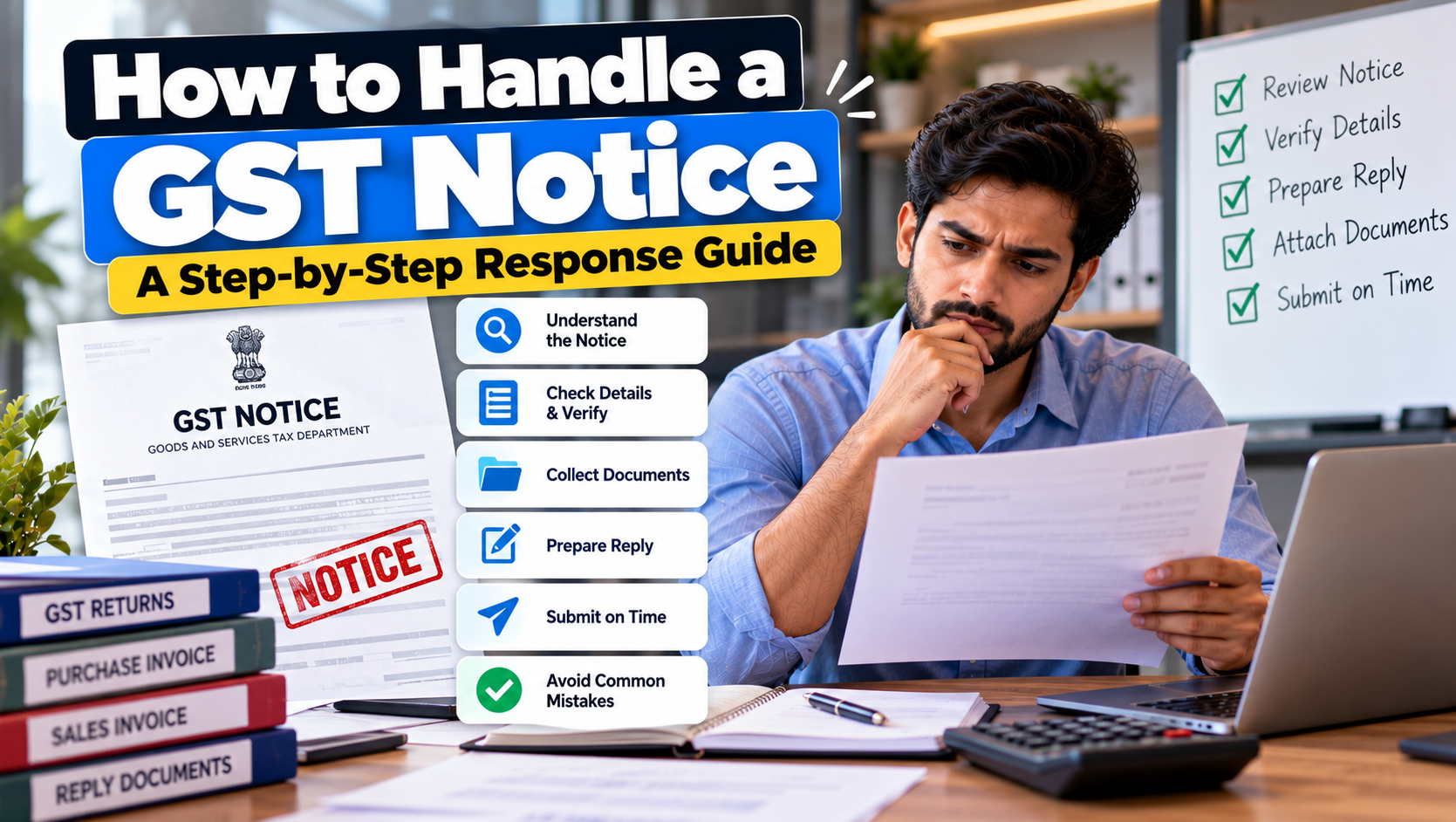
Receiving a GST notice can be stressful for any business owner. Whether you run a small shop in Kerala, manage a trading business in Kochi, operate a service company in Kozhikode or own a growing company elsewhere in India, a notice from the GST department requires careful attention.
However, receiving a GST notice does not automatically mean that your business has committed a violation or must pay the amount mentioned in it. A notice may request clarification, point out discrepancies in returns, seek additional documents or propose a tax demand.
The correct response depends on the type of notice, the issue identified and the applicable legal provisions.
Ignoring a notice or submitting an incomplete reply can lead to further proceedings, additional liabilities or other compliance problems. This guide explains how to handle a GST notice step by step, prepare a proper response and avoid common mistakes.
1. What Is a GST Notice?
A GST notice is an official communication issued by the relevant tax authority requesting information, clarification, compliance or a response to an identified issue under GST law.
The purpose of the notice varies according to the circumstances. It may relate to GST returns, tax payments, input tax credit, registration details, refunds, assessment proceedings or suspected non-compliance.
Common reasons for receiving a GST notice include:
-
Differences between GSTR-1 and GSTR-3B.
-
Mismatches between purchase records and input tax credit claimed.
-
Differences between GST returns and information available to the department.
-
Non-filing or delayed filing of GST returns.
-
Incorrect reporting of taxable supplies.
-
Questions about the eligibility of input tax credit.
-
Discrepancies in turnover or tax payments.
-
Requests for additional documents or explanations.
-
Issues relating to GST registration or refund applications.
-
Suspected short payment or non-payment of GST.
Important: Not every notice has the same purpose, response deadline or legal consequences. Read the actual notice carefully before deciding how to respond.
2. Identify the Type of GST Notice You Have Received
Before preparing your reply, determine exactly what the department is asking you to do.
Different GST forms serve different purposes. The following are some common examples.
FORM GST ASMT-10: Notice for Return Discrepancies
This notice may be issued when the department identifies discrepancies during scrutiny of GST returns.
For example, the officer may identify differences between the turnover reported in different returns or raise questions about input tax credit.
The taxpayer generally responds in FORM GST ASMT-11, explaining the discrepancy and providing supporting information. The applicable deadline should be checked in the notice and under the relevant rules.
FORM GST DRC-01A: Intimation of Potential Tax Liability
This form may communicate tax, interest or penalty amounts ascertained by the officer before the relevant show-cause notice proceedings.
The taxpayer should review the grounds and calculations carefully and determine whether a response or payment is appropriate under the applicable provisions.
Show-Cause Notice
A show-cause notice asks the taxpayer to explain why a proposed action, demand or other consequence should not follow.
It may concern tax allegedly unpaid or short-paid, an erroneous refund or input tax credit alleged to have been wrongly availed or utilised.
The notice should be examined closely because the legal grounds, amounts, period and response requirements can be significant.
FORM GST REG-03: Notice Seeking Additional Registration Information
This form may be used to request clarification or additional documents in specified GST registration or amendment proceedings.
The appropriate reply form and deadline depend on the application and the nature of the notice.
FORM GST DRC-01: Summary of a Show-Cause Notice
This form is associated with the summary of a show-cause notice in relevant demand proceedings. The accompanying notice and related documents should also be reviewed to understand the allegations and required response.
These examples are not an exhaustive list. Your notice may relate to another GST process, so identify the form number and the specific instructions before taking action.
3. Step One: Verify the Notice Is Genuine
Before sharing documents or making payments, verify that the notice is authentic.
Businesses should be cautious about fraudulent emails, messages and calls claiming to be from the GST department.
Follow these checks:
-
Log in to the official GST portal using your authorised credentials.
-
Check the notices and orders available for your registration or relevant case.
-
Compare the notice reference number, GSTIN, date and issuing authority.
-
Verify the relevant financial year or tax period.
-
Check whether the notice refers to an actual return, transaction or application.
-
Review any payment instructions through official channels.
Use the official GST portal: https://www.gst.gov.in/
Do not rely exclusively on a link received through an unsolicited message. Avoid sharing passwords, OTPs or other sensitive credentials with anyone claiming to help resolve the notice.
If you cannot locate the communication on the portal, that alone does not conclusively prove it is fake. Certain communications may follow different service procedures. Verify the notice through the appropriate official channel or a qualified professional.
4. Step Two: Read the Notice Carefully
Once you have verified the communication, read the entire notice, including its annexures and supporting documents.
Pay particular attention to the following details:
Notice reference number: Record the identification number for future communication.
Issue date: Note when the notice was issued and check when it was served or communicated.
GSTIN: Confirm that the notice relates to the correct business registration.
Tax period: Identify the month, quarter or financial year involved.
Nature of discrepancy: Understand exactly what the officer has questioned.
Amount involved: Separate the amounts stated as tax, interest and penalty, if applicable.
Legal provisions: Identify the sections, rules or other provisions cited in the notice.
Response deadline: Record the date by which the reply must be submitted.
Hearing details: Check whether a personal hearing has been scheduled or whether you need to request one.
Do not focus only on the amount mentioned in the notice. Understanding the allegation and its supporting calculations is essential to preparing a meaningful reply.
5. Step Three: Check Your GST Returns and Accounting Records
The next step is to compare the department's allegations with your actual business records.
Collect the documents relevant to the issue. Depending on the notice, these may include:
-
GSTR-1 returns.
-
GSTR-3B returns.
-
GSTR-2B statements.
-
Sales and purchase registers.
-
Tax invoices and credit notes.
-
Debit notes and other supporting documents.
-
Electronic cash ledger and credit ledger details.
-
GST payment challans.
-
Bank statements.
-
E-invoice and e-way bill records, where applicable.
-
Financial statements and trial balance.
-
Previous correspondence with the GST department.
You may not need every document listed above. Select the records that directly address the issue raised in your notice.
Example: Turnover Mismatch
Suppose the department identifies a difference between the turnover reported in GSTR-1 and GSTR-3B.
You should compare the relevant returns with your sales register, invoices, credit notes and tax-payment records.
The difference could arise from a reporting error, a timing difference, an amendment or another transaction-specific issue. Do not assume that every mismatch automatically represents unpaid tax.
Prepare a reconciliation that explains the difference and supports the explanation with appropriate evidence.
Example: Input Tax Credit Discrepancy
Suppose the department questions the input tax credit claimed in a return.
Review the relevant purchase invoices, supplier details, GSTR-2B information, purchase register and applicable ITC conditions.
Identify which transactions are disputed, whether the credit was eligible and whether any correction or further explanation is necessary.
A clear transaction-wise reconciliation is usually more useful than a general statement that the credit is correct.
6. Step Four: Determine Whether the Notice Is Correct
After reviewing your records, classify the issue into one of three broad categories.
Situation A: The Notice Appears Incorrect
If the notice is based on an incorrect assumption or incomplete information, prepare a factual explanation supported by records.
For example, the department may have overlooked a credit note, a previously reported adjustment or a payment already made.
Your reply should identify the exact discrepancy, explain why the department's calculation requires correction and attach supporting evidence.
Situation B: The Notice Is Partly Correct
Sometimes part of the discrepancy may be valid while another part is explainable.
In this situation, prepare a detailed reconciliation showing:
-
The amount questioned by the department.
-
The amount you agree is correct, if any.
-
The amount you dispute.
-
The reason for each difference.
-
Supporting documents and relevant calculations.
Avoid accepting the entire proposed liability if your records support a different result.
Situation C: The Notice Appears Correct
If your review confirms a genuine compliance error, determine the legally appropriate corrective action.
Depending on the issue and the stage of proceedings, this may involve correcting a return where permitted, making a payment, responding to the notice or taking another action under the applicable rules.
Before paying an amount, verify the tax, interest and any penalty implications. The available options and consequences can differ depending on the type of notice and the relevant legal provision.
For substantial or disputed liabilities, seek professional advice before making admissions or payments.
7. Step Five: Prepare a Clear and Evidence-Based Reply
A strong GST notice reply should address the actual allegations instead of providing a generic explanation.
Use a structured format to make your response easier to review.
Recommended Structure for a GST Notice Reply
1. Reference details
Mention the notice reference number, date, GSTIN, business name and relevant tax period.
2. Opening statement
State that the reply is being submitted in response to the specified notice.
3. Issue-wise response
Address each allegation separately and in the order presented in the notice.
4. Facts and explanation
Explain what happened, how the transaction was recorded and why the discrepancy arose.
5. Reconciliation or calculation
Where relevant, provide a table showing the department's figure, your figure and the difference.
6. Supporting documents
Attach the relevant returns, invoices, reconciliations, payment records or other evidence.
7. Request for consideration
State the action you are requesting, such as acceptance of the explanation, correction of the calculation or consideration of the supporting records.
8. Verification and submission
Complete the prescribed verification and submit the reply through the applicable process.
Example of a Reply Explanation
Suppose the notice questions a turnover difference.
A suitable response structure could be:
"The discrepancy mentioned in the notice has been reviewed against the relevant GST returns, sales register and supporting documents. The difference relates to the transactions detailed in the enclosed reconciliation statement. The statement identifies the amounts reported, the reason for the difference and the supporting records for each item. We request that the explanation and enclosed documents be considered while examining the matter."
This is only a general example. Replace it with the actual facts and evidence relevant to your notice. Do not use it to deny a discrepancy that your records do not support.
8. Step Six: Attach the Right Supporting Documents
Supporting documents help establish the factual basis of your explanation.
The documents required will depend on the issue.
| Notice issue | Potential supporting documents |
|---|---|
| Turnover mismatch | GSTR-1, GSTR-3B, sales register and reconciliation |
| ITC discrepancy | Purchase invoices, GSTR-2B, purchase register and ITC reconciliation |
| Tax payment issue | Challans, electronic ledgers and payment records |
| Registration clarification | Address proof, business documents and requested declarations |
| Refund-related query | Refund application, invoices, statements and relevant export or payment documents |
| Classification or tax-rate issue | Invoices, product or service details and relevant supporting analysis |
| Return-filing issue | Filed returns, acknowledgements and relevant filing records |
Use clear filenames and organise the documents in a logical sequence.
If a document is unavailable, do not create or alter evidence to fill the gap. Explain the situation accurately and seek advice on the appropriate response.
9. Step Seven: Submit Your Reply Through the Correct Process
The submission method depends on the type of notice and the procedure specified for that case.
For many notices available through the GST portal, taxpayers can access the relevant notice and use the associated reply functionality.
A general process is:
-
Visit the official GST portal and log in.
-
Open the relevant notices, orders or case-related section.
-
Locate the notice using the available reference details.
-
Open and read the notice and related documents.
-
Select the reply option where available.
-
Enter the response in the prescribed format.
-
Upload supporting documents in the permitted file formats and sizes.
-
Review the complete response before submission.
-
Complete the required verification and file using the permitted authentication method.
-
Save the acknowledgement and a copy of the submitted reply.
The exact menu and process may vary according to the type of proceeding.
For notices related to specific applications, the reply option may be available within that application's case details. Follow the procedure applicable to your notice rather than assuming every notice uses the same screen.
You can refer to the official GST portal's guidance on viewing notices and filing replies.
Important: Drafting a reply is not the same as filing it. Confirm that the submission has been completed successfully and retain proof of filing.
10. Step Eight: Meet the Deadline
One of the most important parts of handling a GST notice is submitting your reply within the prescribed time.
The deadline is not the same for every type of notice.
For example, a notice issued during scrutiny of returns may have a different response period from a registration-related notice or a show-cause notice.
Therefore:
-
Read the deadline stated in the notice.
-
Check the applicable GST provision and rules.
-
Allow sufficient time to gather supporting documents.
-
Do not wait until the final day to begin preparing your reply.
-
If you need more time, check whether an extension or adjournment can be requested under the applicable procedure.
-
Keep proof of any extension granted.
Where the applicable procedure permits an extension, submit a reasoned request before the deadline whenever possible. An extension should not be assumed to have been granted until it is confirmed.
If the deadline has already passed, seek prompt professional advice about the available options. The appropriate next step depends on the type of notice, the stage of proceedings and the applicable law.
11. Step Nine: Prepare for a Personal Hearing, If Required
Some GST proceedings may involve a personal hearing.
If a hearing is scheduled, prepare a concise summary of your position and organise your supporting records.
Before attending, make sure you can explain:
-
The issue raised in the notice.
-
The relevant transactions and tax periods.
-
The reason for any discrepancy.
-
The calculations supporting your position.
-
The documents submitted with your reply.
-
The specific clarification or relief requested.
Carry or retain copies of the notice, reply, attachments and submission acknowledgement.
If you need to request a personal hearing or adjournment, follow the procedure applicable to the case.
Do not assume that submitting a written reply automatically removes the need to attend a hearing when one has been properly scheduled.
12. What Happens After You Submit the Reply?
After the reply is filed, the tax authority may examine your explanation and documents.
Depending on the proceeding, possible outcomes include:
-
Acceptance of the explanation.
-
A request for further clarification or documents.
-
A further hearing.
-
Closure or dropping of the relevant proceedings, where appropriate.
-
Continuation of proceedings.
-
Issuance of an order confirming some or all of the proposed demand.
Keep checking the portal and relevant communications after submission.
If the department issues a further notice or order, read it promptly and record any new deadline.
What If You Disagree With the Final Order?
If an adverse order is issued, examine the findings, calculations and legal reasoning carefully.
Depending on the nature of the order, an appeal or another remedy may be available under GST law. The applicable forum, filing deadline, pre-deposit requirements and procedure must be checked for the specific case.
Under the general framework of Section 107 of the CGST Act, an appeal to the Appellate Authority is ordinarily required within three months from communication of the decision or order, with a limited further period potentially condonable for sufficient cause. Verify the current law and applicable procedure before relying on this general timeline.
Do not assume that you can resolve every adverse order by submitting another ordinary reply to the original notice.
13. Common Mistakes to Avoid When Responding to a GST Notice
Mistake 1: Ignoring the Notice
Ignoring a notice can result in proceedings continuing without your explanation or supporting documents being considered.
Mistake 2: Filing a Generic Reply
A vague statement that all returns are correct may not address the specific discrepancy. Respond to each allegation with facts and evidence.
Mistake 3: Submitting Incomplete Documents
Missing invoices, reconciliations or payment records can make it difficult to verify your explanation.
Mistake 4: Accepting the Proposed Demand Without Verification
Review the calculations and legal basis before accepting a liability. The amount stated in a notice may require clarification or correction.
Mistake 5: Missing the Response Deadline
Late replies can limit your options and may result in further proceedings. Start preparing as soon as you receive the notice.
Mistake 6: Making Unsupported Claims
Every factual statement should be consistent with the business records. Never submit fabricated invoices, altered records or misleading explanations.
Mistake 7: Failing to Keep Proof of Submission
Save the filed reply, uploaded documents and acknowledgement. These records may be important if the matter continues.
Mistake 8: Treating Every Notice as a Tax Demand
Some notices seek information or clarification rather than immediate payment. Understand the purpose of the communication before deciding what action to take.
14. How Professional Support Can Help
GST notice handling can require detailed accounting reconciliation, interpretation of tax provisions, document preparation and careful deadline management.
Professional support may be especially useful when:
-
The proposed tax demand is substantial.
-
The notice questions input tax credit.
-
Multiple GST returns contain discrepancies.
-
The issue relates to classification or tax treatment.
-
The notice alleges suppression, fraud or deliberate non-compliance.
-
A personal hearing is scheduled.
-
An adverse order has already been issued.
-
The matter requires an appeal or another legal remedy.
Clockwell International provides business-support services covering accounting, taxation, GST-related requirements and compliance support.
Depending on the scope of the engagement, professional assistance may help businesses review records, reconcile figures, organise documents and understand the appropriate response process.
To discuss your business requirements, visit https://clockwell.in/ or email info@clockwell.in.
GST Notice Response Checklist
Before submitting your reply, review this checklist:
-
Verify the authenticity of the notice.
-
Confirm the GSTIN and business details.
-
Identify the notice type and relevant tax period.
-
Record the response deadline.
-
Understand each allegation and the legal provisions cited.
-
Reconcile the notice with your GST returns and accounting records.
-
Verify the tax, interest and penalty calculations.
-
Prepare a point-by-point written response.
-
Attach relevant supporting documents.
-
Request a hearing or extension if appropriate and permitted.
-
Submit the reply through the correct process.
-
Save the acknowledgement and submitted documents.
-
Monitor subsequent notices, hearings and orders.
Receiving a GST notice does not automatically mean that your business is guilty of non-compliance. What matters is understanding the issue, verifying the facts and responding through the correct procedure.
The safest approach is to identify the notice type, check the deadline, review your GST returns, prepare an evidence-based reply and retain proof of submission. If the notice involves a substantial demand or a complex legal issue, obtain professional advice before making admissions or taking corrective action.
Do not ignore a GST notice or respond without checking the underlying records. A timely, accurate and well-documented response can help ensure that the department has the relevant information when considering your case.
Frequently Asked Questions About GST Notices
1. What should I do first after receiving a GST notice?
Verify the notice through the appropriate official channel, identify its purpose and deadline, and collect the relevant returns and supporting records.
2. Does receiving a GST notice mean I have to pay tax immediately?
Not necessarily. Some notices request information or clarification, while others propose a tax demand or require a specific action. Read the notice carefully to determine what is required.
3. How many days do I get to reply to a GST notice?
There is no single response period for all GST notices. The deadline depends on the notice type, the applicable provisions and the instructions in the communication.
4. Can I reply to a GST notice online?
Many GST notices can be answered through the GST portal or through the relevant application-specific process. Follow the instructions applicable to your notice.
5. What documents are needed to reply to a GST notice?
The required documents depend on the issue. They may include GST returns, invoices, purchase and sales registers, reconciliation statements, payment challans and other supporting records.
6. What happens if I fail to reply to a GST notice?
The proceedings may continue without your explanation, and further action may follow depending on the type of notice and applicable law.
7. Can I appeal if I disagree with a GST order?
An appeal or another remedy may be available, depending on the nature of the order. Check the applicable deadline, forum and procedural requirements promptly.
8. Where can I check GST notices and official guidance?
Use the official GST Portal and the CBIC GST website to access relevant services, rules and guidance.
This article is for general informational purposes only and does not constitute legal, tax or financial advice. GST notice procedures, deadlines and available remedies depend on the type of notice, the facts of the case and the law applicable to the relevant tax period. Always read the actual notice, verify current official guidance and consult a qualified GST professional or tax lawyer where necessary.
Published on October 28, 2026