
Starting a business requires more than a great idea. Entrepreneurs need capital to develop products, hire employees, acquire customers, build technology and reach the market.
For many startups, seed funding is the first major external capital raised after the founders have invested their own money. It can help a startup move from an idea or early product to a business with measurable traction.
However, raising seed funding is not simply about finding an investor and asking for money. Investors want to understand the problem you are solving, the size of the opportunity, your product, market traction, business model, team and potential return on investment.
This guide explains how to raise seed funding for your startup, including how much to raise, where to find investors, how to prepare your pitch deck, how valuation works, what investors look for and how to handle due diligence.
What Is Seed Funding?
Seed funding is early-stage capital used to help a startup develop and validate its business.
At the seed stage, a company may have:
-
A business idea
-
A prototype
-
A Minimum Viable Product (MVP)
-
Early customers
-
Initial revenue
-
Early market traction
Startup India describes seed funding as financing for startups at an early stage, often when the business is still validating its market, business model or product.
Seed funding can be used for:
-
Product development
-
Technology development
-
Hiring
-
Marketing
-
Customer acquisition
-
Market research
-
Testing and validation
-
Operations
-
Working capital
-
Regulatory or certification requirements
The objective is usually to reach the next important milestone that makes the company more investable.
Why Do Startups Raise Seed Funding?
A startup may raise seed capital because its existing resources are not enough to reach the next stage of growth.
For example, imagine a SaaS startup with:
-
A working MVP
-
50 paying customers
-
₹5 lakh annual recurring revenue
-
A small founding team
The founders may need ₹1 crore to:
-
Hire developers
-
Improve the product
-
Build a sales team
-
Acquire 500 additional customers
-
Expand into new markets
Instead of waiting until the company generates enough cash internally, the founders can raise seed capital and accelerate growth.
The key question should therefore be:
"What milestone will this funding help us achieve?"
Not simply:
"How much money can we raise?"
When Should You Raise Seed Funding?
Timing matters.
Raising money too early can result in:
-
Lower valuation
-
Higher dilution
-
Greater investor dependence
-
Difficulty proving the business model
Waiting too long can also create problems if the company runs out of cash before reaching the next milestone.
You may be ready for seed funding when you have:
-
A validated problem
-
A defined target customer
-
A working MVP or product
-
Evidence of demand
-
Early customers or users
-
A clear business model
-
A credible founding team
-
Initial traction
-
A realistic growth plan
Not every startup needs all of these.
For example, a deep-tech startup may raise capital primarily based on technology, intellectual property and technical validation, while a consumer startup may need strong customer traction.
Step 1: Validate Your Business Idea
Before approaching investors, make sure there is a real problem worth solving.
Ask:
Who has the problem?
Identify your specific customer.
How serious is the problem?
A problem that costs businesses money or time is generally more commercially important than a minor inconvenience.
How are customers solving it today?
Your competitors aren't limited to companies offering the same product.
The customer may currently be using:
-
Spreadsheets
-
Manual processes
-
Employees
-
Existing software
-
Outsourcing
-
Another product
Will customers pay?
Positive feedback is useful, but payment is stronger validation.
Step 2: Build an MVP
An MVP—Minimum Viable Product—is the simplest version of your product that can be used to test the core value proposition.
Your MVP does not need every feature.
It should answer one important question:
"Will customers actually use or pay for this solution?"
Depending on the startup, an MVP could be:
-
Software
-
Mobile application
-
Physical prototype
-
Service
-
Marketplace
-
Landing page
-
Automated workflow
-
Hardware prototype
The goal is to learn quickly before spending heavily.
Step 3: Generate Early Traction
Investors want evidence that the startup can execute.
Traction can take different forms.
Revenue Traction
Examples:
-
₹10 lakh annual revenue
-
₹2 lakh monthly recurring revenue
-
30% month-on-month growth
Customer Traction
Examples:
-
100 paying customers
-
10 enterprise customers
-
5 pilot customers
User Traction
Examples:
-
10,000 active users
-
50,000 downloads
-
30% monthly active-user growth
B2B Traction
Examples:
-
Signed contracts
-
Purchase orders
-
Letters of intent
-
Enterprise pilots
Technology Traction
For deep-tech startups:
-
Successful prototype
-
Patent
-
Clinical validation
-
Laboratory results
-
Technology partnerships
The important thing is to choose metrics that genuinely demonstrate business progress.
Step 4: Decide How Much to Raise
One of the most common mistakes founders make is choosing a funding amount without a detailed financial plan.
Instead, calculate your funding requirement based on your next milestone.
For example:
| Expense | Estimated Amount |
|---|---|
| Product development | ₹20 lakh |
| Hiring | ₹25 lakh |
| Marketing | ₹15 lakh |
| Technology infrastructure | ₹10 lakh |
| Operations | ₹10 lakh |
| Working capital | ₹10 lakh |
| Contingency | ₹10 lakh |
| Total | ₹1 crore |
You might therefore target a ₹1 crore seed round.
But the calculation should go further.
Ask:
How many months of runway will ₹1 crore provide?
If your monthly burn is ₹8 lakh:
₹1 crore ÷ ₹8 lakh ≈ 12.5 months
This gives the startup roughly 12 months of runway before considering additional capital requirements, assuming spending remains close to plan.
Step 5: Understand Startup Runway
Runway refers to how long your startup can operate before it runs out of cash.
Basic formula:
Runway = Available Cash ÷ Monthly Net Burn
For example:
Available cash = ₹60 lakh
Monthly net burn = ₹5 lakh
Runway = 12 months
Ideally, the funding round should give you enough runway to reach a meaningful milestone and create enough progress for the next fundraising round.
Step 6: Prepare Your Financial Model
Investors don't expect early-stage startups to predict the future perfectly.
They do expect founders to understand their numbers.
Your financial model should ideally include:
-
Revenue forecast
-
Cost forecast
-
Employee costs
-
Marketing expenditure
-
Gross margin
-
Operating expenses
-
Monthly cash flow
-
Burn rate
-
Runway
-
Customer acquisition cost
-
Customer lifetime value
-
Break-even analysis
For SaaS businesses, investors may also examine:
-
Monthly Recurring Revenue (MRR)
-
Annual Recurring Revenue (ARR)
-
Churn
-
Net Revenue Retention
-
Customer Acquisition Cost (CAC)
-
Lifetime Value (LTV)
For marketplaces, they may focus on:
-
GMV
-
Take rate
-
Orders
-
Active buyers
-
Active sellers
-
Contribution margin
The metrics should match your business model.
Step 7: Build a Strong Pitch Deck
Your pitch deck is often the first detailed document an investor sees.
A good seed-stage pitch deck can include:
1. Cover Slide
Company name, logo and one-line description.
2. Problem
What problem exists?
3. Solution
How does your product solve it?
4. Product
Show screenshots, product images or a simple product walkthrough.
5. Market
Explain the size and attractiveness of the opportunity.
6. Business Model
Explain how the company makes money.
7. Traction
Show your most important metrics.
8. Competition
Explain how you compare with alternatives.
9. Competitive Advantage
Explain what makes your company difficult to replicate.
10. Go-to-Market Strategy
Explain how you acquire customers.
11. Team
Highlight founder experience and relevant expertise.
12. Financials
Show revenue, growth and projections.
13. Funding Ask
Clearly state:
"We are raising ₹1 crore to achieve X, Y and Z over the next 18 months."
Step 8: Know Your Target Investor
Not every investor is suitable for every startup.
You may approach:
Angel Investors
Individual investors who invest their own capital.
Angel Networks
Groups of angel investors that evaluate startup opportunities collectively.
Seed Venture Capital Funds
Professional investment funds focused on early-stage businesses.
Corporate Investors
Large companies that invest in startups aligned with their strategic interests.
Family Offices
Private investment organisations managing capital for wealthy families.
Accelerators
Programmes that provide mentorship, ecosystem access and sometimes capital.
Government-Backed Programmes
Government programmes can provide grants, loans, incubation or funding facilitation.
Startup India provides resources including the Seed Fund Scheme, Investor Connect, mentorship and funding guidance.
Step 9: Build an Investor List
Don't send your pitch deck randomly to hundreds of investors.
Create a targeted investor database.
For each investor, record:
| Information | Example |
|---|---|
| Investor | ABC Ventures |
| Stage | Seed |
| Sector | SaaS |
| Typical Geography | India |
| Typical Ticket | ₹50L–₹2Cr |
| Portfolio | SaaS / B2B |
| Contact | Partner / Principal |
| Introduction | Founder referral |
| Status | Meeting scheduled |
Prioritise investors who:
-
Invest at your stage
-
Understand your industry
-
Invest in your geography
-
Have the required cheque size
-
Have relevant portfolio companies
-
Can provide strategic value
Step 10: Get Warm Introductions
A warm introduction can be significantly more effective than a completely cold approach.
Potential sources include:
-
Existing founders
-
Mentors
-
Startup incubators
-
Accelerators
-
Chartered accountants
-
Lawyers
-
Industry executives
-
Existing investors
-
Customers
-
University networks
-
Startup ecosystem organisations
For founders in Kerala, Kerala Startup Mission provides access to mentors, investors, incubation and acceleration programmes and funding opportunities.
Step 11: Prepare Your Investor Pitch
Your investor pitch should answer five fundamental questions:
1. What problem are you solving?
2. Why is this problem important now?
3. Why is your solution better?
4. How large can this business become?
5. Why is your team capable of building it?
Keep the explanation simple.
If an investor cannot understand your business after a short conversation, the pitch probably needs improvement.
Step 12: Understand Startup Valuation
Valuation determines how much ownership you give away for the money you raise.
Suppose:
Pre-money valuation = ₹4 crore
Investment = ₹1 crore
Then:
Post-money valuation = ₹5 crore
Investor ownership:
₹1 crore ÷ ₹5 crore = 20%
So the investor would own approximately 20%, subject to the actual investment structure and documentation.
Valuation isn't determined by a single formula.
Investors may consider:
-
Revenue
-
Growth rate
-
Market size
-
Product
-
Technology
-
IP
-
Competition
-
Team
-
Traction
-
Business model
-
Future potential
-
Comparable startups
-
Fundraising environment
Step 13: Understand Dilution
If you raise equity funding, your ownership percentage will generally decrease.
For example:
Before investment:
Founder = 100%
After selling 20%:
Founder = 80%
Investor = 20%
Future funding rounds can create additional dilution.
However, dilution is not automatically negative.
Owning a smaller percentage of a much more valuable company can be better than owning 100% of a company that cannot scale.
The goal should be:
Raise enough capital to create significant enterprise value while managing dilution responsibly.
Step 14: Consider Convertible Instruments
Seed funding doesn't always have to be structured as a straightforward equity investment at a fixed valuation.
Depending on the startup, investors may use instruments such as:
-
Convertible notes
-
Compulsorily convertible preference shares
-
Other convertible securities
-
Debt-linked instruments
The exact legal and tax implications depend on the instrument and transaction structure.
Founders should obtain professional legal and financial advice before signing investment documents.
Step 15: Prepare for Investor Due Diligence
Once an investor becomes seriously interested, the process usually becomes much more detailed.
Investors may examine:
Corporate Documents
-
Certificate of incorporation
-
MOA/AOA
-
Shareholding records
-
Board resolutions
-
Previous investment agreements
Financial Records
-
Bank statements
-
Financial statements
-
Revenue records
-
Tax filings
-
Accounts payable
-
Accounts receivable
Legal Documents
-
Customer contracts
-
Vendor agreements
-
Employment agreements
-
Intellectual-property documents
-
Litigation information
Technology
-
Source-code ownership
-
Architecture
-
Cybersecurity
-
Third-party licences
-
IP ownership
Commercial Information
-
Customer contracts
-
Sales pipeline
-
Retention
-
Churn
-
Customer concentration
Keeping your records organised before fundraising can significantly reduce delays.
Step 16: Protect Your Intellectual Property
If your startup's value depends on technology, brand or intellectual property, make sure ownership is clear.
Consider:
-
Trademark registration
-
Patent protection where appropriate
-
Copyright
-
Founder IP assignment
-
Employee IP agreements
-
Developer agreements
-
Confidentiality agreements
An investor may become uncomfortable if the company claims ownership of technology that was actually developed by an external contractor without proper IP assignment.
Step 17: Improve Your Unit Economics
Growth alone is not enough.
Investors want to understand whether growth can eventually become economically sustainable.
For example:
Customer Acquisition Cost
CAC = Total Sales & Marketing Cost ÷ New Customers
If you spend ₹5 lakh to acquire 100 customers:
CAC = ₹5,000
If the average customer generates significantly more gross profit over its lifetime, the acquisition strategy may be attractive.
But if customer acquisition costs exceed the economic value of customers, rapid growth can actually increase losses.
Step 18: Create a Data Room
A virtual data room is a structured collection of documents investors can review during due diligence.
A basic seed-stage data room can include:
Corporate
-
Incorporation documents
-
Shareholding
-
Board records
Financial
-
P&L
-
Balance sheet
-
Cash flow
-
Bank statements
-
Tax filings
Business
-
Pitch deck
-
Business plan
-
Financial model
-
Customer metrics
Legal
-
Contracts
-
IP documents
-
Employment agreements
Funding
-
Previous investment documents
-
Cap table
-
ESOP information
A clean data room makes your startup look more organised and reduces friction during the investment process.
Step 19: Negotiate More Than Just Valuation
Founders often focus exclusively on valuation.
That's a mistake.
Investment terms can include:
-
Equity percentage
-
Liquidation preference
-
Board rights
-
Voting rights
-
Anti-dilution provisions
-
Founder vesting
-
ESOP pool
-
Information rights
-
Reserved matters
-
Exit provisions
A higher valuation with unfavourable terms may sometimes be worse than a slightly lower valuation with cleaner terms.
Always review the full term sheet.
Step 20: Choose the Right Investor
Money is not the only thing an investor brings.
A strong investor may provide:
-
Industry connections
-
Customer introductions
-
Hiring support
-
Strategic advice
-
Follow-on funding
-
International connections
-
Governance experience
-
Credibility
Ask yourself:
"Can this investor help us build the company beyond the cheque?"
The right investor can become a long-term strategic partner.
Government and Institutional Routes for Seed Funding
Founders should not rely exclusively on private investors.
India has several startup-support mechanisms.
Startup India Seed Fund Scheme
The Startup India Seed Fund Scheme is designed to help eligible early-stage startups with proof of concept, prototype development, product trials, market entry and commercialisation.
The current Startup India scheme playbook states that eligible startups can receive up to ₹20 lakh as a grant for validation/prototype/product trials and up to ₹50 lakh for market entry, commercialisation or scaling through specified debt or convertible instruments, subject to the scheme's conditions. The playbook also notes that the final extended deadline for startup applications was 31 May 2026, while disbursals are ongoing.
Therefore, founders should check the official portal for the current application status rather than assuming applications are open.
Kerala Startup Mission
For Kerala-based startups, Kerala Startup Mission (KSUM) provides an ecosystem covering early-stage funding, incubation, acceleration, investor connections and market access.
KSUM's Seed Support framework is intended to help innovative technology startups with areas such as product development, testing, test marketing, mentoring, consultancy, IP-related activities and manpower.
KSUM also operates a Fund of Funds, through which KSUM invests as a Limited Partner in SEBI-registered Alternative Investment Funds that can then invest in startups based in or operating from Kerala.
How Much Seed Funding Should You Raise?
There is no universal seed-round amount.
Instead, determine:
1. Current monthly burn
How much does the company spend each month?
2. Required runway
How many months do you need?
3. Next milestone
What measurable result must you achieve?
4. Buffer
How much contingency do you need?
A simple approach is:
Funding Requirement = Monthly Burn × Required Runway + Planned Growth Investment + Contingency
For example:
Monthly burn = ₹6 lakh
Required runway = 18 months
Planned growth investment = ₹20 lakh
Contingency = ₹10 lakh
Funding requirement:
₹6 lakh × 18 = ₹1.08 crore
₹1.08 crore + ₹20 lakh + ₹10 lakh
= ₹1.38 crore
You could therefore target a round around this requirement, subject to your fundraising strategy and investor discussions.
Common Seed Funding Mistakes
1. Raising Too Much Too Early
Excessive capital can encourage unnecessary spending and create unnecessary dilution.
2. Raising Too Little
A small round that only gives you a few months of runway may force you back into fundraising before reaching meaningful milestones.
3. Focusing Only on Valuation
Terms and investor quality matter.
4. Pitching Everyone
Target investors who are genuinely relevant.
5. Hiding Problems
Experienced investors expect startups to have challenges.
Be transparent about:
-
Competition
-
Cash burn
-
Customer churn
-
Technical risks
-
Regulatory risks
6. Ignoring Accounting
Poor financial records can delay or derail due diligence.
7. No Clear Use of Funds
Investors want to know how their money will create value.
8. Unrealistic Projections
A forecast showing 50x growth without supporting assumptions can damage credibility.
9. No Cap Table Discipline
Founders should understand exactly who owns what before accepting investment.
10. Accepting the First Investor Without Evaluation
Fundraising is also a selection process.
Seed Funding Checklist
Before approaching investors, make sure you have:
☐ Validated customer problem
☐ MVP or working product
☐ Initial market traction
☐ Clear business model
☐ Revenue strategy
☐ Pitch deck
☐ Financial model
☐ Cap table
☐ Funding requirement
☐ Use-of-funds plan
☐ Investor target list
☐ Data room
☐ Corporate documents
☐ IP ownership documentation
☐ Customer contracts
☐ Tax and accounting records
☐ Clear fundraising milestones
A Simple Seed Funding Roadmap
Your fundraising journey can look like this:
IDEA
↓
Validate Problem
↓
Build MVP
↓
Get First Customers
↓
Measure Traction
↓
Build Financial Model
↓
Prepare Pitch Deck
↓
Identify Target Investors
↓
Warm Introductions
↓
Investor Meetings
↓
Term Sheet
↓
Due Diligence
↓
Legal Documentation
↓
Funding
↓
Execute Milestones
↓
Prepare for the Next Stage
The exact sequence can vary by startup and funding structure.
Final Thoughts
Raising seed funding is not simply about convincing someone to invest in your idea.
It is about demonstrating that you understand the problem, customer, market, product, business model, numbers and path to scale.
The strongest seed-stage founders usually approach fundraising with a clear plan:
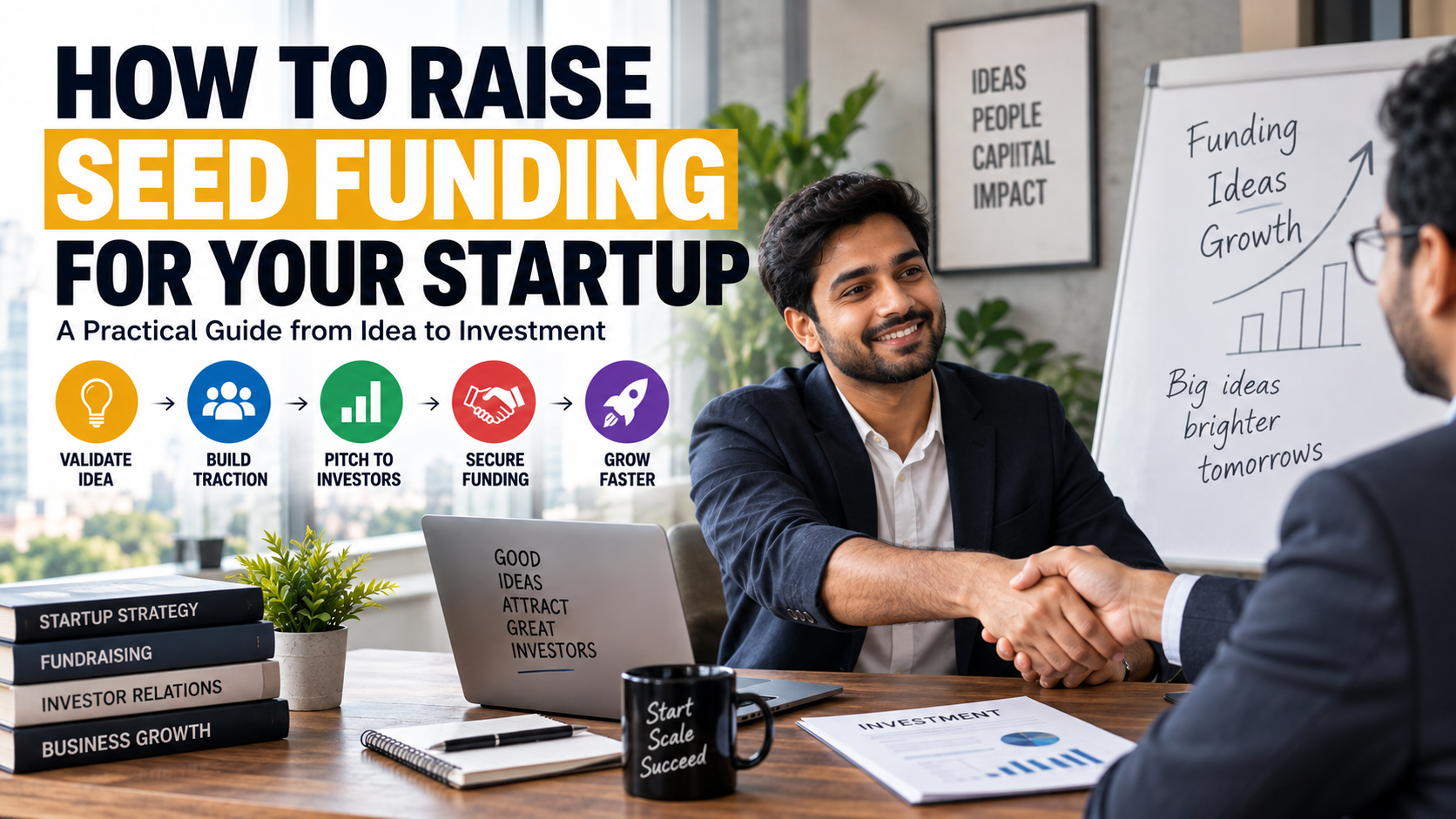
Validate → Build → Measure → Raise → Execute → Scale
Before contacting investors, make your startup investment-ready. Build a strong product, document your traction, understand your financials, organise your legal records and prepare a clear explanation of how the investment will create the next stage of growth.
For founders in Kerala, the funding ecosystem extends beyond private investors. Kerala Startup Mission provides funding, incubation, acceleration, investor connections and market-access programmes, while Startup India provides national-level resources and schemes for eligible startups.
Ultimately, the objective of seed funding is not merely to put money into your bank account.
The objective is to use capital intelligently to build a stronger, more valuable and more scalable company.
Disclaimer: Funding structures, government schemes, eligibility requirements, investment terms and application windows can change. The information in this article is for general educational purposes and should not be treated as investment, legal, tax or financial advice. Founders should consult qualified professionals and verify current requirements with the relevant government agency, investor or financial institution before proceeding.
Published on September 14, 2026