
Running a successful business involves more than generating sales and earning profits. Business owners must also understand where their money comes from, how it is used, what the company owns and how much it owes. One of the most important financial documents that provides this information is a balance sheet.
However, many small business owners find financial statements confusing. Accounting terms such as assets, liabilities, shareholders' equity and working capital can make financial reports seem complicated. The good news is that you do not need to be an accountant to understand the basics.
Learning how to read a balance sheet helps you understand your company's financial position, make better business decisions and identify potential financial problems before they become serious.
A balance sheet provides a snapshot of a company's financial condition at a particular point in time. It shows what the business owns, what it owes and the amount invested by its owners.
In this guide, we will explain how to read a balance sheet in simple language, understand its major components, identify important financial ratios and use balance sheet information to make smarter business decisions.
1. What Is a Balance Sheet?
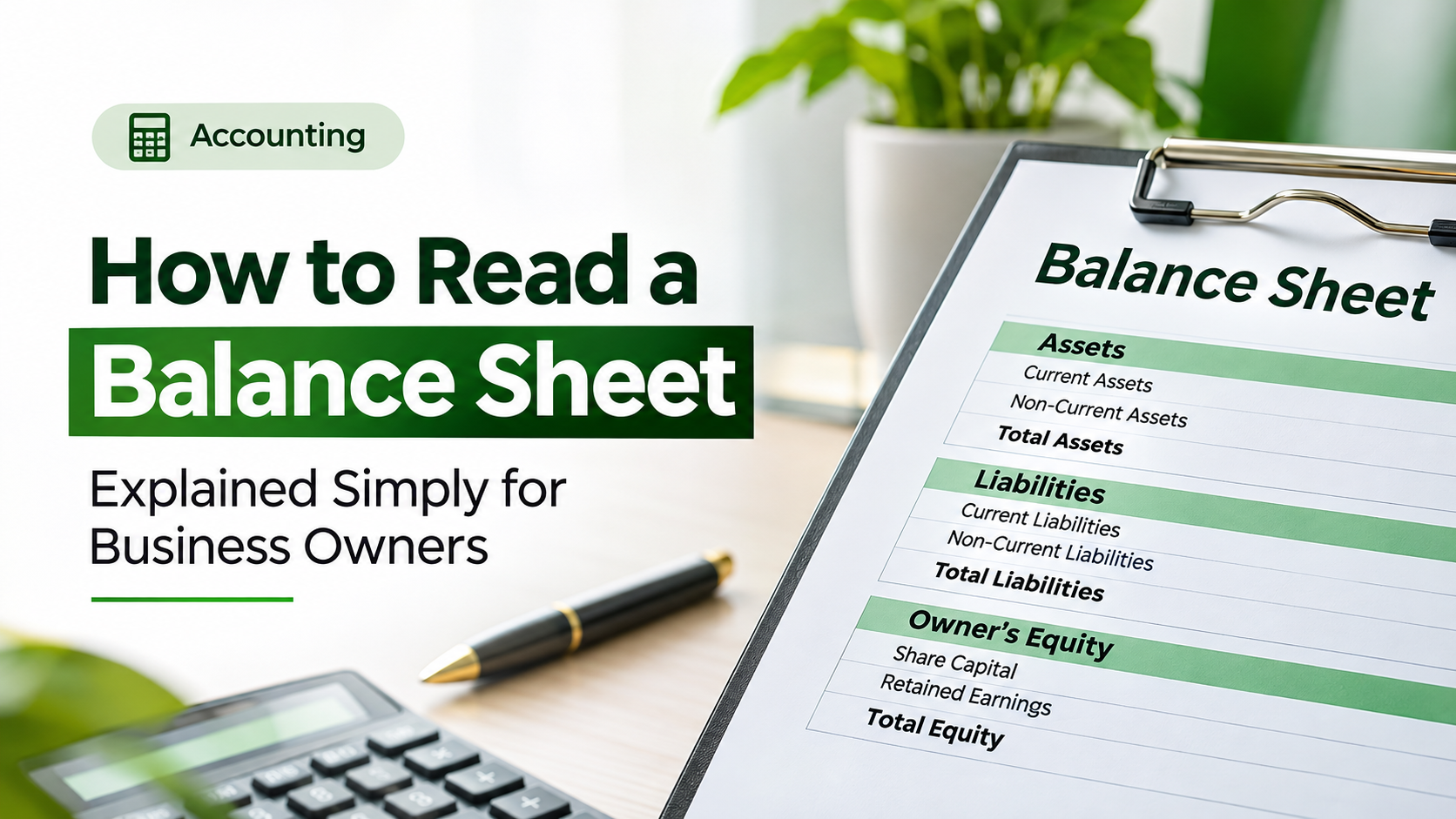
A balance sheet is a financial statement that presents the financial position of a business on a specific date. It provides information about the company's assets, liabilities and owner's equity.
Unlike an income statement, which records revenue and expenses over a period, a balance sheet shows the financial position at a particular moment.
For example, a business might prepare a balance sheet as of 31 March 2026. This report will show the company's financial position on that date.
A balance sheet helps business owners answer three important questions:
-
What does my business own?
-
How much does my business owe?
-
What is the remaining value belonging to the owners?
These three questions form the foundation of understanding how to read a balance sheet.
Why Is a Balance Sheet Important?
A balance sheet is more than an accounting document. It is an important management tool that helps businesses understand their financial stability.
Some major benefits include:
-
Understanding financial health: It helps determine whether the company has sufficient assets to meet its financial obligations.
-
Managing business debt: Business owners can identify outstanding loans and other liabilities.
-
Improving cash flow management: It provides information about cash, receivables and short-term obligations.
-
Supporting business decisions: Financial information helps owners plan investments, expansions and future expenses.
-
Building investor confidence: Investors and lenders use balance sheets to evaluate a company's financial position.
For small businesses, regularly reviewing this statement can help prevent financial difficulties and support long-term growth.
2. Understanding the Three Main Components of a Balance Sheet
To understand how to read a balance sheet, you must first understand its three main components:
-
Assets
-
Liabilities
-
Shareholders' Equity or Owner's Equity
These components are connected through a basic accounting formula.
The Balance Sheet Formula
This is known as the accounting equation.
It means that everything a business owns is financed either through borrowed money or through the owner's investment and accumulated earnings.
For example, suppose a company has total assets worth ₹20,00,000. It has outstanding liabilities of ₹8,00,000 and owner's equity of ₹12,00,000.
The calculation is:
₹20,00,000 = ₹8,00,000 + ₹12,00,000
The equation balances because total assets equal total liabilities and equity.
Understanding this formula is the first step towards reading and interpreting financial statements correctly.
3. What Are Assets in a Balance Sheet?
Assets are resources owned or controlled by a business that are expected to provide future economic benefits.
In simple terms, assets represent everything valuable that helps a business operate and generate income.
Examples include:
-
Cash in bank accounts
-
Buildings and land
-
Machinery and equipment
-
Inventory and stock
-
Office furniture
-
Vehicles
-
Accounts receivable
-
Investments
Assets are generally divided into two major categories: current assets and non-current assets.
A. Current Assets
Current assets are resources that a business expects to convert into cash, sell or consume during its normal operating cycle or within twelve months.
Common examples include:
Cash and Cash Equivalents: Money available in bank accounts and cash balances that can be used immediately for business operations.
Accounts Receivable: Money customers owe the company for products or services already provided.
Inventory: Products, raw materials and finished goods that a business holds for sale or production.
Prepaid Expenses: Payments made in advance for expenses such as insurance, rent or subscriptions.
Short-Term Investments: Investments that can generally be converted into cash within a short period.
Current assets are important because they indicate the resources available to meet everyday business requirements.
B. Non-Current Assets
Non-current assets are long-term resources that a company expects to use for more than one year.
Examples include:
Property: Land, buildings and other real estate owned by the business.
Plant and Machinery: Equipment used in manufacturing or business operations.
Furniture and Fixtures: Office desks, chairs, storage units and other workplace equipment.
Vehicles: Cars, delivery vehicles and transportation equipment used for business purposes.
Intangible Assets: Non-physical assets such as patents, trademarks, copyrights and certain software rights.
Non-current assets support the long-term operations and growth of a company.
Why Should Business Owners Monitor Assets?
Monitoring assets helps business owners understand how efficiently resources are being used.
For example, if a business has a large amount of inventory that remains unsold for several months, it may indicate poor stock management or declining customer demand.
Similarly, increasing accounts receivable could mean customers are taking longer to make payments.
By reviewing assets regularly, businesses can identify inefficiencies and improve financial management.
4. What Are Liabilities in a Balance Sheet?
Liabilities represent the financial obligations or debts that a business owes to other individuals, organisations or financial institutions.
In simple terms, liabilities are the amounts a company needs to pay in the future.
Examples include:
-
Bank loans
-
Outstanding supplier payments
-
Employee salaries payable
-
Taxes payable
-
Rent payable
-
Business credit card balances
-
Other outstanding expenses
Liabilities are divided into two main categories: current liabilities and non-current liabilities.
A. Current Liabilities
Current liabilities are financial obligations that a business expects to settle within twelve months or during its normal operating cycle.
Common examples include:
Accounts Payable: Money owed to suppliers for goods or services purchased on credit.
Short-Term Loans: Loans or borrowings that must be repaid within one year.
Outstanding Expenses: Expenses such as electricity bills, rent and salaries that have been incurred but not yet paid.
Taxes Payable: Tax amounts that the business is required to pay to the government.
Current Portion of Long-Term Debt: The portion of a long-term loan that must be repaid within the next twelve months.
Current liabilities help business owners understand their immediate financial responsibilities.
B. Non-Current Liabilities
Non-current liabilities are financial obligations that are generally payable after more than twelve months.
Examples include:
Long-Term Bank Loans: Loans taken to purchase machinery, property or expand business operations.
Debentures: Long-term debt instruments issued by companies to raise funds.
Lease Liabilities: Long-term financial obligations arising from lease agreements.
Deferred Tax Liabilities: Tax amounts expected to become payable in future periods because of temporary differences in accounting and tax treatment.
Understanding long-term liabilities helps business owners evaluate their debt commitments and financial risks.
Why Is Liability Management Important?
Having liabilities does not necessarily indicate that a business is financially unhealthy. Many successful businesses use loans and credit facilities to support expansion.
However, excessive borrowing can create financial pressure.
For example, a company with high monthly loan repayments may struggle to pay suppliers, employees and other operating expenses.
Business owners should regularly review their liabilities to understand whether the company can comfortably meet its repayment obligations.
5. What Is Shareholders' Equity?
Shareholders' equity represents the owners' residual interest in a company after deducting total liabilities from total assets.
In simple terms, it represents the value belonging to the business owners based on the balance sheet.
The formula is:
For example:
-
Total Assets: ₹30,00,000
-
Total Liabilities: ₹12,00,000
-
Shareholders' Equity: ₹18,00,000
Equity generally includes the following components:
Share Capital
Share capital represents the amount invested by shareholders in exchange for ownership shares in the company.
For example, when business owners contribute money in return for shares, that investment becomes part of the company's share capital.
Retained Earnings
Retained earnings represent the accumulated profits that a company has kept in the business rather than distributing them as dividends.
These earnings can be used for business expansion, purchasing equipment, repaying debt or supporting daily operations.
Reserves and Surplus
Reserves are amounts set aside from profits or recognised through certain accounting transactions for specific purposes or general financial strength.
The exact presentation of equity depends on the company's legal structure and applicable accounting standards.
Why Is Equity Important?
Equity helps business owners understand how much of the company's assets are financed through ownership rather than borrowed funds.
A business with healthy equity may have greater financial flexibility and a stronger foundation for future growth.
However, equity should always be evaluated alongside profitability, cash flow and debt levels.
6. Practical Example: How to Read a Balance Sheet
The easiest way to understand how to read a balance sheet is through a simple business example.
Imagine a small trading company called ABC Traders. The company prepares its balance sheet as of 31 March 2026.
Below is a simplified example.
ABC Traders – Balance Sheet
AS AT 31 MARCH 2026 · ILLUSTRATIVE FIGURES
|
Particulars |
Amount |
|---|---|
|
ASSETS |
|
|
Cash and Bank Balance |
₹3,00,000 |
|
Accounts Receivable |
₹2,00,000 |
|
Inventory |
₹5,00,000 |
|
Total Current Assets |
₹10,00,000 |
|
Property and Equipment |
₹8,00,000 |
|
Furniture and Vehicles |
₹2,00,000 |
|
Total Non-Current Assets |
₹10,00,000 |
|
Total Assets |
₹20,00,000 |
|
LIABILITIES |
|
|
Accounts Payable |
₹2,00,000 |
|
Short-Term Loans |
₹1,00,000 |
|
Total Current Liabilities |
₹3,00,000 |
|
Long-Term Bank Loan |
₹5,00,000 |
|
Total Liabilities |
₹8,00,000 |
|
SHAREHOLDERS' EQUITY |
|
|
Share Capital |
₹7,00,000 |
|
Retained Earnings |
₹5,00,000 |
|
Total Equity |
₹12,00,000 |
|
Total Liabilities and Equity |
₹20,00,000 |
What Does This Balance Sheet Tell Us?
Let's understand the financial position of ABC Traders.
1. The company owns assets worth ₹20 lakh.
This includes cash, inventory, money owed by customers, property and equipment.
2. The company has total liabilities of ₹8 lakh.
It owes ₹3 lakh in short-term obligations and ₹5 lakh in long-term loans.
3. The owners' equity is ₹12 lakh.
This represents the residual value after deducting liabilities from assets.
4. The balance sheet is balanced.
Total assets equal total liabilities and equity.
₹20,00,000 = ₹8,00,000 + ₹12,00,000
This example shows how business owners can use a balance sheet to understand their company's financial position without needing advanced accounting knowledge.
7. Important Financial Ratios to Analyse a Balance Sheet
Reading the numbers is only the first step. Business owners should also analyse the figures to understand what they mean.
Financial ratios help convert accounting information into useful insights.
Here are some important ratios to monitor.
A. Current Ratio
The current ratio measures whether a business has enough current assets to meet its short-term financial obligations.
Formula:
Using the ABC Traders example:
-
Current Assets = ₹10,00,000
-
Current Liabilities = ₹3,00,000
Current Ratio = 10,00,000 ÷ 3,00,000
This means ABC Traders has ₹3.33 in current assets for every ₹1 of current liabilities.
A ratio above 1 generally indicates that current assets exceed current liabilities. However, an unusually high ratio may also indicate inefficient use of cash or excess inventory.
B. Quick Ratio
The quick ratio measures whether a business can meet its short-term obligations using its most liquid assets.
Inventory and prepaid expenses are generally excluded.
Formula:
Using ABC Traders:
-
Current Assets = ₹10,00,000
-
Inventory = ₹5,00,000
-
Prepaid Expenses = ₹0
-
Current Liabilities = ₹3,00,000
Quick Ratio = ₹5,00,000 ÷ ₹3,00,000
This suggests that the business has ₹1.67 in quick assets for every ₹1 of current liabilities.
C. Debt-to-Equity Ratio
The debt-to-equity ratio compares a company's debt with its shareholders' equity.
Formula:
For ABC Traders:
-
Total Debt = ₹6,00,000 (short-term loans and long-term bank loans)
-
Shareholders' Equity = ₹12,00,000
Debt-to-Equity Ratio = 6,00,000 ÷ 12,00,000
This indicates that the company has ₹0.50 in interest-bearing debt for every ₹1 of equity.
The ideal ratio depends on the industry, business model and financing strategy.
D. Working Capital
Working capital measures the difference between current assets and current liabilities.
Formula:
For ABC Traders:
₹10,00,000 − ₹3,00,000 = ₹7,00,000
Positive working capital indicates that current assets exceed current liabilities.
It helps businesses manage regular expenses, supplier payments and short-term financial commitments.
E. Debt Ratio
The debt ratio measures the proportion of a company's total assets financed through liabilities.
Formula:
For ABC Traders:
₹8,00,000 ÷ ₹20,00,000 × 100
This means 40% of the company's assets are financed through liabilities.
These ratios should be compared with previous periods and industry benchmarks rather than evaluated in isolation.
8. How to Read a Balance Sheet Step by Step
Business owners do not need to analyse every accounting entry to understand their company's financial position. Following a structured approach makes the process easier.
Here are seven practical steps.
Step 1: Check the Reporting Date
Start by checking the date mentioned on the balance sheet.
A balance sheet represents the financial position of a business on a particular date. Comparing statements from different periods helps identify financial improvements or problems.
For example, compare the balance sheet as of 31 March 2025 with 31 March 2026 to understand how the business has changed.
Step 2: Review Total Assets
Look at the company's total assets and identify the major categories.
Check:
-
How much cash is available?
-
Is inventory increasing or decreasing?
-
Are customers paying their outstanding invoices?
-
Does the business own valuable equipment or property?
An increase in assets can indicate business growth, but it is important to understand whether those assets are productive and generating value.
Step 3: Examine Current Liabilities
Review the company's short-term financial obligations.
Pay attention to supplier payments, outstanding salaries, taxes and short-term loans.
If current liabilities are increasing faster than current assets, the business may experience difficulties meeting its short-term obligations.
Step 4: Understand Long-Term Debt
Check the company's long-term borrowings and repayment commitments.
Ask whether the business has borrowed too much compared with its earnings and ability to generate cash.
A manageable level of debt can support expansion, while excessive borrowing may increase financial risk.
Step 5: Review Shareholders' Equity
Examine share capital, retained earnings and reserves.
Increasing retained earnings may indicate that the business is generating profits and reinvesting them into operations.
However, equity movements should be understood alongside dividends, new investments and accumulated losses.
Step 6: Calculate Important Financial Ratios
Use ratios such as:
-
Current Ratio
-
Quick Ratio
-
Debt-to-Equity Ratio
-
Working Capital
-
Debt Ratio
These calculations help business owners understand liquidity, debt and financial stability.
Step 7: Compare Previous Balance Sheets
Never depend on a single balance sheet to evaluate the overall financial health of a company.
Compare financial statements across several periods to identify trends.
For example, if accounts receivable continue increasing every year, it may indicate delays in customer payments.
Regular comparison helps business owners make informed decisions.
9. Common Warning Signs to Look for in a Balance Sheet
A balance sheet can reveal financial problems before they become serious.
Business owners should pay attention to the following warning signs.
1. Increasing Business Debt
If liabilities increase continuously without a corresponding improvement in assets or earnings, the company may be taking on excessive financial obligations.
Review borrowing levels and repayment schedules regularly.
2. Declining Cash Balance
A declining cash balance may indicate that the company is spending more money than it receives.
This can create difficulties in paying suppliers, employees and other operating expenses.
3. Excessive Inventory
Large amounts of unsold inventory can block business funds.
Products that remain in storage for too long may become outdated, damaged or difficult to sell.
Businesses should monitor stock levels and improve inventory management.
4. Increasing Accounts Receivable
If customers take longer to pay their invoices, the company may experience cash flow problems.
Establishing clear payment terms and following up on overdue invoices can help reduce this risk.
5. Negative Working Capital
Negative working capital occurs when current liabilities exceed current assets.
This may indicate that a business is struggling to meet its short-term financial obligations.
However, some business models, such as certain retail businesses, can operate successfully with negative working capital. Industry context is important.
6. Accumulated Losses
Continuous losses can reduce retained earnings and shareholders' equity.
If losses continue for several financial periods, the company may face financial instability.
Identifying these warning signs early allows business owners to take corrective action.
10. Difference Between a Balance Sheet, Income Statement and Cash Flow Statement
Many business owners confuse these three financial statements. Although they are connected, each provides different financial information.
|
Financial Statement |
What It Shows |
|---|---|
|
Balance Sheet |
Assets, liabilities and equity at a specific date |
|
Income Statement |
Revenue, expenses and profit or loss over a period |
|
Cash Flow Statement |
Cash received and cash paid during a period |
Balance Sheet
The balance sheet helps understand the financial position of the business.
It answers the question: What does the company own and owe?
Income Statement
The income statement shows whether a company has generated a profit or incurred a loss during a particular period.
It answers the question: Is the business profitable?
Cash Flow Statement
The cash flow statement explains how money enters and leaves the business through operating, investing and financing activities.
It answers the question: Where is the company's cash coming from and where is it going?
Why Should Business Owners Understand All Three?
A company can report a profit but still experience cash shortages.
For example, a business may make substantial sales on credit. Although the sales increase reported revenue, customers may not have paid their invoices yet.
This means the business can be profitable while struggling to pay immediate expenses.
Reviewing all three financial statements provides a more complete understanding of business performance.
11. Common Mistakes Business Owners Make When Reading a Balance Sheet
Understanding financial statements is important, but interpreting them incorrectly can lead to poor business decisions.
Here are some common mistakes to avoid.
1. Looking Only at Total Assets
Having valuable assets does not automatically mean that a business is financially healthy. Owners must also examine liabilities, liquidity and debt levels.
2. Ignoring Outstanding Payments
Some business owners focus on sales and revenue while overlooking unpaid supplier invoices, taxes and loan repayments.
3. Confusing Profit with Cash
Profit and cash are not the same. A company may generate accounting profits without having sufficient cash available.
4. Not Comparing Financial Periods
Looking at only one balance sheet makes it difficult to identify long-term financial trends.
5. Ignoring Inventory Quality
High inventory values may look positive, but unsold, damaged or outdated stock can reduce the actual value of business resources.
6. Not Seeking Professional Accounting Support
Complex accounting entries, tax adjustments and financial reporting requirements should be reviewed by qualified accounting professionals.
Avoiding these mistakes helps business owners interpret financial information more accurately.
12. How Often Should Business Owners Review Their Balance Sheet?
There is no single review schedule that suits every business. However, reviewing financial statements regularly helps owners maintain better financial control.
Here is a practical approach:
-
Monthly: Review cash balances, receivables, payables, inventory and outstanding loans.
-
Quarterly: Analyse financial ratios, debt levels and changes in working capital.
-
Annually: Review the complete balance sheet alongside the income statement and cash flow statement.
For growing businesses, monthly financial reporting is particularly useful because financial conditions can change quickly.
Regular reviews also help identify accounting errors and unusual financial movements.
13. How Professional Accounting Services Help Businesses Understand Financial Statements
Preparing and interpreting a balance sheet requires accurate accounting records and proper financial reporting practices.
For many small businesses, managing accounting activities internally can become challenging as operations grow.
Professional accounting support can help businesses maintain accurate records, monitor financial performance and make informed decisions.
Some important accounting services include:
-
Bookkeeping Services: Recording daily business transactions and maintaining organised financial records.
-
Financial Statement Preparation: Preparing balance sheets, income statements and cash flow statements.
-
Financial Reporting: Providing useful reports that help management understand business performance.
-
Accounts Payable and Receivable Management: Monitoring supplier payments and customer collections.
-
Financial Analysis: Evaluating financial ratios, liquidity, profitability and business debt.
-
Tax and Compliance Support: Helping businesses maintain appropriate financial documentation and meet applicable regulatory requirements.
With proper accounting support, business owners can spend less time managing complicated financial records and more time focusing on business growth.
For businesses looking to improve their financial management, professional guidance can make a significant difference.
14. Best Practices for Maintaining an Accurate Balance Sheet
A reliable balance sheet depends on accurate and regularly updated accounting information.
Business owners can follow these practices to improve financial reporting.
-
Maintain proper records of all business transactions.
-
Reconcile bank statements regularly.
-
Track customer payments and outstanding invoices.
-
Review inventory values and stock movements.
-
Record all loans and repayment obligations correctly.
-
Monitor fixed assets and depreciation.
-
Separate personal and business transactions.
-
Review financial statements regularly with an accounting professional.
Following these practices improves financial transparency and makes it easier to evaluate the company's financial position.
Published on November 13, 2026