
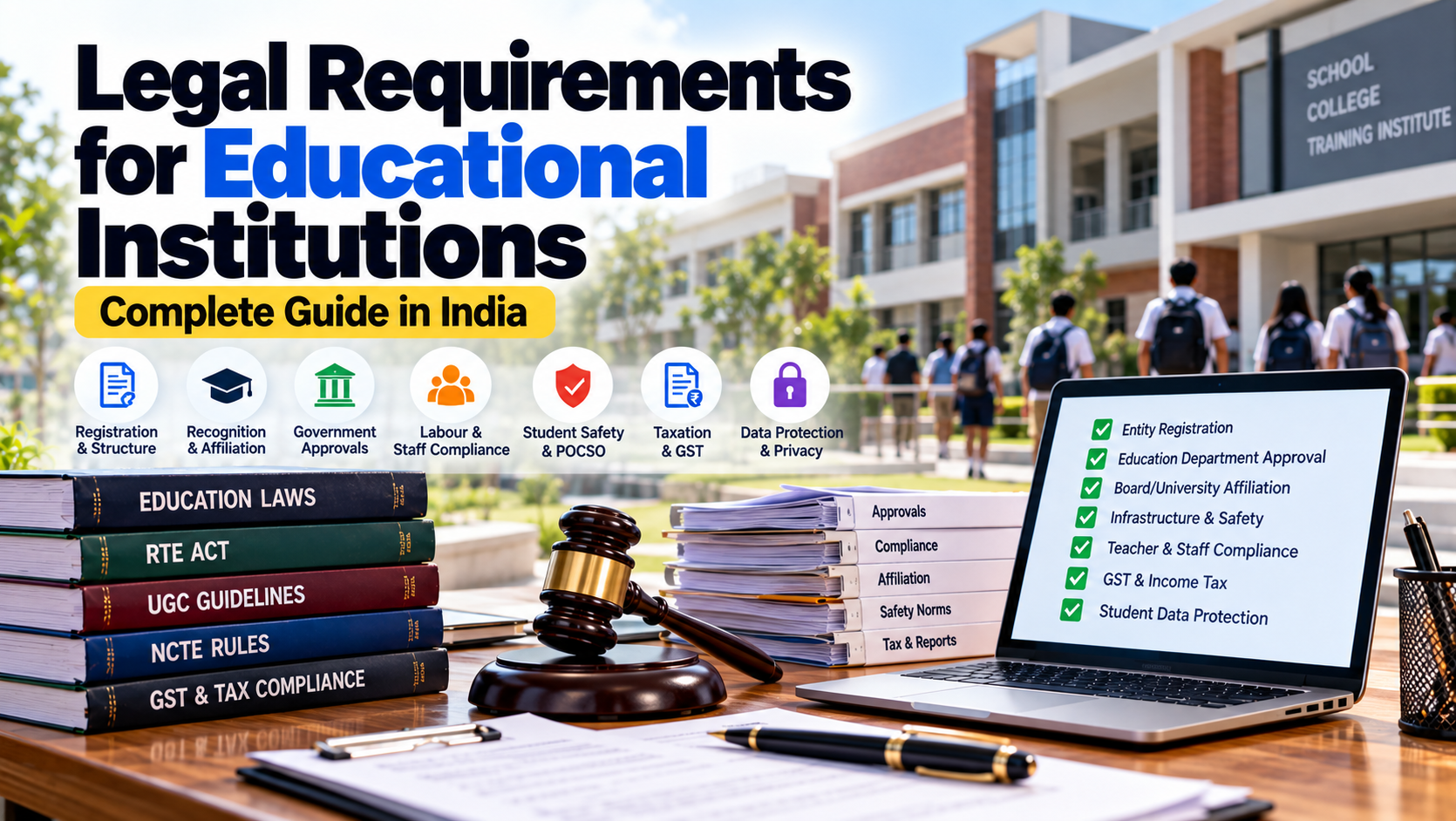
Starting and operating an educational institution in India involves much more than arranging classrooms, hiring teachers and admitting students.
Depending on the type of institution, the promoters may need to deal with entity registration, education-sector recognition, affiliation, infrastructure approvals, child-safety laws, employment compliance, taxation, GST, data protection and ongoing regulatory reporting.
The legal requirements can vary significantly between:
-
Schools
-
Colleges
-
Universities
-
Teacher-training institutions
-
Coaching centres
-
Vocational training institutes
-
Skill-development institutions
-
Preschool and play schools
-
Online education providers
-
Professional training institutes
For example, a school seeking CBSE affiliation follows a different regulatory framework from a college affiliated with a university, while a teacher-education institution requires recognition under the National Council for Teacher Education (NCTE) framework. UGC also maintains separate regulations covering recognition, affiliation, academic standards and higher-education institutions.
This guide explains the major legal requirements for educational institutions in India, with particular attention to private and self-financing institutions.
What Are the Legal Requirements for an Educational Institution?
There is no single registration called an "educational institution licence" that applies to every institution in India.
Instead, compliance is usually a combination of:
-
Legal entity registration
-
Education-sector recognition or approval
-
Affiliation or accreditation, where applicable
-
Building and safety approvals
-
Staff and labour compliance
-
Tax and accounting compliance
-
Student protection and safeguarding
-
Data protection
-
Local and State-specific permissions
-
Ongoing regulatory compliance
The exact requirements depend on what the institution teaches, who it teaches, what qualification it awards and which regulator or affiliating body governs it.
Step 1: Choose the Legal Structure
Before opening an institution, promoters need to determine the appropriate legal structure.
Common structures include:
-
Trust
-
Society
-
Section 8 company
-
Company, where legally appropriate for the particular educational activity
-
Government or statutory institution
-
University established under applicable legislation
For many formal school and higher-education models, especially institutions intended to operate on a not-for-profit basis, a trust, society or Section 8 company may be used, subject to the applicable education rules.
The appropriate structure should be determined before applying for recognition or affiliation because the education regulator may impose specific requirements on the sponsoring entity.
Trust, Society or Section 8 Company?
The choice of entity can affect:
-
Governance
-
Ownership/control
-
Funding
-
Tax treatment
-
Compliance
-
Admission policies
-
Ability to receive donations
-
Recognition/affiliation applications
-
Reporting requirements
Trust
A trust may be established under the applicable trust law and State-specific framework.
Society
A society can be formed under the applicable societies-registration framework and may be used for educational and charitable activities.
Section 8 Company
A Section 8 company is a company formed for charitable or other permitted not-for-profit objects under the Companies Act.
The right structure depends on the proposed institution and the rules of the relevant regulator.
Does an Educational Institution Need Government Recognition?
For many regulated educational activities, simply registering a business entity does not give the institution the legal authority to provide a recognised qualification.
This distinction is critical.
For example:
Company/Society/Trust Registration
does not automatically mean:
School Recognition / College Affiliation / University Recognition
The institution may need a separate approval, recognition or affiliation from the competent authority.
Legal Requirements for Schools
Schools generally need to comply with a combination of:
-
State education laws
-
Right to Education requirements, where applicable
-
Recognition requirements
-
Board affiliation requirements
-
Building and safety requirements
-
Child-protection laws
-
Teacher qualification requirements
-
Fee-related rules
-
Transport/safety requirements
-
Employment laws
-
Local authority requirements
The exact requirements depend on the State and the board.
Right to Education Act and School Recognition
The Right of Children to Free and Compulsory Education Act, 2009 (RTE Act) establishes statutory norms for elementary education and contains recognition requirements for schools covered by the Act.
Section 18 provides that a school cannot be established or recognised under the relevant framework unless it fulfils the prescribed norms and standards. Section 19 links recognition to the norms and standards specified in the Schedule.
This means that a school cannot simply begin functioning as a recognised school without meeting the applicable requirements.
Schools should therefore determine:
-
Whether the RTE Act applies
-
Which authority grants recognition
-
What infrastructure standards apply
-
Teacher requirements
-
Student-teacher requirements
-
Admission requirements
-
Records and reporting obligations
CBSE Affiliation
If a school intends to operate under the Central Board of Secondary Education (CBSE), it needs to comply with the CBSE affiliation framework.
CBSE states that its affiliation bye-laws establish parameters and standards for affiliated schools and define the framework within which affiliated schools operate.
CBSE's current SARAS system provides the affiliation application and related information, and its 2026 circulars include applications for the 2027–28 affiliation session.
A school should therefore not advertise itself as a CBSE-affiliated school before obtaining the appropriate affiliation.
Infrastructure Requirements for Schools
Educational institutions need appropriate infrastructure for the type of education being provided.
Depending on the applicable rules, this can include:
-
Classrooms
-
Laboratories
-
Library
-
Sanitation facilities
-
Drinking water
-
Playground/sports facilities
-
Accessibility facilities
-
Administrative areas
-
Fire-safety systems
-
Building safety certification
-
Electrical safety
-
Emergency exits
-
Boundary/security arrangements
CBSE requirements include safety and mandatory certificates, and CBSE has stated that schools must maintain valid fire-safety and building-safety certificates and other required documents.
Local building, fire and municipal requirements may also apply independently.
Fire Safety Compliance
Fire safety is a major requirement for educational institutions.
Depending on the building and applicable State/local rules, an institution may need:
-
Fire safety approval/NOC
-
Fire extinguishers
-
Fire alarm systems
-
Emergency exits
-
Evacuation plans
-
Emergency lighting
-
Fire drills
-
Periodic inspection/renewal
The exact approval process varies by State and local authority.
A school should maintain copies of all current safety certificates rather than treating them as one-time documents.
Building Safety
The institution's building should comply with applicable:
-
Building regulations
-
Structural safety requirements
-
Local authority rules
-
Occupancy requirements
-
Zoning/land-use requirements
-
Accessibility requirements
For affiliated schools, the relevant board may also require specific building and infrastructure documentation.
Educational institutions should never assume that a building approved for residential or commercial use is automatically suitable for an educational institution.
Accessibility Requirements
Educational institutions should also consider accessibility for students, employees and visitors with disabilities.
Depending on the applicable framework, this can include:
-
Accessible entrances
-
Ramps
-
Accessible toilets
-
Appropriate pathways
-
Lifts where required
-
Accessible classrooms/facilities
-
Reasonable accommodation
Accessibility should be considered during the building-design stage rather than added only after the institution begins operations.
Teacher Qualifications
Educational institutions cannot treat teaching positions as ordinary employment positions without considering the applicable academic requirements.
The required qualification depends on:
-
School level
-
Subject
-
Board
-
University
-
Professional programme
-
Regulatory authority
For example, teacher-education programmes are specifically regulated by NCTE.
The NCTE Act provides for recognition of institutions offering teacher-education courses and requires compliance with prescribed norms and standards, including matters such as financial resources, accommodation, library, laboratory and qualified staff.
Legal Requirements for Teacher-Training Institutions
Institutions offering programmes such as teacher education can fall under the National Council for Teacher Education (NCTE) framework.
The NCTE Act specifically provides for recognition of institutions offering teacher-education courses.
An institution intending to offer a teacher-education course must apply for recognition through the applicable NCTE process. Recognition involves satisfying prescribed conditions and norms.
Therefore, a person cannot simply establish an institute and start offering a regulated teacher-education qualification without the required recognition.
B.Ed., M.Ed. and Similar Programmes
Teacher-education programmes such as:
-
B.Ed.
-
M.Ed.
-
B.P.Ed.
-
D.El.Ed. and other recognised teacher-education programmes
can involve NCTE recognition and applicable university/examining-body requirements.
NCTE maintains a database of recognised teacher-education institutions and courses.
Before starting such a programme, promoters should verify:
-
NCTE recognition
-
University/examining-body affiliation
-
Course approval
-
Faculty qualifications
-
Infrastructure
-
Intake capacity
-
Applicable norms
Legal Requirements for Colleges
A college offering higher-education programmes normally requires an appropriate relationship with a recognised university or other competent statutory framework.
UGC maintains regulations relating to:
-
Recognition of colleges
-
Affiliation
-
Autonomous colleges
-
Academic standards
-
Faculty qualifications
-
Higher-education institutions
The UGC currently lists regulations concerning recognition and affiliation of colleges and also has newer 2025 regulations on minimum standards of instruction for undergraduate and postgraduate programmes.
University Affiliation
A private college generally cannot simply award recognised university degrees independently.
The college may need affiliation with the appropriate university and compliance with the applicable State, UGC and professional-regulator requirements.
The exact process depends on:
-
State
-
University
-
Course
-
Professional regulator
-
Type of institution
-
Funding model
For example, professional courses can also fall under regulators such as:
-
NCTE
-
AICTE
-
NMC
-
PCI
-
BCI
-
INC
-
Other statutory/professional bodies
Who Can Award a Degree in India?
This is an extremely important legal issue.
UGC explains that the authority to confer degrees under Section 22 of the UGC Act is limited to institutions falling within the statutory categories specified by law, including universities established by Central or State legislation, deemed universities and institutions specially empowered by Parliament.
Therefore, a private training centre should not advertise an ordinary course as a "degree" unless it has the legal authority to award that degree.
A training institute can provide certificates or other permitted awards, but it should not misrepresent them as recognised university degrees.
Certificate Courses vs Recognised Degrees
There is a major difference between:
Certificate of Course Completion
and
Recognised Degree
For example:
"Certificate in Digital Marketing"
may be an institute-issued certificate.
But:
"Bachelor's Degree in Digital Marketing"
has a very different legal and academic meaning.
Institutions should clearly state:
-
Who issues the certificate
-
Whether it is recognised
-
Whether it is affiliated
-
Duration
-
Curriculum
-
Accreditation, if any
-
Whether it leads to a regulated qualification
Transparent advertising can help avoid student disputes and regulatory issues.
Private Coaching and Training Institutes
Not every educational business is a school or college.
A private institute may provide:
-
Coaching
-
Professional training
-
Computer courses
-
Accounting courses
-
Spoken English
-
Skill development
-
Design training
-
Digital marketing
-
Vocational training
-
Entrance-exam coaching
The legal requirements for these institutions can be substantially different from those of a recognised school or college.
The institution should determine whether the specific course is regulated by a statutory authority before advertising a formal qualification.
GST and Educational Institutions
GST treatment is another important area.
Not every service provided by an institution is automatically exempt merely because the institution calls itself an "educational institution."
Under Notification No. 12/2017-Central Tax (Rate), specified services provided by an educational institution to its students, faculty and staff are exempt, subject to the definition and conditions in the notification.
CBIC has clarified that educational services supplied by qualifying educational institutions to their students are covered by the exemption under Entry 66.
The definition of "educational institution" in that notification includes:
-
Preschool education and education up to higher secondary school or equivalent
-
Education as part of a curriculum for obtaining a qualification recognised by law
-
Education as part of an approved vocational education course
Are All Coaching Classes GST Exempt?
No.
This is an important distinction.
A private coaching centre does not automatically qualify as an "educational institution" merely because it provides education.
The GST treatment depends on the nature of the institution and the services supplied.
Therefore, before claiming GST exemption, an institute should determine:
-
Whether it fits the notification's definition
-
Whether the course is part of a recognised curriculum
-
Whether it is an approved vocational course
-
Nature of the service
-
Applicable GST notification
GST on Other Services Provided by Educational Institutions
An institution may provide several services apart from tuition.
Examples include:
-
Hostel
-
Canteen
-
Transport
-
Cafeteria
-
Event space
-
Consultancy
-
Training for external organisations
-
Renting facilities
-
Advertising
-
Sale of books or merchandise
Each service may have a different GST treatment.
CBIC has specifically clarified that certain services provided by an educational institution to its students, faculty and staff are covered by the exemption, while services supplied to an educational institution by outside providers can have separate treatment.
Therefore, the accounting system should not automatically classify every institutional revenue stream as GST-exempt.
Income Tax and Educational Institutions
Tax treatment depends heavily on the legal structure and purpose of the institution.
Potential structures include:
-
Trust
-
Society
-
Section 8 company
-
Private company
-
Partnership/proprietorship for non-regulated training businesses
Institutions operating for charitable or educational purposes may need to evaluate eligibility for applicable income-tax exemptions and registrations.
Depending on the structure and circumstances, this can involve:
-
PAN
-
Income-tax return
-
Books of account
-
Audit
-
Applicable charitable-tax registrations
-
TDS compliance
-
Donor records
-
Financial statements
An educational institution should not assume that being a school or college automatically makes all of its income tax-exempt.
Section 12AB Registration
Eligible charitable or educational institutions may consider registration under Section 12AB of the Income-tax framework where the relevant conditions are satisfied.
The registration framework is particularly relevant for entities operating for charitable or educational purposes.
The institution should maintain:
-
Governing documents
-
Objects clause
-
Financial statements
-
Donation records
-
Application/registration records
-
Activity reports
-
Supporting evidence for educational activities
The exact tax treatment depends on the entity and applicable provisions.
80G Registration
Where eligible, an institution may also consider approval under Section 80G for donor-related tax benefits.
This is particularly relevant where the institution is funded through eligible donations.
However, 80G approval and 12AB registration are separate concepts and should not be confused.
The institution must satisfy the applicable conditions and maintain appropriate records.
TDS Compliance
Educational institutions may make many payments that can attract TDS.
Examples include:
-
Salaries
-
Professional fees
-
Contractor payments
-
Rent
-
Consultancy
-
Certain other payments
The institution should identify applicable TDS obligations before making payments.
The accounts department should maintain:
-
Vendor PAN
-
TDS section
-
TDS rate
-
Threshold
-
Deduction date
-
Deposit records
-
TDS returns
-
Certificates
For institutions with many vendors and employees, automated TDS accounting can significantly reduce errors.
Employee and Labour Compliance
Educational institutions are employers and therefore need to consider applicable labour laws.
Depending on the institution and workforce, this can include:
-
Employment contracts
-
Minimum-wage requirements where applicable
-
Payroll records
-
Leave policies
-
Working-hour requirements
-
EPF
-
ESI
-
Gratuity
-
Maternity-related requirements
-
Professional tax
-
State Shops and Establishments requirements, where applicable
-
Contract-labour compliance
The exact applicability depends on the institution, State and employee category.
EPF and Educational Institutions
EPF can become relevant once an establishment falls within the applicable coverage criteria.
EPFO states that covered establishments generally include establishments employing 20 or more persons, subject to the statutory conditions.
Because educational institutions may employ:
-
Teachers
-
Administrative staff
-
Security staff
-
Drivers
-
Housekeeping
-
Support staff
-
Technical staff
management should regularly review the applicability of employee-related social-security laws.
POSH Compliance in Educational Institutions
The Sexual Harassment of Women at Workplace (Prevention, Prohibition and Redressal) Act, 2013 applies to workplaces, and the statutory definition of workplace expressly includes private-sector organisations and institutions carrying on educational activities.
The Act provides for an Internal Committee framework for workplace sexual-harassment complaints.
Educational institutions should therefore establish appropriate mechanisms for:
-
Prevention
-
Awareness
-
Complaint handling
-
Internal Committee procedures
-
Employee training
-
Documentation
-
Confidentiality
-
Annual reporting where applicable
This is relevant to schools, colleges, training institutions and other educational workplaces depending on the circumstances.
POCSO Compliance and Child Protection
Institutions working with children have particularly important safeguarding responsibilities.
The Protection of Children from Sexual Offences (POCSO) Act, 2012 establishes offences and procedures relating to sexual offences against children. India Code lists offences including penetrative sexual assault, sexual assault, sexual harassment and offences involving child pornography.
The POCSO framework also contains mandatory-reporting requirements. Official POCSO guidance explains that persons having knowledge of child sexual abuse can be subject to mandatory reporting obligations under Section 19/21.
Educational institutions should therefore have a documented child-protection system covering:
-
Staff background verification
-
Child-safety policies
-
Complaint/reporting mechanisms
-
Staff awareness
-
Visitor controls
-
Transport safety
-
CCTV and security practices where appropriate
-
Emergency contacts
-
Reporting procedures
-
Confidential handling of sensitive information
School Safety and Security
The Ministry of Education has developed national guidelines concerning school safety and security.
The guidelines address the responsibility of school management, principals and teachers in creating safe conditions for children and cover areas such as protection from abuse, violence, accidents, health hazards and disasters.
NCPCR also currently publishes school-safety resources, including its Manual on Safety and Security of Children in Schools and guidelines for private play schools.
Institutions should therefore maintain a practical safety system rather than treating safety as only a paperwork requirement.
Student Data Protection
Modern educational institutions collect significant amounts of personal data.
Examples include:
-
Student names
-
Date of birth
-
Address
-
Parent information
-
Phone numbers
-
Academic records
-
Attendance
-
Medical information
-
Identification documents
-
Photographs
-
Video recordings
-
Payment information
-
Online-learning data
The Digital Personal Data Protection Act, 2023 contains specific provisions for processing children's personal data. The Act requires verifiable parental consent before processing a child's personal data, subject to the statutory framework, and restricts tracking/behavioural monitoring and targeted advertising directed at children, subject to the Act's exceptions.
The Digital Personal Data Protection Rules, 2025 were notified on 13 November 2025 and provide a phased commencement framework.
Educational institutions should therefore begin reviewing:
-
Privacy notices
-
Consent mechanisms
-
Student-data collection
-
Data retention
-
Vendor/data-processor contracts
-
Access controls
-
Data-security measures
-
Parent/guardian consent processes
-
Data breach procedures
Online Classes and Data Protection
Online education creates additional data-protection considerations.
An institution may use:
-
Zoom/Teams-type platforms
-
Learning-management systems
-
Student portals
-
Cloud storage
-
Online examination software
-
Attendance software
-
Payment gateways
-
Parent communication apps
Before adopting such platforms, institutions should understand:
-
What information is collected
-
Why it is collected
-
Where it is stored
-
Who can access it
-
Whether third parties process it
-
How long it is retained
-
How data can be deleted
Student Admission Documents
An institution should maintain a clear admission process.
Depending on the type of institution, records can include:
-
Application form
-
Identity information
-
Previous academic records
-
Transfer certificate
-
Birth certificate
-
Address information
-
Parent/guardian details
-
Medical information where legitimately required
-
Consent forms
-
Fee records
Institutions should avoid collecting unnecessary personal information.
Fee Collection and Fee Policies
Educational institutions should have a transparent fee structure.
The institution should clearly document:
-
Tuition fee
-
Admission fee
-
Examination fee
-
Transport fee
-
Hostel fee
-
Lab fee
-
Activity fee
-
Refund policy
-
Late-payment charges
-
Scholarship/discount policy
Schools affiliated with CBSE are subject to specific fee-related requirements in the affiliation framework; CBSE's affiliation documentation states that schools must disclose fee details before the start of the session and should not impose hidden charges under fee heads.
State-specific fee regulations can also apply.
Advertising and Marketing Compliance
Educational institutions should be careful about claims in advertisements.
Avoid unsupported claims such as:
-
"100% placement guaranteed"
-
"Government approved" when no such approval exists
-
"UGC approved degree" without the relevant authority
-
"University certificate" without actual affiliation
-
"Internationally recognised" without evidence
-
"No. 1 college" without substantiation
-
Guaranteed salary claims
Marketing materials should clearly distinguish between:
Institute certificate
and
Recognised qualification
This is particularly important for private training centres.
Franchise and Franchisee Education Models
Some educational brands operate through franchise models.
Before starting a franchise centre, both parties should clearly define:
-
Brand ownership
-
Curriculum
-
Certificate issuance
-
Student database
-
Fee collection
-
Faculty requirements
-
Quality control
-
Marketing rights
-
Territory
-
Refund responsibilities
-
Data-processing responsibilities
-
Termination
If the franchisor is offering a recognised qualification, the franchise arrangement must also comply with the relevant regulatory framework.
A franchise agreement alone does not create statutory recognition.
Foreign Collaboration and International Courses
Institutions offering international programmes may need to consider additional requirements.
This can involve:
-
Foreign university collaboration
-
Twinning programmes
-
Joint degrees
-
Foreign qualifications
-
Student exchange
-
Cross-border data transfers
-
Foreign funding
-
FCRA, where applicable
UGC has regulations and frameworks concerning academic collaboration and foreign educational institutions.
An institution should therefore obtain specialist advice before advertising a foreign degree or international academic partnership.
FCRA and Foreign Donations
If an educational institution receives foreign contributions, the Foreign Contribution (Regulation) Act (FCRA) may become relevant.
An institution should not assume that ordinary charitable or educational registration automatically permits it to receive foreign donations.
Where foreign contributions are contemplated, the institution should separately assess:
-
FCRA eligibility
-
Registration/prior permission
-
Designated bank account requirements
-
Utilisation rules
-
Reporting
-
Record keeping
This is a separate compliance area from ordinary educational recognition.
Accounting Requirements
A professionally managed educational institution should maintain proper accounting records.
Accounts should separately track:
Revenue
-
Tuition fees
-
Admission fees
-
Examination fees
-
Hostel fees
-
Transport fees
-
Training income
-
Donations, where applicable
-
Grants
-
Other income
Expenses
-
Salaries
-
Rent
-
Electricity
-
Internet
-
Teaching materials
-
Repairs
-
Software
-
Marketing
-
Security
-
Transport
-
Professional fees
-
Maintenance
Fee Reconciliation
One of the most important accounting controls is reconciliation between:
Student Management System
↓
Fee Collection
↓
Bank Account
↓
Accounting Software
↓
Financial Statements
The accounts team should identify:
-
Unpaid fees
-
Duplicate payments
-
Refunds
-
Scholarships
-
Discounts
-
Outstanding balances
-
Bank charges
This helps prevent revenue leakage.
GST and Fee Accounting
Where an institution has both GST-exempt and taxable services, the accounting system should separately classify revenue.
For example:
Educational service covered by exemption
versus
Commercial service that does not qualify for the exemption
This distinction can also affect input-tax-credit treatment.
The institution should therefore avoid applying a blanket "GST exempt" tag to every transaction.
Annual Compliance
Educational institutions should maintain an annual compliance calendar.
Corporate/Entity Compliance
-
Annual returns
-
Financial statements
-
Board/trust/society meetings
-
Statutory records
-
Auditor requirements
Tax Compliance
-
Income-tax return
-
GST returns, where applicable
-
TDS returns
-
Tax audit, where applicable
Education Compliance
-
Recognition renewal
-
Affiliation renewal
-
Accreditation
-
Student data reporting
-
Faculty information
-
Examination requirements
Safety Compliance
-
Fire certificate
-
Building certificate
-
Electrical safety
-
Transport safety
-
Emergency preparedness
Employee Compliance
-
Payroll
-
EPF
-
ESI
-
Professional tax
-
Leave records
-
POSH compliance
Common Legal Mistakes Educational Institutions Make
1. Starting Classes Before Approval
An institution may register its entity but still lack the recognition or affiliation required for the particular programme.
2. Calling an Institute "University"
The word "university" has specific legal implications.
An ordinary private institute should not represent itself as a university without the statutory authority to do so.
3. Advertising Unrecognised Degrees
A certificate course should not be marketed as a recognised degree without the required legal authority.
4. Ignoring State Rules
Education is regulated through a combination of central and State frameworks.
Requirements can differ significantly between States.
5. Treating All Education Revenue as GST Exempt
Only services meeting the applicable GST exemption conditions should be treated as exempt.
6. Poor Child-Safety Systems
Schools and child-focused institutions need practical safeguarding systems, not just written policies.
7. Ignoring POSH
Educational institutions are workplaces and can fall within the POSH Act.
8. Collecting Excessive Student Data
Institutions should review what student and parent data they collect and why.
9. Allowing Expired Safety Certificates
Fire and building-safety certificates should be monitored and renewed before expiry.
10. Mixing Personal and Institutional Funds
Management should maintain proper separation between personal finances and institution finances.
Legal Compliance Checklist for Educational Institutions
Entity
-
Choose appropriate legal structure
-
Register trust/society/company as applicable
-
Obtain PAN
-
Open institutional bank account
-
Define governing documents
Education Approval
-
Identify competent regulator
-
Obtain school recognition where required
-
Obtain board affiliation where required
-
Obtain university affiliation where required
-
Obtain NCTE recognition for applicable teacher-education programmes
-
Obtain professional-body approval where required
Infrastructure
-
Land/building documents
-
Building approval
-
Occupancy/use approval where applicable
-
Fire safety
-
Electrical safety
-
Water/sanitation
-
Accessibility
-
Emergency systems
Student Protection
-
Child-safety policy
-
POCSO compliance
-
Staff verification
-
Complaint mechanism
-
Emergency procedures
-
Transport safety
-
Student safeguarding
Employees
-
Employment agreements
-
Payroll system
-
EPF where applicable
-
ESI where applicable
-
Professional tax where applicable
-
POSH compliance
-
Leave and attendance records
Tax
-
PAN
-
TAN
-
Income-tax compliance
-
GST assessment
-
TDS
-
Audit where applicable
-
Donation records where applicable
Data Protection
-
Privacy notice
-
Student-data policy
-
Parent consent where required
-
Data retention policy
-
Vendor/data-processor controls
-
Access controls
-
Security measures
Special Requirements by Institution Type
| Institution | Major Regulatory Areas |
|---|---|
| School | State recognition, RTE where applicable, Board affiliation, safety, child protection |
| CBSE School | CBSE affiliation + State/local requirements + safety |
| College | University affiliation, UGC framework, State requirements |
| University | Statutory establishment/recognition + UGC framework |
| B.Ed./Teacher Education | NCTE recognition + affiliating/examining body |
| Coaching Centre | Local business rules, tax, labour, consumer/advertising and course-specific requirements |
| Vocational Institute | Course-specific approval/recognition where applicable |
| Preschool/Play School | State/local requirements and child-safety framework |
| Online Institute | Education-specific rules + tax + data protection + advertising/consumer requirements |
This table is only a high-level guide. The actual regulatory requirements should be checked against the institution's exact activities.
How to Start an Educational Institution Legally
A practical sequence is:
Step 1: Define the Institution
Decide:
-
School?
-
College?
-
Training institute?
-
Coaching centre?
-
Teacher-training institution?
-
Skill centre?
Step 2: Identify the Regulator
Determine whether the institution is governed by:
-
State Education Department
-
CBSE
-
UGC
-
NCTE
-
AICTE
-
A university
-
Professional council
-
Skill-development authority
-
Local authority
Step 3: Choose the Legal Entity
Select:
Trust / Society / Section 8 Company / Other permitted structure
Step 4: Secure Premises
Verify:
-
Land title/lease
-
Building use
-
Local approvals
-
Infrastructure
-
Safety
Step 5: Obtain Recognition/Approval
Do not begin regulated programmes before obtaining the required approval.
Step 6: Hire Qualified Staff
Verify qualifications and maintain appointment records.
Step 7: Set Up Accounting
Implement:
-
Fee management
-
Payroll
-
GST
-
TDS
-
Bank reconciliation
-
Financial reporting
Step 8: Establish Student-Safety Policies
Implement:
-
Child protection
-
POCSO procedures
-
POSH
-
Emergency response
-
Data protection
Step 9: Begin Admissions
Admissions and marketing should accurately describe the institution's approval and affiliation status.
Step 10: Maintain Ongoing Compliance
Recognition is not the end of the process.
The institution needs continuous compliance.
Frequently Asked Questions
Can I start a school after registering a company?
Company/entity registration alone does not automatically authorise a school to operate as a recognised school. Applicable State recognition, board affiliation and other approvals must be considered.
Can a private institute issue a degree?
Not simply because it is a registered company or institute. Degree-awarding authority is governed by law, including Section 22 of the UGC Act.
Is GST applicable to educational institutions?
Certain educational services provided by qualifying educational institutions are exempt under GST. However, the exemption depends on the definition and conditions in the relevant notification.
Is GST applicable to coaching centres?
It depends on the nature of the institution and service. A private coaching centre should not automatically assume that its fees are covered by the educational-institution exemption.
Is CBSE affiliation mandatory for every school?
No. CBSE is one school board. Schools may operate under other recognised boards or State systems depending on the applicable framework.
Is NCTE approval required for every educational institution?
No. NCTE specifically regulates teacher education. Institutions offering teacher-education courses need to assess NCTE recognition requirements.
Do educational institutions need POSH compliance?
Educational institutions can fall within the workplace definition under the POSH Act, which expressly includes educational institutions. Applicable institutions should establish the required complaint mechanism.
Do schools need a child-protection policy?
Schools and other institutions working with children should have appropriate child-safety and safeguarding systems. National school-safety guidance and NCPCR resources address safety and security of children in schools.
Do educational institutions need data-protection measures?
Yes. Institutions process substantial amounts of student, parent and employee information. The DPDP framework contains specific provisions relating to children's personal data, including parental consent requirements, subject to the statutory framework and implementation timeline.
Can an educational institution operate without affiliation?
That depends on the type of institution and the programme. A private training centre offering its own certificate is different from a college claiming to offer a university degree. The required recognition/affiliation should be determined before launching the programme.
Final Thoughts
The legal requirements for an educational institution depend heavily on what the institution teaches, which students it serves, what qualification it offers and which regulator governs it.
A school, college, B.Ed. institution, coaching centre and university do not follow the same compliance framework.
The key areas to evaluate are:
Legal Entity
↓
Education Recognition
↓
Affiliation / Accreditation
↓
Infrastructure & Safety
↓
Teacher & Staff Compliance
↓
Student Protection
↓
GST & Income Tax
↓
Data Protection
↓
Ongoing Regulatory Compliance
The most important principle is simple:
Registering an organisation is not the same as obtaining permission to provide a regulated educational qualification.
Before starting an institution, promoters should identify every approval required for the specific course and student category. This is particularly important for institutions that advertise recognised degrees, diplomas, professional qualifications or board affiliations.
For schools and child-focused institutions, legal compliance should also extend beyond education recognition to child safety, POCSO, infrastructure safety, staff screening and data protection.
For higher-education institutions, the focus expands to UGC requirements, university affiliation, academic standards, professional regulators and qualification-awarding authority.
A properly designed compliance system helps an institution protect its students, employees and management while building a credible and sustainable education business.
Published on September 30, 2026