
Filing income tax returns can be a challenging task for small business owners, freelancers, professionals, and transport operators. Maintaining detailed books of accounts, calculating profits, and getting accounts audited can consume valuable time and resources.
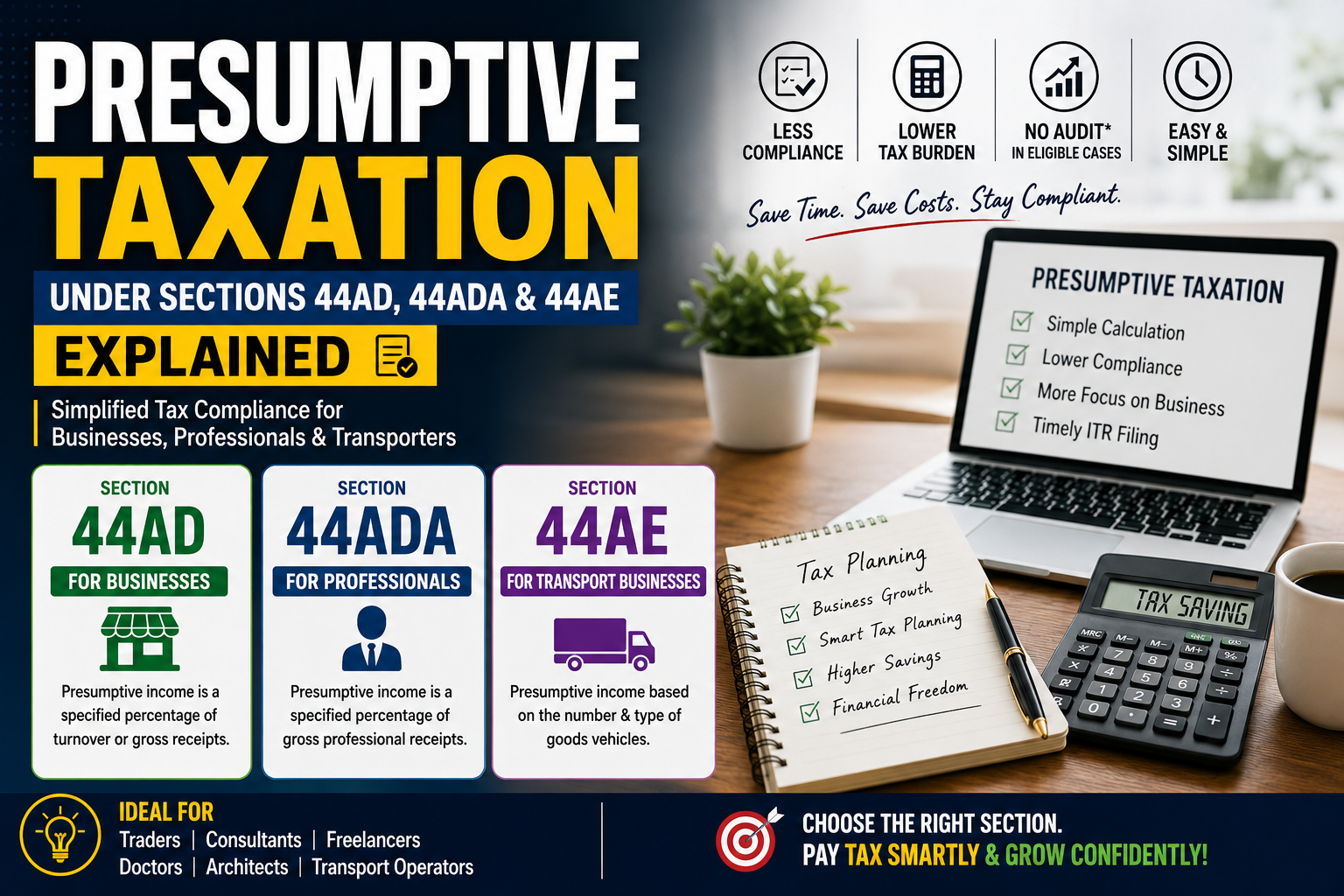
To simplify tax compliance, the Income Tax Act provides a Presumptive Taxation Scheme under Sections 44AD, 44ADA, and 44AE. These provisions allow eligible taxpayers to declare income at a prescribed rate without maintaining detailed books of accounts or undergoing tax audits in many cases.
If you're a trader, consultant, doctor, architect, software professional, freelancer, or transport business owner, understanding presumptive taxation can help reduce compliance burdens while ensuring legal compliance.
In this guide, we'll explain how Sections 44AD, 44ADA, and 44AE work, who is eligible, their benefits, limitations, and how to choose the right scheme.
What is Presumptive Taxation?
Presumptive Taxation is a simplified method of calculating taxable income where the Income Tax Department presumes a certain percentage of turnover or receipts as profit.
Instead of maintaining detailed books of accounts and calculating actual profits, eligible taxpayers declare income according to the applicable presumptive provisions.
The objectives are to:
- Simplify tax compliance
- Reduce paperwork
- Lower compliance costs
- Encourage voluntary tax compliance
- Minimize audit requirements
Why Was the Presumptive Taxation Scheme Introduced?
Many small businesses and professionals struggle with:
- Maintaining books of accounts
- Preparing financial statements
- Hiring accountants
- Tax audit expenses
- Complex tax calculations
The presumptive taxation scheme reduces these compliance requirements while allowing taxpayers to file returns more easily.
Types of Presumptive Taxation
The Income Tax Act provides three major presumptive taxation provisions:
- Section 44AD – Small Businesses
- Section 44ADA – Professionals
- Section 44AE – Goods Carriage (Transport) Businesses
Each section has different eligibility conditions and methods of calculating taxable income.
Section 44AD – Presumptive Taxation for Small Businesses
Section 44AD is designed for eligible small businesses.
It allows taxpayers to declare income as a prescribed percentage of turnover instead of calculating actual profits.
Who Can Opt for Section 44AD?
Generally, Section 44AD is available to eligible resident taxpayers carrying on qualifying businesses, subject to the conditions prescribed under the Income Tax Act.
It is commonly used by:
- Retail shops
- Wholesale traders
- Manufacturers
- General trading businesses
- Small service providers (where eligible)
How Income is Calculated Under Section 44AD
Under this scheme:
- A prescribed percentage of eligible turnover or gross receipts is treated as taxable income.
- Digital receipts may qualify for a lower presumptive percentage compared to cash receipts, subject to prevailing tax provisions.
If actual profits are higher, the taxpayer may voluntarily declare the higher income.
Benefits of Section 44AD
- Simplified tax calculation
- Reduced paperwork
- Lower accounting costs
- No detailed profit calculation
- Relief from tax audit in many eligible cases
- Faster income tax filing
Section 44ADA – Presumptive Taxation for Professionals
Section 44ADA specifically benefits specified professionals.
Many freelancers and independent professionals prefer this scheme because it significantly simplifies tax compliance.
Eligible Professionals
Section 44ADA generally applies to specified professions notified under the Income Tax Act, including professions such as:
- Doctors
- Chartered Accountants
- Architects
- Engineers
- Interior Designers
- Lawyers
- Consultants
- Technical Professionals
- Other notified professionals
Professionals should verify whether their profession qualifies under current law.
Income Calculation Under Section 44ADA
Under Section 44ADA:
- A prescribed percentage of gross professional receipts is deemed to be taxable income.
- The remaining amount is treated as allowable expenses without requiring detailed proof.
This removes the need to maintain extensive expense records for tax computation purposes, subject to the conditions of the scheme.
Benefits of Section 44ADA
- No detailed expense tracking
- Simplified accounting
- Reduced compliance burden
- Easier income tax return filing
- Lower professional compliance costs
- Relief from tax audit in many eligible situations
Section 44AE – Presumptive Taxation for Transport Businesses
Section 44AE is designed specifically for businesses involved in the business of plying, hiring, or leasing goods carriages.
This provision is particularly useful for:
- Truck owners
- Logistics businesses
- Transport contractors
- Fleet operators with eligible goods vehicles
Who Can Opt for Section 44AE?
Businesses operating a limited number of eligible goods vehicles during the relevant financial year may qualify, subject to the prescribed conditions.
Eligibility should be assessed based on the latest provisions of the Income Tax Act.
Income Calculation Under Section 44AE
Unlike Sections 44AD and 44ADA, taxable income under Section 44AE is determined based on prescribed rules linked to eligible goods vehicles rather than overall turnover.
The deemed income varies according to the type of vehicle and applicable legal provisions.
Benefits of Section 44AE
- Simplified taxation
- Reduced bookkeeping
- Easier compliance
- Suitable for small transport operators
- Lower accounting costs
Comparison: Section 44AD vs 44ADA vs 44AE
| Feature | Section 44AD | Section 44ADA | Section 44AE |
|---|---|---|---|
| Suitable For | Small Businesses | Specified Professionals | Goods Transport Businesses |
| Basis of Income | Percentage of eligible turnover/receipts | Percentage of professional receipts | Prescribed income based on eligible goods vehicles |
| Books of Accounts | Simplified requirements | Simplified requirements | Simplified requirements |
| Tax Audit | Generally not required if conditions are met | Generally not required if conditions are met | Generally not required if conditions are met |
| Best For | Traders & Small Businesses | Freelancers & Professionals | Truck Owners & Transport Operators |
Advantages of Presumptive Taxation
1. Less Compliance
Businesses spend less time maintaining accounting records.
2. Reduced Accounting Costs
Professional accounting expenses are often lower.
3. No Detailed Expense Tracking
There's generally no need to maintain detailed records of every business expense for presumptive income computation.
4. Faster Return Filing
Income Tax Returns become easier to prepare and file.
5. Better Cash Flow Management
Businesses can focus more on operations rather than complex compliance.
6. Lower Risk of Calculation Errors
The simplified method reduces mistakes in profit computation.
Limitations of Presumptive Taxation
Despite its benefits, presumptive taxation may not suit every business.
Consider these limitations:
- Businesses with very low profit margins may prefer regular accounting.
- Certain businesses and professions are not eligible.
- Conditions apply if taxpayers wish to declare income lower than the presumptive amount.
- Maintaining proper records may still be advisable for business management and financing purposes.
Professional advice is recommended before opting for the scheme.
Who Should Choose Presumptive Taxation?
This scheme is generally suitable for:
Small Business Owners
Retailers, wholesalers, and traders with straightforward operations.
Freelancers
Professionals offering consulting, design, legal, or technical services.
Doctors
Independent medical practitioners.
Chartered Accountants
Practicing professionals eligible under Section 44ADA.
Architects
Professionals with moderate receipts seeking simplified compliance.
Transport Businesses
Truck owners and fleet operators meeting the prescribed eligibility conditions.
When Should You Avoid Presumptive Taxation?
Regular accounting may be preferable if:
- Your actual profit is substantially lower than the deemed income.
- You require detailed financial statements for investors or lenders.
- Your business does not meet the eligibility conditions.
- You have complex business operations requiring detailed financial reporting.
Common Mistakes Taxpayers Make
Avoid these common errors:
- Choosing the wrong presumptive section.
- Assuming every business is eligible.
- Ignoring turnover or receipt limits prescribed by law.
- Failing to comply with return filing requirements.
- Not maintaining supporting documents where necessary.
- Switching schemes without understanding the consequences under the Income Tax Act.
Practical Example
Consider three taxpayers:
Business Owner
A retail trader chooses Section 44AD and computes taxable income using the prescribed percentage of eligible turnover instead of maintaining detailed profit calculations.
Freelancer
A software consultant opts for Section 44ADA and declares the prescribed percentage of gross professional receipts as taxable income.
Transport Operator
A truck owner eligible under Section 44AE calculates income based on the prescribed rules applicable to the goods vehicles operated during the year.
Each taxpayer benefits from simplified compliance while remaining within the applicable legal framework.
How Clockwell Can Help
Choosing the right taxation scheme requires careful evaluation of your business, profession, turnover, and long-term financial goals.
At Clockwell, we assist businesses and professionals with:
- Income Tax Return Filing
- Presumptive Taxation Advisory
- Tax Planning
- GST Registration & Filing
- Accounting & Bookkeeping
- Tax Audit Support
- Business Advisory
- Virtual CFO Services
- Company Registration
- LLP Registration
- Financial Compliance
Our experts help you determine whether presumptive taxation is the right choice and ensure your returns are filed accurately and on time.
The Presumptive Taxation Scheme under Sections 44AD, 44ADA, and 44AE is an excellent option for many small businesses, professionals, and transport operators seeking a simpler way to comply with income tax laws. By reducing bookkeeping requirements and simplifying tax calculations, these provisions save time, lower compliance costs, and allow entrepreneurs to focus on growing their businesses.
However, presumptive taxation is not a one-size-fits-all solution. Eligibility conditions, income levels, business models, and future expansion plans should all be considered before opting for the scheme.
If you're unsure whether Section 44AD, 44ADA, or 44AE is best for you, consulting experienced tax professionals can help you make the right decision while maximizing compliance and minimizing unnecessary tax-related complications.
Published on July 29, 2026