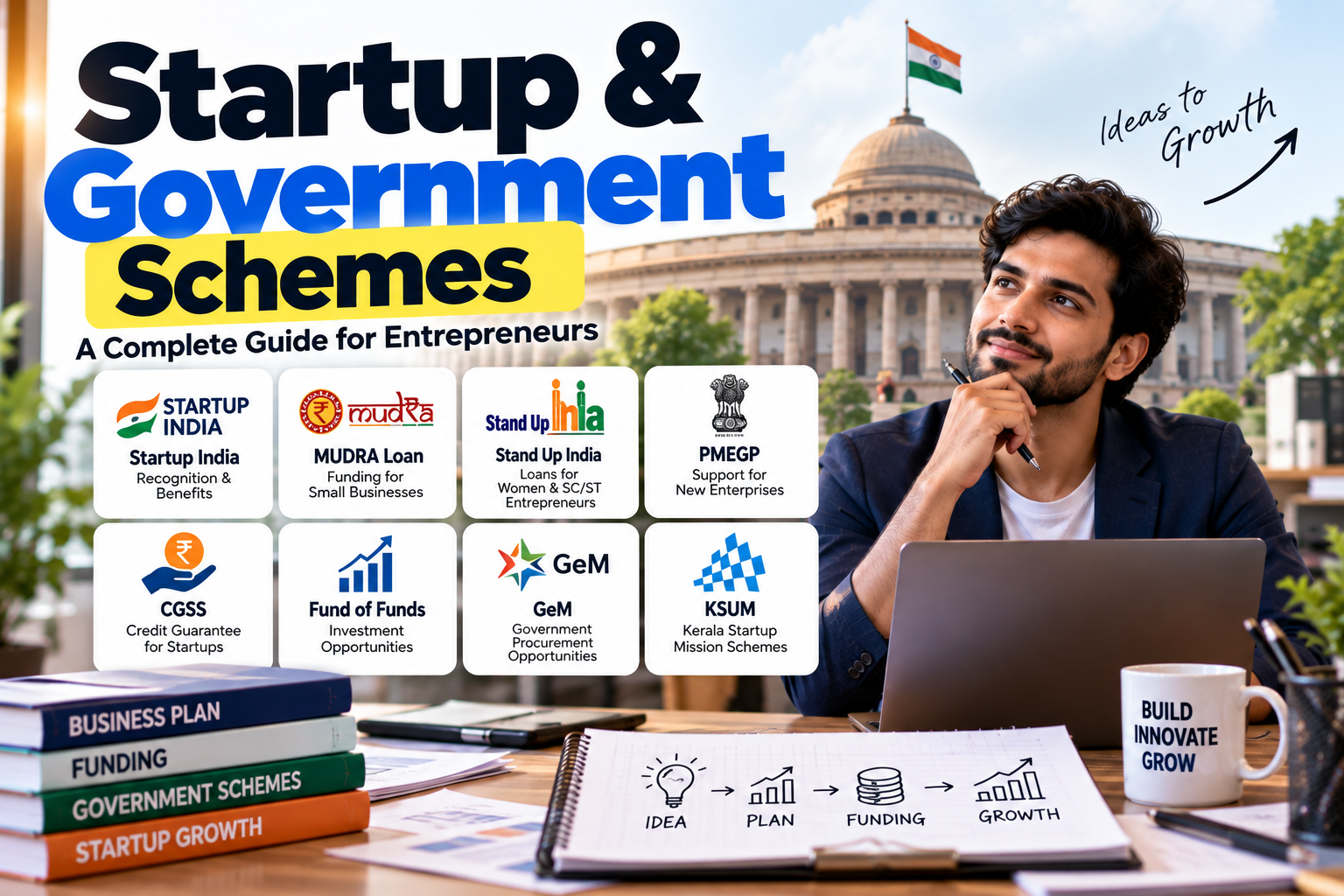
Starting a business is an exciting opportunity, but turning an idea into a successful enterprise requires more than determination. Entrepreneurs need capital, market access, professional guidance, technology, and a clear understanding of regulatory requirements. For many founders, arranging the initial investment and managing business expenses can be among the biggest challenges.
To support entrepreneurship, the Government of India and various state governments offer schemes designed to encourage innovation, provide financial assistance, improve access to credit, and help businesses expand. Depending on the nature and stage of a business, entrepreneurs may be eligible for startup grants, business loans, credit guarantees, intellectual property support, and other benefits.
Understanding startup government schemes in India can help founders identify suitable opportunities, prepare stronger applications, and make informed financial decisions.
In this guide, we explore important government schemes for startups, their potential benefits, eligibility considerations, application procedures, and practical steps entrepreneurs should take before applying.
1. What Are Government Schemes for Startups?
Government schemes for startups are programmes introduced by central or state government departments to encourage entrepreneurship, innovation, employment generation, and economic development.
These programmes may support businesses through different forms of assistance, including:
-
Startup grants: Financial assistance for eligible research, product development, testing, or innovation.
-
Business loans: Funding for eligible business activities, equipment, working capital, or expansion.
-
Credit guarantees: Arrangements that help eligible lenders provide credit to qualifying businesses.
-
Seed funding: Early-stage financial support for developing and commercialising innovative products or services.
-
Tax-related benefits: Specific tax incentives available to qualifying businesses under applicable provisions.
-
Intellectual property support: Assistance with eligible patent, trademark, and design registration processes.
-
Market access: Opportunities to supply products or services to government departments and public-sector organisations.
-
Incubation and mentoring: Business guidance, technical support, networking, and access to startup ecosystems.
However, these benefits are not automatically available to every newly established business. Eligibility depends on the particular scheme, business structure, sector, financial position, location, and other conditions.
2. Startup India: A Key Initiative for Entrepreneurs
Startup India is a flagship initiative of the Government of India designed to strengthen the startup ecosystem and encourage innovation-led businesses.
One of its important features is recognition by the Department for Promotion of Industry and Internal Trade (DPIIT).
What Is DPIIT Startup Recognition?
DPIIT recognition allows eligible businesses to access certain benefits and programmes associated with the Startup India initiative.
Under the general startup recognition framework, an eligible entity must satisfy the applicable conditions, which include requirements relating to its legal structure, age, turnover, originality, and innovation or scalability.
Eligible entity types include:
-
Private Limited Companies
-
Limited Liability Partnerships (LLPs)
-
Registered Partnership Firms
-
Cooperative Societies, subject to applicable recognition conditions
Under the general framework, an ordinary startup typically must not have existed for more than 10 years from incorporation and must not have exceeded the prescribed annual turnover threshold of ₹200 crore in any financial year since incorporation. Eligible DeepTech startups may qualify under a separate framework with a longer age limit and a higher turnover threshold.
The business must also meet the applicable requirements concerning innovation, improvement of products or services, scalability, or employment and wealth creation. Businesses formed by splitting up or reconstructing an existing business are generally excluded.
Founders should confirm the current criteria before applying, as the rules and recognition categories may change.
Potential Benefits of Startup India Recognition
Depending on eligibility and the relevant programme, recognised startups may access:
-
Opportunities to apply for eligible government funding programmes.
-
Intellectual property facilitation and support.
-
Certain self-certification and compliance-related benefits.
-
Eligible public procurement opportunities.
-
Mentorship and incubation networks.
-
Specific tax benefits, where separately eligible and approved.
Important: DPIIT recognition does not automatically provide a grant, guarantee a loan, or make a startup eligible for every tax exemption. Some benefits require separate applications and approvals.
Entrepreneurs can review the current requirements through the official Startup India portal.
3. Important Government Schemes for Startups in India
Different schemes serve different business needs. A technology startup developing an innovative product may require seed funding, while a small manufacturing business may need a bank loan to purchase machinery.
The following schemes and initiatives are worth exploring.
3.1 Startup India Seed Fund Scheme (SISFS)
The Startup India Seed Fund Scheme was designed to support eligible early-stage startups that need funding to validate an idea, develop a prototype, test a product, or begin commercialisation.
The scheme's published framework provides for:
-
Grants of up to ₹20 lakh for eligible proof-of-concept validation, prototype development, or product trials.
-
Investment support of up to ₹50 lakh through permitted debt, convertible instruments, or other approved structures for eligible market-entry and commercialisation activities.
Funding is provided through selected incubators rather than being automatically paid to every applicant.
Who May Qualify?
The published scheme criteria include DPIIT recognition, incorporation within the prescribed age limit at the time of application, and a viable, scalable business proposition involving technology or innovation.
The incubator evaluates the startup according to the scheme guidelines and its assessment process.
Important Application Status Update
The official Seed Fund portal has published an extended deadline of 31 May 2026 for startup applications under the scheme. That date has passed.
Therefore, entrepreneurs should not assume that fresh applications are currently open. Check the official portal for any subsequent extension, new funding window, or successor programme before planning an application.
Official portal: Startup India Seed Fund Scheme
3.2 Credit Guarantee Scheme for Startups (CGSS)
Accessing a business loan can be difficult for a young company that has limited assets, a short credit history, or insufficient collateral.
The Credit Guarantee Scheme for Startups aims to improve access to eligible debt funding by providing credit-guarantee coverage to participating lenders for qualifying loans to eligible DPIIT-recognised startups.
The revised framework provides for a maximum guarantee-cover limit of up to ₹20 crore per eligible borrower, subject to scheme rules and the type of facility.
Potential forms of eligible debt funding include working capital, term loans, venture debt, and other permitted credit facilities.
How Does It Work?
The guarantee is not a grant paid directly to the startup. Instead, the guarantee mechanism supports participating lending institutions that finance eligible startups.
A founder generally needs to:
-
Check DPIIT recognition and scheme eligibility.
-
Prepare a business plan and financial projections.
-
Identify a participating bank or other eligible lending institution.
-
Submit the required loan application and supporting documents.
-
Undergo the lender's credit assessment and applicable scheme checks.
Approval is not automatic. The lender evaluates repayment capacity, business viability, financial records, and other relevant factors.
Official information: Credit Guarantee Scheme for Startups
3.3 Fund of Funds for Startups (FFS)
The Fund of Funds for Startups is intended to encourage investment in eligible startups through the venture capital ecosystem.
Instead of investing directly in every startup, the government-backed structure channels capital through eligible, SEBI-registered Alternative Investment Funds (AIFs), which then invest in startups according to their investment strategies.
How Can a Startup Benefit?
An entrepreneur seeking equity investment may explore venture capital funds that invest in businesses operating within the startup's sector and development stage.
To improve the chances of attracting investment, founders should prepare:
-
A clear business model.
-
A presentation explaining the market opportunity.
-
Financial statements and realistic projections.
-
Details of existing customers and revenue.
-
Information about the founding team.
-
A funding requirement and proposed use of funds.
-
A clear explanation of how the business can grow.
Remember: FFS is not a direct government grant application for individual founders. Investment decisions are made by the participating funds according to their investment criteria.
Official information is available through the Startup India portal.
3.4 Pradhan Mantri MUDRA Yojana (PMMY)
The Pradhan Mantri MUDRA Yojana supports eligible micro-enterprises through loans provided by participating financial institutions.
It may be relevant to entrepreneurs establishing or expanding eligible businesses in manufacturing, trading, services, and certain activities allied to agriculture.
The scheme includes four loan categories:
| Category | Loan amount |
|---|---|
| Shishu | Up to ₹50,000 |
| Kishor | Above ₹50,000 and up to ₹5 lakh |
| Tarun | Above ₹5 lakh and up to ₹10 lakh |
| Tarun Plus | Above ₹10 lakh and up to ₹20 lakh, for eligible borrowers who have successfully repaid a previous Tarun loan |
MUDRA loans can support eligible term-loan and working-capital requirements. The scheme's published framework does not require collateral for these loans, although borrowers must still satisfy the lender's eligibility and documentation requirements.
Who Should Consider MUDRA?
Depending on the lender's assessment and applicable scheme conditions, potential applicants may include:
-
Small retail businesses.
-
Service providers.
-
Eligible manufacturing enterprises.
-
Repair and maintenance businesses.
-
Small trading enterprises.
-
Certain eligible agriculture-allied businesses.
For example, an entrepreneur opening a small repair centre may investigate whether a MUDRA loan can support eligible equipment or working-capital requirements.
The final loan amount, interest rate, repayment period, and approval decision depend on the lending institution and applicable rules.
Official information: Pradhan Mantri MUDRA Yojana
3.5 Prime Minister's Employment Generation Programme (PMEGP)
The Prime Minister's Employment Generation Programme is a credit-linked subsidy programme intended to support the establishment of eligible new micro-enterprises and generate employment.
It may be relevant to entrepreneurs planning certain manufacturing or service-sector businesses.
Under the published guidelines for new units, the maximum project cost eligible for margin-money subsidy is generally:
-
₹50 lakh for manufacturing projects.
-
₹20 lakh for business or service projects.
The scheme provides for a beneficiary contribution and a margin-money subsidy, with rates depending on factors such as the applicant category and whether the project is located in a rural or urban area.
For example, under the published framework, the general-category beneficiary contribution is generally 10% of the project cost, while the special-category contribution is generally 5%. Subsidy rates vary according to the applicable category and project location.
PMEGP is not a universal startup grant. It follows specific eligibility requirements and a bank-linked process.
Who May Consider PMEGP?
Potential applicants may include eligible individuals planning a new micro-enterprise that meets the scheme's conditions.
Before applying, verify:
-
Whether the proposed activity is permitted.
-
Whether the business qualifies as a new enterprise under the scheme.
-
The eligible project-cost limit.
-
The required beneficiary contribution.
-
The applicable subsidy rate.
-
The current application and bank-approval process.
Official information: PMEGP e-Portal
3.6 Government e-Marketplace (GeM)
Government departments and public-sector organisations purchase a wide range of goods and services. The Government e-Marketplace provides an online procurement platform for eligible sellers and service providers.
Eligible startups may use this platform to explore government procurement opportunities and develop a customer base beyond the private sector.
Depending on the applicable procurement rules, eligible DPIIT-recognised startups may receive certain relaxations, such as exemptions from specified prior-turnover or prior-experience requirements. These relaxations are subject to tender conditions and do not remove product-quality, technical, financial, or performance requirements.
How Can Startups Use GeM?
-
Identify the products or services the business can supply.
-
Complete the applicable seller registration.
-
Prepare product descriptions and required business documentation.
-
Review relevant procurement opportunities.
-
Check the tender's technical and commercial conditions.
-
Submit bids or quotations where eligible.
-
Maintain the ability to deliver within the required standards and timelines.
GeM is particularly worth exploring for businesses offering eligible products, technology solutions, professional services, equipment, or other goods and services purchased by government organisations.
Official portal: Government e-Marketplace
3.7 Startup Intellectual Property Protection (SIPP)
Intellectual property can be an important business asset, particularly for startups that develop new technologies, products, brands, designs, or innovative processes.
The Startup Intellectual Property Protection initiative has been designed to facilitate intellectual property protection for eligible startups.
Depending on the applicable programme rules, assistance may be available for processes relating to:
-
Patents.
-
Trademarks.
-
Industrial designs.
Protecting intellectual property can help businesses establish ownership, strengthen brand identity, and prepare for investment or commercial expansion.
However, registration is not automatic, and eligibility, professional support, government fees, and reimbursement conditions must be checked separately.
Entrepreneurs should identify the intellectual property they need to protect and seek appropriate professional advice before submitting applications.
Official information: Startup India
4. Government Schemes for Startups in Kerala
Entrepreneurs in Kerala can explore both central government programmes and initiatives administered through the Kerala Startup Mission (KSUM).
KSUM supports the state's startup ecosystem through funding opportunities, incubation, mentoring, networking, and other entrepreneurship programmes.
The suitability of a scheme depends on the business model, innovation level, development stage, eligibility criteria, and availability of funding.
4.1 Kerala Startup Mission Idea Grant
The Idea Grant is intended to help eligible innovators and early-stage startups validate promising ideas and develop initial proof-of-concept or prototype work.
The current KSUM programme information lists support of up to ₹3 lakh for eligible applicants, subject to the scheme's conditions.
Possible uses may include eligible product development, prototyping, testing, and validation activities.
This type of support is particularly relevant when a founder has an idea that needs technical development and validation before moving towards a market-ready product.
4.2 Productisation Grant
Developing an initial prototype is only one part of building a business. Startups may also need to improve product design, undertake testing, complete engineering work, and prepare for commercialisation.
KSUM's Productisation Grant is intended to support eligible startups at this stage.
The published programme lists grants of up to ₹7 lakh under the standard scheme. Separate provisions may apply to eligible women-led or transgender-led startups.
Applicants should review the current guidelines to confirm the available amount, eligible expenses, and application requirements.
4.3 Kerala Startup Mission Seed Fund
KSUM also provides seed-funding support for eligible startups that need financial assistance to develop products, acquire customers, undertake testing, or move towards commercialisation.
The Seed Fund scheme information lists support of up to ₹15 lakh, generally structured as a soft loan rather than a grant.
The published criteria include requirements relating to registration in Kerala, DPIIT recognition, an active KSUM Unique ID, and the development of an innovative product or technology.
The funding may be subject to repayment, interest, a moratorium, milestone-based disbursement, and other conditions.
This distinction is important: a grant normally does not need to be repaid when the recipient meets the applicable terms, whereas a loan must be repaid according to its agreement.
4.4 Scale-up Support
Startups that have already validated their products and generated revenue may require additional capital to expand into new markets, strengthen operations, or improve their products.
KSUM lists scale-up funding opportunities for qualifying startups, including a Scale-up Seed Fund and Scale-up Grant.
The published Scale-up Seed Fund information describes support of up to ₹25 lakh for eligible startups, subject to detailed eligibility and assessment requirements. The Scale-up Grant programme lists assistance of up to ₹15 lakh for eligible businesses.
These amounts are maximum published limits, not guaranteed payments. Eligibility, revenue requirements, previous funding, permitted expenses, and other conditions can affect the amount available to a particular startup.
4.5 Patent Reimbursement in Kerala
Startups developing innovative products or technologies may need to protect their intellectual property in India or overseas.
KSUM's published scheme information lists patent reimbursement support of up to:
-
₹2 lakh for eligible Indian patent expenses.
-
₹10 lakh for eligible US patent expenses.
Applicants must verify the current programme guidelines, eligible expenses, application timing, and documentation requirements before incurring costs.
Where Can Kerala Entrepreneurs Find These Schemes?
Visit the official Kerala Startup Mission website to explore funding, incubation, and other startup-support programmes.
Practical tip: Do not apply to a scheme simply because it offers a large funding amount. First determine whether the business meets the criteria and whether the funding structure matches its actual needs.
5. Which Government Scheme Is Right for Your Business?
There is no single scheme that is best for every entrepreneur. The right choice depends on what the business does, how much funding it requires, and what stage it has reached.
Use the following table as an initial guide.
| Business requirement | Schemes or programmes to explore |
|---|---|
| Developing an innovative prototype | Kerala Startup Mission grants; relevant incubator programmes; NIDHI PRAYAS opportunities |
| Early-stage startup funding | Applicable seed-funding programmes and incubator support |
| Accessing eligible startup debt funding | Credit Guarantee Scheme for Startups, through participating lenders |
| Funding a small eligible business | Pradhan Mantri MUDRA Yojana |
| Setting up an eligible new micro-enterprise | PMEGP |
| Attracting equity investment | Venture capital funds and the Fund of Funds ecosystem |
| Selling products or services to government organisations | Government e-Marketplace |
| Protecting a brand or invention | Applicable trademark, patent, and intellectual property support programmes |
| Expanding a Kerala-based technology startup | Relevant Kerala Startup Mission funding and scale-up programmes |
This table is a starting point, not a determination of eligibility. Each scheme has its own application requirements, and some programmes may not currently be accepting applications.
6. How to Apply for Startup Government Schemes in India
Applying for government funding requires preparation. Even when a business meets the basic eligibility criteria, an incomplete application or an unclear funding plan can delay the process.
Follow these steps to prepare a stronger application.
Step 1: Choose the Appropriate Business Structure
The legal structure of your business can affect which schemes you can access.
Common options include:
-
Sole proprietorship.
-
Partnership firm.
-
Limited Liability Partnership (LLP).
-
Private Limited Company.
A proprietorship may suit certain small businesses, while an LLP or Private Limited Company may be more suitable for businesses seeking specific startup recognition, equity investment, or structured expansion.
The appropriate structure depends on ownership, liability, taxation, compliance costs, and funding plans.
Important: Do not assume that every government scheme requires a Private Limited Company. Check the legal-structure requirements of the particular programme before incorporating your business.
Step 2: Complete the Required Registrations
Depending on the business and scheme, registrations or documents may include:
-
Certificate of Incorporation or relevant business registration.
-
PAN.
-
Business bank account.
-
GST registration, where applicable.
-
Udyam registration, where eligible.
-
DPIIT startup recognition, where required.
-
KSUM Unique ID, for relevant Kerala Startup Mission programmes.
-
Industry-specific licences or approvals, where applicable.
Not every document is required for every application.
For example, a GST registration requirement depends on the applicable GST law and the nature of the business; it is not a universal prerequisite for every startup grant.
Step 3: Prepare a Business Plan
A business plan explains what the business does, who its customers are, how it generates revenue, and how it intends to grow.
A useful plan should cover:
-
Business overview.
-
Customer problem and proposed solution.
-
Target market and competitors.
-
Product or service details.
-
Pricing and revenue model.
-
Marketing and sales strategy.
-
Operating expenses.
-
Financial projections.
-
Funding requirement.
-
Proposed use of funds.
-
Major business risks and mitigation plans.
For an innovative startup, include technical milestones, prototype development, testing plans, and commercialisation objectives.
Step 4: Prepare Financial Projections
Financial projections help demonstrate whether the business has a realistic plan for using the funds.
Prepare estimates for:
-
Startup and setup expenses.
-
Monthly operating costs.
-
Expected revenue.
-
Cash flow.
-
Working-capital requirements.
-
Loan repayments, where applicable.
-
Break-even point.
-
Future investment needs.
Use reasonable assumptions and support them with market information wherever possible.
If applying for a loan, pay particular attention to the business's ability to meet repayments. If applying for a grant, show how the proposed expenditure will achieve the scheme's approved milestones.
Step 5: Collect the Required Documents
Depending on the scheme, applicants may need to provide:
-
Founder or promoter identification and address documents.
-
Business registration certificates.
-
PAN and relevant tax documents.
-
Bank statements.
-
Financial statements, where available.
-
Project report or business plan.
-
Revenue records and customer information.
-
Quotations for equipment or other proposed expenditure.
-
Technical documentation or prototype details.
-
Ownership and shareholding information.
-
Previous funding details.
-
Category certificates, where applicable.
-
Declarations required under the scheme.
Prepare a document folder and verify that the information is consistent across all applications.
Step 6: Submit the Application Through the Correct Channel
Use the official portal, approved incubator, participating bank, or designated government department specified by the scheme.
Do not rely solely on third-party advertisements or intermediaries claiming to guarantee approval.
Before submitting, check:
-
Whether applications are currently open.
-
Whether your business meets the eligibility criteria.
-
Whether all required documents are attached.
-
Whether the proposed expenses are permitted.
-
Whether the application has been completed correctly.
-
Whether an application fee is officially required.
-
Whether any deadlines apply.
Save the acknowledgement or application reference number.
Step 7: Respond to Clarifications and Track Progress
Some schemes require additional documents, a presentation, an interview, a pitch to an expert committee, or a review by a bank or incubator.
Respond within the specified time and retain records of all submissions.
If funding is approved, carefully review the sanction letter or grant agreement before accepting the funds. Pay particular attention to permitted expenses, reporting requirements, milestones, repayment terms, interest, and conditions for release of subsequent instalments.
7. Common Reasons Startup Scheme Applications Face Difficulties
Not every application receives approval. Understanding common problems can help founders improve their preparation.
Incomplete Documentation
Missing registration certificates, inconsistent business details, unsigned declarations, or incomplete financial records may delay an application.
How to avoid it: Prepare a document checklist based on the scheme's official guidelines.
Choosing the Wrong Scheme
A business may apply for a technology-focused grant even though its activities do not satisfy the innovation criteria.
How to avoid it: Match the business model and development stage with the scheme's actual objectives.
An Unclear Use of Funds
A funding request may be difficult to evaluate if the applicant does not explain how the money will be spent.
How to avoid it: Break the funding request into specific activities, costs, milestones, and expected outcomes.
Weak Financial Planning
Unrealistic revenue projections or insufficient cash-flow planning can weaken a loan application and create problems after funding.
How to avoid it: Use conservative assumptions and prepare a realistic cash-flow forecast.
Missing Application Deadlines
Some programmes accept applications only during specified windows. Others operate through periodic calls or limited funding allocations.
How to avoid it: Verify the current application status on the official portal before preparing the full application.
Treating a Loan as a Grant
A loan remains repayable even if it is offered under a government-supported programme.
How to avoid it: Review the interest rate, moratorium, instalments, security requirements, and repayment conditions before accepting the funding.
Neglecting Ongoing Compliance
Receiving funding does not eliminate the business's statutory responsibilities.
How to avoid it: Maintain accurate accounts, submit applicable returns, preserve supporting documents, and complete reporting requirements on time.
8. Financial and Compliance Preparation Before Applying
A startup's funding application is only one part of building a sustainable business. Founders should also establish a sound accounting and compliance system.
Maintain Accurate Books of Accounts
Record business income, expenses, assets, liabilities, loans, and investments correctly.
Accurate financial records make it easier to prepare financial statements, assess business performance, and respond to requests from banks, investors, incubators, or government departments.
Separate Business and Personal Transactions
Use the appropriate business banking arrangements and maintain clear records of transactions between founders and the business.
This improves financial transparency and helps prevent confusion when preparing accounts or applying for funding.
Understand GST and Income Tax Obligations
Determine which tax registrations, returns, payments, and other obligations apply to the business.
Requirements depend on the business structure, turnover, activities, location, and applicable law.
Startup recognition should not be confused with a blanket exemption from GST, income tax, or other statutory obligations.
Track Funding Utilisation
If a grant or loan is approved for specific purposes, maintain invoices, receipts, bank records, and other evidence showing how the funds were used.
Where the scheme requires milestone reports or utilisation certificates, prepare them according to the prescribed format and timeline.
Monitor Cash Flow
A business can report accounting profits and still face a cash shortage.
Prepare regular cash-flow forecasts to anticipate payroll, rent, supplier payments, taxes, loan instalments, and other commitments.
Good financial management helps founders use external funding responsibly and plan for the next stage of growth.
9. A Practical Checklist for Startup Founders
Before applying for a government scheme, review the following checklist.
Business readiness
-
The business idea and revenue model are clearly defined.
-
The legal structure is suitable for the business.
-
Required business registrations are complete.
-
The proposed activity matches the scheme's objectives.
Eligibility
-
The business meets the applicable age and turnover requirements.
-
Any required DPIIT recognition or state startup registration is complete.
-
The founder meets the relevant applicant criteria.
-
The business is operating in an eligible sector or activity.
Financial preparation
-
A business plan or project report is ready.
-
The funding requirement is calculated.
-
The proposed use of funds is clearly explained.
-
Financial projections and cash-flow estimates are prepared.
-
Loan repayment capacity has been assessed, where relevant.
Documentation and submission
-
Required business and founder documents are available.
-
Financial records are accurate and consistent.
-
The official application window is open.
-
All forms and declarations have been reviewed.
-
The acknowledgement and reference number are saved.
After approval
-
The sanction terms or grant agreement have been reviewed.
-
Funds will be used only for permitted purposes.
-
Accounting and reporting systems are in place.
-
Applicable statutory and scheme deadlines are being tracked.
10. How Clockwell International Can Help Entrepreneurs
Navigating business registrations, accounting, taxation, and compliance can be challenging, especially for founders who are focused on building their products and acquiring customers.
Clockwell International LLP supports businesses with professional services relating to company registration, accounting, taxation, GST, audit, and compliance.
Depending on the business's requirements, professional assistance can help entrepreneurs prepare for funding applications by improving the organisation and accuracy of their business records.
Support may include:
-
Guidance on choosing a suitable business structure.
-
Assistance with eligible company or LLP registration procedures.
-
Guidance on applicable GST and tax registrations.
-
Accounting and bookkeeping support.
-
Financial statement preparation.
-
Compliance planning and record management.
-
Assistance in organising business documents for review by lenders or other relevant institutions.
-
General guidance on identifying relevant government programmes and understanding their published requirements.
Scheme eligibility, funding approval, tax benefits, and loan sanctions remain subject to the relevant authorities, lenders, incubators, and applicable rules. Professional assistance cannot guarantee approval.
For information about Clockwell's services, visit clockwell.in or contact info@clockwell.in.
Frequently Asked Questions (FAQs)
1. Which government scheme is best for startups in India?
There is no single best scheme for every startup. Innovative early-stage businesses may explore relevant incubator or seed-funding programmes, eligible micro-enterprises may consider MUDRA loans, and qualifying new micro-enterprises may investigate PMEGP. The right option depends on the business model, funding requirement, eligibility, and current application availability.
2. Can I receive government funding to start a business?
Potentially, yes. Various government programmes support eligible entrepreneurs through grants, loans, credit guarantees, and other forms of assistance. However, each scheme has its own conditions, and funding is not guaranteed simply because a business is newly registered.
3. Is DPIIT recognition mandatory for every government business scheme?
No. DPIIT recognition is required for certain Startup India benefits and programmes, but other schemes have different eligibility rules. For example, a micro-enterprise applying under a suitable MUDRA lending programme is assessed under the applicable loan requirements rather than a universal DPIIT-recognition requirement.
4. Can an LLP apply for startup government schemes?
An LLP can qualify for certain programmes, including DPIIT startup recognition if it satisfies the applicable conditions. Whether it can apply for a particular grant, loan, or other benefit depends on that scheme's eligibility criteria.
5. Are government startup schemes completely free?
Not all schemes provide grants. Some offer repayable loans, some provide investments through debt or convertible instruments, and others facilitate credit through participating lenders. Entrepreneurs should understand the financial terms before accepting any assistance.
6. Can a small business apply for MUDRA loans?
Eligible micro-enterprises may apply through participating financial institutions. The lender assesses the application under the scheme's conditions and its applicable credit procedures. Approval and loan terms are not automatic.
7. What documents are needed to apply for a startup scheme?
Requirements vary, but may include business registration documents, PAN, bank statements, a project report, financial projections, founder details, and supporting evidence for the proposed use of funds. Some schemes also require DPIIT recognition, state startup registration, technical information, or other documents.
8. Are there government schemes specifically for startups in Kerala?
Yes. Entrepreneurs in Kerala can explore programmes administered through Kerala Startup Mission, including eligible idea-stage, product-development, seed-funding, scale-up, and intellectual property support initiatives. Applicants should confirm current eligibility and application availability on the official KSUM website.
9. Is the Startup India Seed Fund Scheme currently open for new applications?
The official Seed Fund portal has published an extended startup application deadline of 31 May 2026. As that deadline has passed, founders should check the official portal for any subsequent extension or new application window before applying.
10. Does receiving a government grant exempt a startup from taxes and statutory compliance?
No. A grant does not automatically exempt a business from GST, income tax, company-law obligations, or other applicable requirements. Any tax benefit must be separately available under the relevant law and subject to its conditions.
Government schemes can create valuable opportunities for entrepreneurs by improving access to funding, encouraging innovation, supporting business expansion, and opening new markets. However, the benefits vary considerably between programmes, and not every startup will qualify for every scheme.
The most effective approach is to identify the business's actual needs, select programmes that match its stage of development, verify current eligibility, and prepare accurate financial and legal documentation before applying.
For entrepreneurs in Kerala and across India, combining suitable government support with sound accounting, realistic financial planning, and timely statutory compliance can provide a stronger foundation for sustainable business growth.
Planning to start or expand your business? Explore the relevant government programmes, verify their current requirements, and organise your registrations and financial records before submitting an application.
Disclaimer: This article is for general informational purposes only and is not legal, tax, investment, or financial advice. Scheme terms, eligibility criteria, funding availability, deadlines, and benefits may change. Verify the latest requirements through the relevant official government portal or implementing authority before making business or financial decisions.
Published on October 31, 2026