

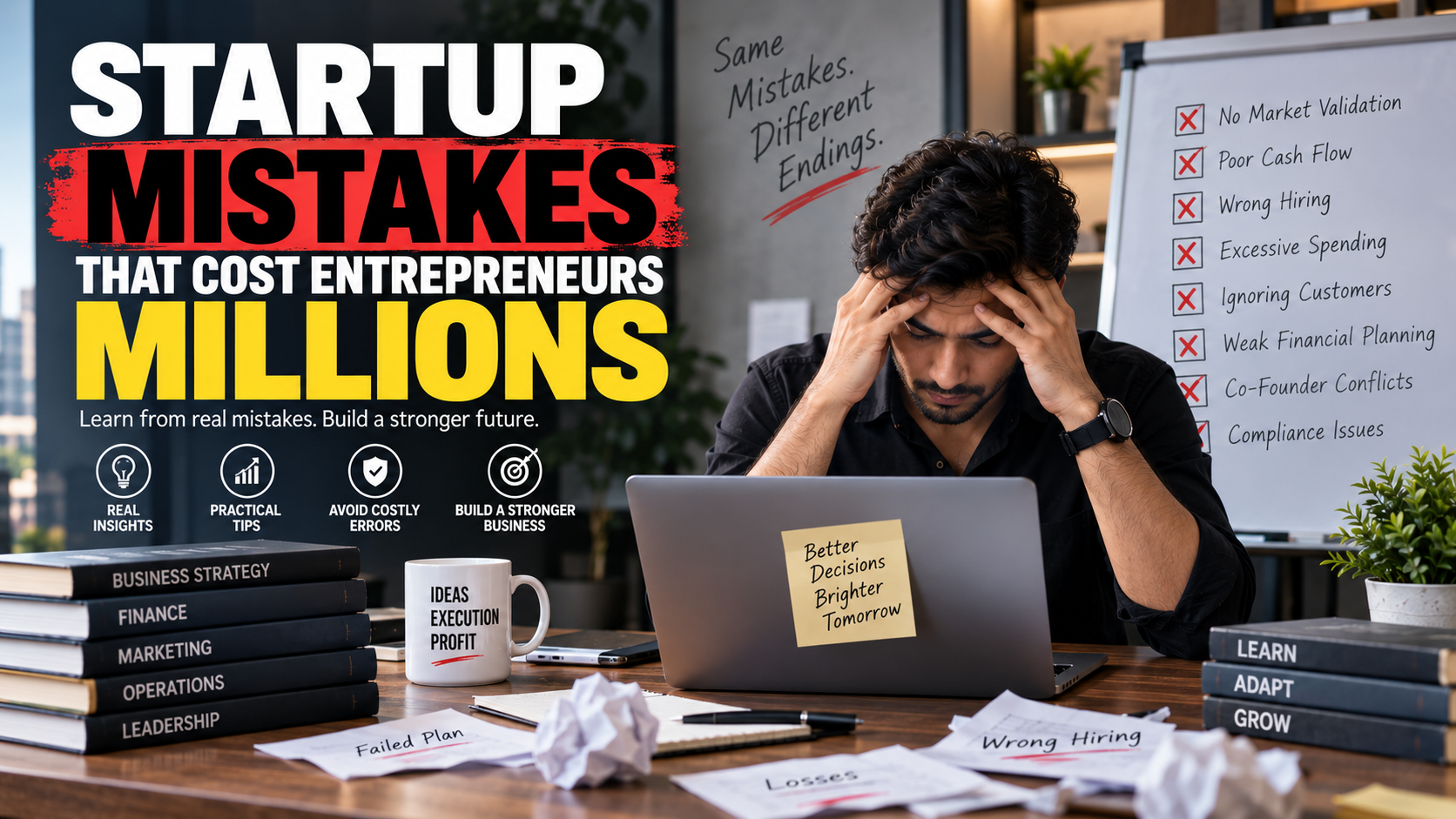
Starting a business is exciting, but entrepreneurship also comes with significant financial and operational risks.
Many startup failures are not caused by a lack of ambition or a bad product alone. Entrepreneurs can lose substantial amounts of money because of poor financial planning, weak market validation, uncontrolled spending, unclear ownership, legal problems, bad hiring decisions, ineffective marketing, or scaling too quickly.
Some mistakes may cost a few thousand rupees. Others can cost lakhs or even millions when they compound over several years.
The good news is that many of these mistakes are preventable.
In this guide, we explore the startup mistakes that cost entrepreneurs millions, why they happen, how they affect a business, and what founders can do to avoid them.
1. Starting Without Validating the Market
One of the most expensive startup mistakes is building a product before confirming that customers actually need it.
Founders sometimes spend months developing:
-
Websites
-
Mobile applications
-
Hardware
-
Software
-
Packaging
-
Branding
-
Inventory
Only after launching do they discover that customers aren't willing to pay.
Why It Is Expensive
Imagine spending:
-
₹10 lakh on development
-
₹5 lakh on branding
-
₹5 lakh on marketing
Total investment:
₹20 lakh
If there is no real demand, most of that investment may generate little return.
How to Avoid It
Before building the full product:
-
Interview potential customers
-
Study competitors
-
Create a prototype
-
Build an MVP
-
Run small tests
-
Collect pre-orders where appropriate
-
Test willingness to pay
Market validation should come before major spending.
2. Spending Too Much Too Early
Having funding can create a false sense of security.
A startup raises ₹2 crore and suddenly starts spending like a ₹20 crore company.
The founder may hire too many employees, rent an expensive office, buy unnecessary equipment and spend heavily on marketing.
Example
Suppose a startup has ₹1 crore in the bank.
Monthly expenses:
₹10 lakh
The runway is approximately:
10 months
If expenses increase to ₹20 lakh per month, runway falls to:
5 months
The company hasn't doubled its funding—but it has effectively halved its survival time.
Better Approach
Every major expense should answer:
"How does this help us reach the next business milestone?"
3. Ignoring Cash Flow
Revenue does not automatically mean that a business has cash.
A company could show ₹1 crore in sales while still struggling to pay salaries and suppliers.
For example:
-
Sales: ₹1 crore
-
Customer payment period: 90 days
-
Supplier payment period: 30 days
The company may have to pay suppliers and employees long before customers pay their invoices.
This creates a working-capital gap.
Track These Metrics
-
Cash balance
-
Monthly burn
-
Accounts receivable
-
Accounts payable
-
Operating cash flow
-
Working capital
-
Runway
A profitable-looking company can still fail if it runs out of cash.
4. Mixing Personal and Business Money
Some founders use one bank account for everything.
They pay:
-
Personal expenses
-
Business expenses
-
Employee expenses
-
Vendor bills
-
Travel costs
from the same account.
This creates accounting and tax problems and makes it difficult to understand the actual financial position of the business.
Better Approach
Maintain:
Personal finances → Personal account
Business finances → Business bank account
Also establish proper accounting processes from the beginning.
5. Choosing the Wrong Business Structure
The legal structure of a business affects:
-
Liability
-
Taxation
-
Compliance
-
Ownership
-
Fundraising
-
Governance
-
Exit options
Common structures in India include:
-
Sole proprietorship
-
Partnership
-
Limited Liability Partnership (LLP)
-
Private Limited Company
-
Public Limited Company
A founder who plans to raise institutional equity may need a different structure from someone running a small owner-managed business.
Don't Choose Based Only on Registration Cost
A structure that appears cheaper initially may create limitations later.
Consider:
Today's requirements + future funding + growth + ownership + compliance.
6. Not Having a Founders' Agreement
Two friends start a company.
One handles technology.
The other handles sales.
Everything looks perfect.
Two years later, they disagree about:
-
Ownership
-
Salary
-
Decision-making
-
Working hours
-
Company direction
-
Future funding
Without clear agreements, the dispute can become expensive.
A Founders' Agreement Can Address
-
Ownership
-
Roles
-
Responsibilities
-
Decision-making
-
Founder vesting
-
Intellectual property
-
Exit situations
-
Transfer of shares
-
Deadlock mechanisms
The agreement should be drafted and reviewed appropriately for the company's circumstances.
7. Giving Away Too Much Equity Too Early
Some founders give away large portions of their company before understanding its potential value.
For example:
Founder: 100%
Early investor receives:
40%
Founder:
60%
Later, the company raises another round.
Additional dilution reduces the founder's ownership further.
Why This Matters
Fundraising is often a multi-stage journey.
Founders should consider:
-
Current capital requirement
-
Future rounds
-
ESOP pool
-
Investor rights
-
Expected dilution
-
Long-term control
Don't negotiate only on the amount of money.
Understand the complete investment structure.
8. Choosing the Wrong Investors
Money can solve a cash problem—but the wrong investor can create new problems.
Investors may have different expectations regarding:
-
Growth
-
Control
-
Reporting
-
Board participation
-
Exit
-
Future fundraising
For example, a founder building a sustainable business may have different priorities from a VC investor targeting venture-scale returns.
Before Accepting Investment
Research:
-
Investor portfolio
-
Previous founder experiences
-
Investment thesis
-
Typical cheque size
-
Board involvement
-
Follow-on funding
-
Reputation
-
Sector expertise
An investor should be evaluated as a long-term business partner, not merely a source of capital.
9. Ignoring Intellectual Property
A startup may invest heavily in technology but fail to properly establish ownership of its intellectual property.
Problems can arise when:
-
Freelancers create the code
-
Agencies design the brand
-
Employees develop technology
-
Founders contribute pre-existing IP
-
Contractors create product designs
without clear contractual ownership arrangements.
Potential IP Assets
-
Trademarks
-
Patents
-
Copyright
-
Software
-
Product designs
-
Trade secrets
-
Databases
-
Brand assets
IP ownership should be properly documented.
10. Hiring Too Quickly
Hiring is one of the largest expenses for many startups.
Founders sometimes hire:
-
Large sales teams
-
Senior executives
-
Multiple developers
-
HR staff
-
Marketing teams
before the business model is proven.
Example
A startup hires 10 employees at an average total monthly cost of ₹60,000 each.
Monthly payroll:
₹6 lakh
Annual payroll:
₹72 lakh
If the company doesn't have sufficient revenue, this can consume capital rapidly.
Better Approach
Hire around validated business needs.
Early employees should ideally solve critical problems that the founders cannot efficiently handle themselves.
11. Scaling Before Product-Market Fit
Scaling an unproven business can multiply losses.
Imagine:
100 customers → ₹1 lakh revenue
The founder decides to spend heavily to acquire:
10,000 customers
But if the product has high churn or poor customer satisfaction, scaling marketing simply creates more customers who leave.
First Improve:
-
Product
-
Customer experience
-
Retention
-
Pricing
-
Unit economics
-
Customer acquisition
Then scale what is working.
12. Poor Pricing Strategy
Underpricing can be just as dangerous as overpricing.
Suppose a company sells a service for:
₹1,000
Cost of delivering it:
₹900
Gross contribution:
₹100
The company needs huge volume to cover salaries, marketing and overhead.
Many founders focus on getting customers without calculating whether those customers are economically valuable.
Review:
-
Cost of production
-
Gross margin
-
Customer acquisition cost
-
Customer lifetime value
-
Competitor pricing
-
Customer willingness to pay
Pricing should support the economics of the business.
13. Spending Too Much on Marketing Without Measurement
Marketing can become a major source of wasted money.
A startup may spend ₹10 lakh on advertising but fail to track:
-
Leads
-
Conversion rate
-
Customer acquisition cost
-
Revenue
-
Return on advertising spend
-
Customer lifetime value
Without measurement, increasing the budget does not necessarily increase profitable growth.
Every Campaign Should Answer:
How much did we spend?
How many qualified leads did we get?
How many customers converted?
How much revenue did they generate?
14. Ignoring Customer Retention
Some founders obsess over acquiring new customers while ignoring existing ones.
If customers leave quickly, the company has to continuously spend money replacing them.
For subscription businesses, important metrics include:
-
Churn
-
Retention
-
Monthly recurring revenue
-
Net revenue retention
-
Customer lifetime value
Improving retention can have a significant impact on the economics of a recurring-revenue business.
15. Expanding Into Too Many Markets
A startup operating successfully in one city may suddenly decide to enter:
-
Five additional cities
-
Three countries
-
Multiple customer segments
at the same time.
Expansion can introduce:
-
New employees
-
New regulations
-
Marketing costs
-
Logistics costs
-
Customer support requirements
-
Local partnerships
Better Strategy
Expand based on evidence.
Ask:
"What has to be true for this new market to work?"
Test before committing significant capital.
16. Ignoring Taxes and Compliance
Compliance isn't just paperwork.
Missed obligations can lead to:
-
Interest
-
Penalties
-
Notices
-
Litigation
-
Regulatory restrictions
-
Difficulty during due diligence
Depending on the business, compliance may include:
-
Income tax
-
GST
-
TDS
-
MCA filings
-
Payroll requirements
-
Labour regulations
-
Local licences
-
Industry-specific regulations
A startup should maintain a compliance calendar and professional accounting support where appropriate.
17. Poor Bookkeeping
Some founders think accounting is something to deal with at the end of the financial year.
That can create serious problems.
Without updated accounts, founders may not know:
-
Actual profitability
-
Cash position
-
Outstanding receivables
-
Outstanding liabilities
-
Tax obligations
-
Monthly burn
Investors and lenders may also require reliable financial information.
Better Approach
Maintain accounting records monthly, not just annually.
18. No Financial Forecast
A startup without financial projections can easily overspend.
A basic financial model should forecast:
-
Revenue
-
Cost of goods/services
-
Payroll
-
Marketing
-
Technology
-
Rent
-
Taxes
-
Working capital
-
Capital expenditure
-
Cash balance
Run different scenarios:
Conservative
Lower revenue + higher expenses
Base Case
Expected performance
Growth Case
Higher revenue + increased investment
Scenario planning helps founders understand how much capital may be required.
19. Building for Everyone
"Everyone is our customer."
This sounds attractive but usually creates an unfocused business strategy.
A startup should identify a specific Ideal Customer Profile (ICP).
For example:
Instead of:
"We provide accounting software for businesses."
Consider:
"We provide cloud accounting software for small retail businesses with 5–20 employees."
A narrower initial market can make product development and marketing more focused.
20. Ignoring Competitors
Some founders say:
"We have no competitors."
Usually, customers have alternatives.
Those alternatives may be:
-
Competitor products
-
Manual processes
-
Spreadsheets
-
Existing suppliers
-
Internal employees
-
Doing nothing
Understanding alternatives helps founders identify their real competitive advantage.
21. Trying to Build Everything In-House
Startups sometimes spend heavily building systems that already exist.
Examples include:
-
Custom CRM
-
Custom accounting software
-
Custom communication tools
-
Custom analytics
-
Custom HR systems
In some cases, using existing SaaS tools can be significantly cheaper.
Build internally when the technology creates a meaningful competitive advantage.
22. Ignoring Cybersecurity
For technology businesses, cybersecurity failures can be extremely expensive.
Risks include:
-
Data breaches
-
Account takeover
-
Ransomware
-
Payment fraud
-
Customer-data exposure
-
Business interruption
Basic security measures should include:
-
Strong passwords
-
Multi-factor authentication
-
Access controls
-
Backups
-
Software updates
-
Employee security training
-
Monitoring
The specific requirements depend on the business and the type of data handled.
23. Depending Too Much on One Customer
Imagine:
Customer A = 60% of total revenue
If that customer leaves, the company can suddenly face a major financial problem.
Customer concentration should therefore be monitored.
Founders should work toward a diversified customer base where commercially practical.
24. Not Having Written Contracts
Handshake agreements can become expensive disagreements.
Written contracts should clearly establish relevant terms such as:
-
Deliverables
-
Payment
-
Timelines
-
Responsibilities
-
Intellectual property
-
Confidentiality
-
Termination
-
Dispute resolution
This is particularly important for:
-
Large customers
-
Vendors
-
Employees
-
Contractors
-
Partners
-
Investors
25. Chasing Vanity Metrics
Not every number represents real business progress.
Examples of vanity metrics:
-
Social media followers
-
Website visits
-
App downloads
-
Impressions
These numbers can be useful, but founders should connect them to meaningful outcomes.
More important metrics may include:
-
Paying customers
-
Revenue
-
Gross margin
-
Retention
-
Conversion
-
CAC
-
LTV
-
Cash flow
26. Expensive Office and Branding Before Revenue
A beautiful office does not create product-market fit.
Neither does an expensive logo.
Early-stage founders should prioritise:
Product → Customers → Revenue → Retention → Growth
before spending heavily on non-essential overhead.
Branding is important, but spending should be proportional to the stage of the business.
27. Not Planning for Working Capital
A growing company often needs more working capital, not less.
For example, a manufacturing company may need to purchase:
-
Raw materials
-
Packaging
-
Inventory
before receiving customer payments.
As sales increase, working-capital requirements can increase too.
Growth without sufficient working capital can create a cash crisis.
28. Ignoring the Cost of Employee Turnover
Hiring someone isn't the only cost.
When a key employee leaves, the company may lose:
-
Recruitment costs
-
Training investment
-
Productivity
-
Customer relationships
-
Institutional knowledge
Founders should focus on:
-
Clear roles
-
Fair compensation
-
Good management
-
Career development
-
Strong company culture
29. Not Preparing for Due Diligence
A startup may appear attractive until an investor discovers:
-
Missing contracts
-
Unclear cap table
-
Tax issues
-
IP ownership problems
-
Unrecorded liabilities
-
Poor accounting
-
Undocumented employee arrangements
These issues can delay or affect fundraising.
Maintain a Data Room
Keep important documents organised:
Corporate + Financial + Legal + Tax + IP + Customer + Employee + Investment
30. Failing to Know When to Stop
Not every business idea should continue indefinitely.
Founders sometimes continue investing money into a product despite repeated evidence that:
-
Customers aren't buying
-
Costs remain too high
-
Retention is poor
-
The market has changed
-
The business model isn't working
Being persistent is valuable.
But persistence should be combined with evidence-based decision-making.
Sometimes the right move is:
-
Pivot
-
Change pricing
-
Change customer segment
-
Reduce costs
-
Shut down the product
-
Start a different venture
The Most Expensive Startup Mistakes
Some mistakes are particularly dangerous because they compound over time.
| Mistake | Potential Impact |
|---|---|
| No market validation | Product development waste |
| Poor cash-flow management | Liquidity crisis |
| Excessive hiring | High fixed costs |
| Early over-expansion | Burn acceleration |
| Poor pricing | Weak margins |
| Excessive founder dilution | Reduced ownership |
| Weak contracts | Legal and financial exposure |
| Tax/compliance failures | Penalties and operational risk |
| IP ownership problems | Investment/legal complications |
| Poor accounting | Bad financial decisions |
| Customer concentration | Revenue shock |
| Unmeasured marketing | Advertising waste |
The actual financial impact depends on the company, industry and circumstances.
How to Avoid Costly Startup Mistakes
1. Validate Before Investing
Test demand before committing substantial capital.
2. Track Cash Weekly
Know exactly how much money is available.
3. Review Financials Monthly
Don't wait until year-end.
4. Keep Ownership Clear
Maintain an updated cap table.
5. Document Agreements
Use appropriate written contracts.
6. Protect IP
Make ownership clear from the beginning.
7. Hire Carefully
Add people when there is a clear business requirement.
8. Measure Marketing
Track the complete funnel from spending to revenue.
9. Scale Gradually
Expand based on proven economics.
10. Get Professional Advice
Accountants, lawyers, tax professionals and other specialists can help identify risks before they become expensive problems.
A Simple Startup Financial Health Checklist
Review these numbers every month:
Cash
☐ Current bank balance
☐ Monthly burn
☐ Cash runway
Revenue
☐ Monthly revenue
☐ Revenue growth
☐ Recurring revenue where applicable
Customers
☐ New customers
☐ Customer retention
☐ Churn
☐ Customer concentration
Marketing
☐ Marketing spend
☐ Leads
☐ Conversion rate
☐ Customer acquisition cost
Operations
☐ Payroll
☐ Vendor payments
☐ Inventory
☐ Receivables
☐ Payables
Compliance
☐ GST
☐ TDS
☐ Income tax
☐ Corporate filings
☐ Licences
A Better Startup Decision Framework
Before making a major business decision, ask five questions:
1. What problem are we solving?
2. What evidence supports this decision?
3. What will it cost?
4. What happens if we're wrong?
5. What measurable result should we expect?
This simple framework can prevent many expensive decisions.
Final Thoughts
Entrepreneurship always involves risk.
No founder can eliminate every mistake.
But entrepreneurs can reduce avoidable risks by making decisions based on market evidence, financial data, proper documentation and disciplined execution.
The most expensive startup mistakes often don't happen overnight.
They compound:
Poor planning → unnecessary spending → cash-flow pressure → rushed decisions → slower growth → financial losses
The opposite process can create a healthier foundation:
Validate → Plan → Track → Document → Test → Improve → Scale
Whether you are building your first startup or preparing an existing business for investment, focus on the fundamentals.
Understand your customers.
Know your numbers.
Protect your ownership.
Maintain proper accounts.
Use contracts.
Manage cash.
And scale only when the business model supports it.
A startup does not become successful simply by growing faster. It becomes stronger by growing intelligently.
Disclaimer: This article is intended for general educational purposes and should not be considered legal, tax, investment, accounting or financial advice. Startup risks vary by industry, company structure and circumstances. Entrepreneurs should consult qualified professionals before making significant financial, legal or business decisions.
Published on September 16, 2026