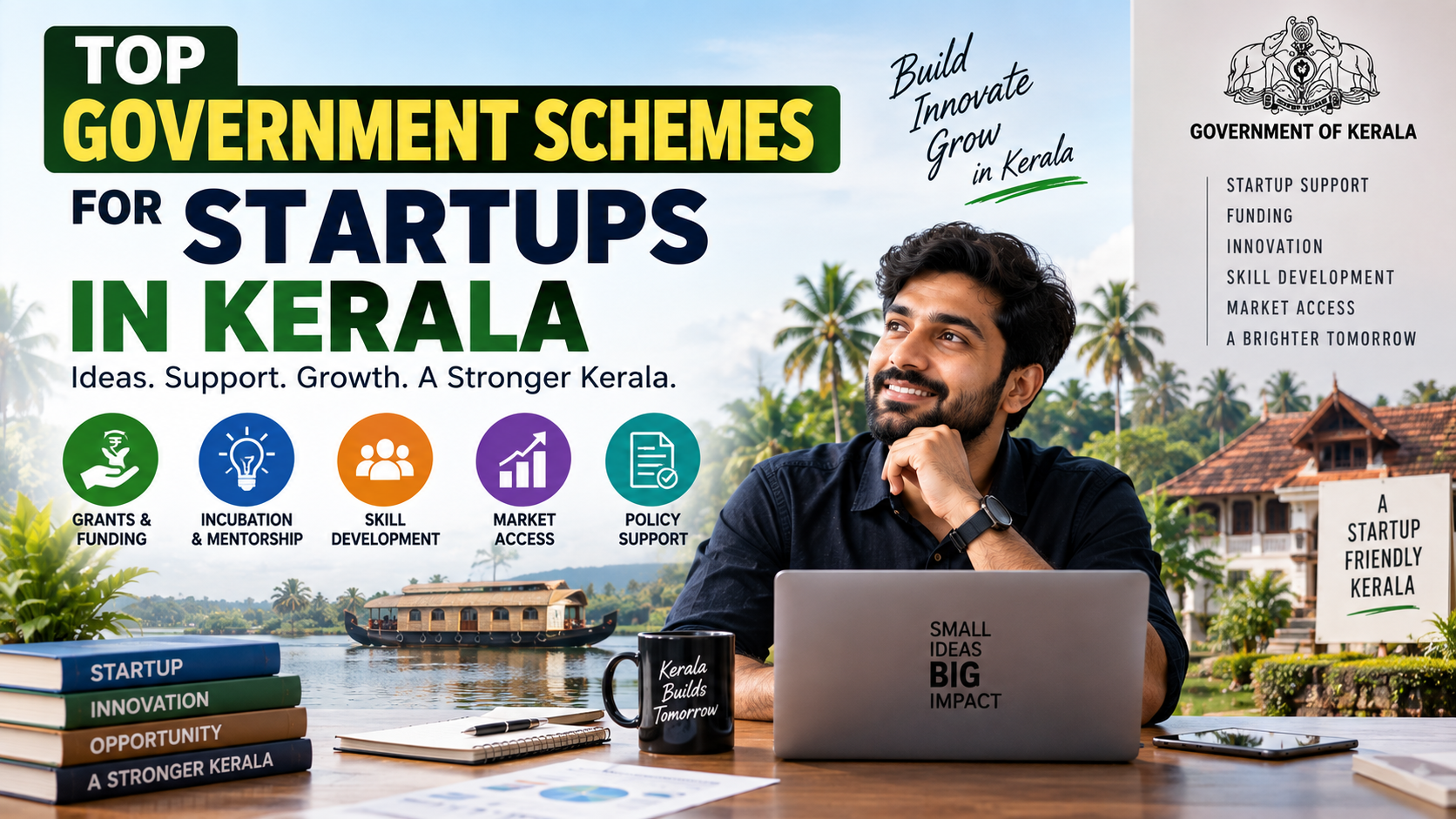
Starting a business in Kerala can be challenging, especially when it comes to funding, product development, market access, technology development and compliance. The good news is that startups in Kerala can access several government-backed schemes designed to reduce these barriers.
The Kerala Startup Mission (KSUM) is the state's nodal agency for startup-related programmes and provides funding, incubation, acceleration, market access and other ecosystem support. In addition, Kerala startups can access several Government of India programmes through Startup India and other central agencies.
These schemes can support a startup at different stages—from validating an idea and developing an MVP to entering the market and scaling operations.
In this guide, we explain the top government schemes for startups in Kerala, who they are designed for, the type of support available and how entrepreneurs can approach them.
What Are Government Startup Schemes?
Government startup schemes are programmes introduced by state or central government agencies to encourage entrepreneurship, innovation and employment.
Depending on the scheme, support may come in different forms:
- Grants
- Seed funding
- Soft loans
- Credit guarantees
- Patent reimbursement
- Incubation
- Mentoring
- Product-development assistance
- Market-access support
- Government procurement opportunities
- Investor connections
- Research and development support
An important point is that not every government scheme gives cash directly to founders. Some provide funding through incubators, financial institutions, venture funds or government procurement programmes.
1. Kerala Startup Mission Idea Grant
The KSUM Idea Grant is one of the most relevant schemes for entrepreneurs who are still at the idea, design, Proof-of-Concept (PoC) or early MVP stage.
The current KSUM programme provides financial assistance of up to ₹3 lakh for eligible innovative technology-based products. The funding can support activities such as product development, prototyping, testing, validation and technology development.
Who Can Benefit?
The scheme is particularly relevant to:
- First-time founders
- Technology entrepreneurs
- Innovators
- Early-stage startups
- Founders developing a new technology product
- Entrepreneurs working towards a PoC or MVP
KSUM states that applicants can be innovators based in Kerala and that company incorporation and KSUM Unique ID certification are required before fund disbursal.
Maximum Support
Up to ₹3 lakh
Best For
Idea → PoC → Early MVP
2. KSUM Productisation Grant
Once a startup has moved beyond the idea stage and has a working prototype, the next challenge is turning that prototype into a commercially viable product.
The Productisation Grant is designed for this stage.
Eligible startups can receive financial assistance of up to ₹7 lakh to convert an MVP into a market-ready product, including product development, testing and validation.
The programme is aimed at innovative technology-based products.
Key Eligibility Conditions
The current KSUM information indicates that the startup should:
- Be in the product-development stage
- Own an innovative technology product
- Be incorporated as a Pvt Ltd, LLP or eligible company structure
- Have active MCA status
- Hold a valid KSUM Unique ID at the relevant stage
If the startup has already received an Idea Grant, only the remaining eligible amount may be available under the Productisation Grant.
Maximum Support
Up to ₹7 lakh
Best For
MVP → Market-ready product
3. Women / Transgender Productisation Grant
Kerala also provides additional support for women- and transgender-led startups.
The Women/Transgender Productisation Grant provides additional funding on top of the standard Productisation Grant, subject to the scheme's conditions.
The current KSUM programme allows eligible startups to receive up to ₹12 lakh in total productisation support, including an additional grant of up to ₹5 lakh, where the applicable eligibility requirements are satisfied. Women/transgender founders must hold at least 51% shareholding under the programme's stated criteria.
Why It Matters
Women entrepreneurs often face additional barriers in accessing early-stage capital. This programme provides targeted support while also connecting founders to Kerala's broader startup ecosystem.
Best For
Women/transgender-led technology startups developing market-ready products
4. KSUM Market Acceleration Grant
Building a product is only the first part of building a business.
Once a startup begins generating revenue, it may need funding for:
- Customer acquisition
- Marketing
- Branding
- Product improvements
- Market expansion
- Certifications
- Business development
The Market Acceleration Grant is designed for startups that have entered the early-revenue stage.
Eligible startups can receive up to ₹10 lakh under the current programme.
The startup generally needs to have an innovative technology-based product, be incorporated in an eligible structure and hold a KSUM Unique ID.
Best For
Early revenue → Market expansion
5. KSUM Scale-Up Grant
A startup that has achieved product-market validation may need substantially more resources to expand.
The Scale-Up Grant is designed for innovative technology-based startups that have demonstrated market traction and are ready to scale.
The current scheme provides financial assistance of up to ₹15 lakh.
The scheme can support activities such as:
- Market expansion
- Branding
- Marketing
- Customer acquisition
- Product enhancement
- Revenue growth
KSUM currently specifies traction-based eligibility, including either ₹10 lakh revenue from the product in the previous six months or at least ₹30 lakh raised through external equity investment, subject to the scheme's other requirements.
Best For
Validated product → High-growth startup
6. KSUM Seed Loan
Not every startup can fund growth through grants.
Some businesses need working capital or additional funds for product development and early commercialisation. For such businesses, KSUM's Seed Loan is an important option.
KSUM currently lists an early-revenue Seed Loan of up to ₹15 lakh as part of its early-stage funding programmes.
Unlike a grant, a loan has to be repaid according to its terms.
Grant vs Seed Loan
| Grant | Seed Loan |
|---|---|
| Generally non-repayable | Must be repaid |
| Milestone-based support may apply | Repayment terms apply |
| Suitable for specific eligible activities | Useful for funding business growth |
| Usually highly competitive | Subject to loan evaluation |
Best For
Prototype → Early commercial traction
7. KSUM Scale-Up Seed Fund
Startups that have already achieved traction may require more capital than an early-stage seed loan provides.
KSUM currently lists a Scale-Up Seed Fund of up to ₹25 lakh for growth-stage startups.
This can be relevant to startups that have moved beyond experimentation and are working on:
- Expansion
- Capacity building
- Customer acquisition
- Revenue growth
- Market development
Because this is a funding programme rather than a grant, entrepreneurs should carefully evaluate repayment and financial obligations before accepting funding.
8. KSUM Research & Development Grant
Kerala has a growing ecosystem of deep-tech and research-driven startups.
For businesses developing sophisticated technologies, the normal startup grant may not be sufficient.
The KSUM R&D Grant is designed for deep-tech and high-technology startups working on research-driven products.
The current programme provides support of up to ₹30 lakh.
The programme is particularly relevant to areas such as:
- Deep tech
- Hardware and electronics
- Defence and space technology
- Health technology
- Industrial applications
- Agri-food technology
- Emerging technologies
Best For
Research → Technology development → Commercialisation
9. BCDD Grant for Entrepreneurs from Backward Classes
The Government of Kerala, through the Backward Classes Development Department (BCDD) and KSUM, also provides targeted startup funding for eligible graduates from backward classes.
The BCDD Funding Support Scheme can provide up to ₹10 lakh per startup, structured around idea validation and productisation support.
The scheme is designed to encourage inclusive entrepreneurship and increase participation in Kerala's technology startup ecosystem.
Best For
Eligible entrepreneurs from the applicable backward-class categories who are developing technology-driven startups.
10. KSUM Government as a Marketplace
Funding isn't the only way a government can support a startup.
One of the most valuable opportunities can be getting the government itself as a customer.
KSUM's Government as a Marketplace initiative creates opportunities for eligible startups to sell innovative products and services to government departments and public-sector organisations.
KSUM's published programme information includes procurement opportunities such as direct procurement and limited tender routes, along with relaxations related to prior experience, turnover, tender fees and earnest money deposit for eligible startups.
Why This Is Important
A government contract can provide:
- Revenue
- Customer validation
- Credibility
- References
- Market visibility
- Opportunities for future contracts
For B2G startups, this can be just as important as receiving a grant.
11. KSUM Fund of Funds
The KSUM Fund of Funds works differently from a conventional startup grant.
KSUM participates as a Limited Partner in SEBI-registered Alternative Investment Funds (AIFs). Those professionally managed funds then invest in startups based in or operating from Kerala.
This means founders do not simply apply to KSUM for a grant under the Fund of Funds.
Instead, the programme helps increase the availability of venture capital for Kerala startups by bringing institutional and private investment into the ecosystem.
Best For
Startups seeking venture capital and growth-stage equity
12. Startup India Seed Fund Scheme
Kerala startups should not limit themselves to state-level programmes.
The Startup India Seed Fund Scheme (SISFS) is a national programme designed to support startups with funding for:
- Proof of concept
- Prototype development
- Product trials
- Market entry
- Commercialisation
The scheme operates through eligible incubators.
However, entrepreneurs should pay attention to the current application status. The official SISFS portal states that the final extended deadline for startup applications was 31 May 2026, so founders should not assume that applications are currently open. Future opportunities should be checked on the official Startup India/SISFS portal.
Best For
Early-stage innovative startups
13. Credit Guarantee Scheme for Startups
Getting a startup loan can be difficult because young businesses often do not have sufficient collateral or a long financial history.
The Credit Guarantee Scheme for Startups (CGSS) addresses part of this problem by providing guarantee cover to eligible lending institutions financing DPIIT-recognised startups.
The current framework has increased the maximum debt eligible for guarantee cover to ₹20 crore per eligible borrower. The guarantee is provided through the relevant institutional mechanism rather than directly to the startup.
The scheme can cover eligible forms of debt such as:
- Venture debt
- Working capital
- Subordinated debt
- Mezzanine debt
- Debentures
- Other eligible fund-based and non-fund-based facilities
Important
A startup does not simply receive ₹20 crore from the government.
The scheme provides credit guarantee support to participating financial institutions, which then assess the startup and decide whether to provide funding.
Best For
DPIIT-recognised startups seeking debt funding
14. NIDHI Programmes
Technology startups and innovators can also explore the NIDHI ecosystem operated under the Department of Science & Technology.
Programmes such as NIDHI-PRAYAS support innovators in converting ideas into prototypes, while the NIDHI Seed Support Programme helps eligible startups move toward commercialisation.
KSUM's current early-stage funding overview lists NIDHI-PRAYAS support of up to ₹10 lakh and NIDHI Startup Seed Support ranging from ₹25 lakh to ₹1 crore, subject to the applicable programme and eligibility conditions.
These programmes are particularly relevant to technology, hardware and innovation-led startups.
Which Government Scheme Is Best for Your Startup?
The right scheme depends heavily on your startup's stage.
| Startup Stage | Scheme to Explore | Potential Support |
|---|---|---|
| Idea / PoC | KSUM Idea Grant | Up to ₹3 lakh |
| MVP / Product Development | KSUM Productisation Grant | Up to ₹7 lakh |
| Women/Transgender Productisation | KSUM Women/Transgender Grant | Up to ₹12 lakh total |
| Early Revenue | KSUM Market Acceleration Grant | Up to ₹10 lakh |
| Growth / Scale | KSUM Scale-Up Grant | Up to ₹15 lakh |
| Early Revenue Funding | KSUM Seed Loan | Up to ₹15 lakh |
| Growth Funding | KSUM Scale-Up Seed Fund | Up to ₹25 lakh |
| Deep-Tech / R&D | KSUM R&D Grant | Up to ₹30 lakh |
| Eligible BCDD entrepreneurs | BCDD Grant | Up to ₹10 lakh |
| Government sales | Government as a Marketplace | Procurement opportunity |
| Venture Capital | KSUM Fund of Funds | Indirect equity ecosystem support |
| Debt funding | Startup Credit Guarantee Scheme | Guarantee support |
| Technology innovation | NIDHI programmes | Scheme-dependent |
The amounts above are indicative of the current programme information published by the respective government platforms. Eligibility, application windows, funding conditions and allowable expenses can change.
How to Apply for Government Startup Schemes in Kerala
Getting government funding is not simply about filling out an application.
A startup should prepare its business and documentation before applying.
Step 1: Identify Your Startup Stage
First determine whether your business is at:
- Idea stage
- PoC stage
- MVP stage
- Product development stage
- Early revenue stage
- Growth stage
- Scale-up stage
Applying for a growth-stage scheme when your product is still at the idea stage can result in rejection.
Step 2: Get the Required Startup Recognition
Many programmes require startup registration or recognition.
For KSUM programmes, a KSUM Unique ID is an important requirement for several schemes.
For Central Government programmes, DPIIT recognition may be required.
Therefore, entrepreneurs should first determine which registrations are applicable to their business.
Step 3: Prepare a Strong Business Plan
A good application should clearly explain:
- The problem
- Your solution
- Target customers
- Market opportunity
- Competitive advantage
- Business model
- Revenue model
- Technology
- Current traction
- Funding requirement
- Proposed use of funds
- Expected milestones
Government committees want to understand not only what you are building but also why the business can create measurable value.
Documents Usually Required
Exact documentation varies by scheme, but startups should generally be prepared with documents such as:
Company Documents
- Certificate of Incorporation
- MOA/AOA or LLP agreement
- PAN
- MCA records
- KSUM Unique ID
- DPIIT recognition, where applicable
Financial Documents
- Bank account details
- Financial statements
- Revenue records
- Investment documents
- CA certificates, where required
- Utilisation certificates for previous grants
Founder Documents
- Founder identity proof
- Founder details
- Shareholding information
- Relevant category certificates, where applicable
Startup Documents
- Pitch deck
- Business plan
- Product information
- Prototype/MVP details
- Patent/IP information
- Market research
- Customer/traction information
KSUM's published documentation requirements for its funding programmes show that documents such as incorporation records, PAN, KSUM Unique ID, bank details, CA-certified certificates, revenue/investment evidence and utilisation certificates can be required depending on the scheme.
How to Increase Your Chances of Getting Government Funding
Government schemes can be competitive.
Here are some practical steps that can improve your application.
1. Clearly Define the Problem
Avoid saying:
"We are building an innovative platform."
Explain the actual customer problem and why existing solutions are inadequate.
2. Show a Real Market
Explain:
- Who will buy?
- How many potential customers exist?
- What are they currently using?
- How much are they willing to pay?
3. Demonstrate Traction
If available, include:
- Paying customers
- Revenue
- Pilot customers
- Purchase orders
- Partnerships
- User growth
- Letters of intent
- Investment received
4. Explain Exactly How You Will Use the Money
Instead of saying:
"We need ₹10 lakh for growth."
Provide a clear plan such as:
- Product development — ₹3 lakh
- Testing — ₹1.5 lakh
- Certification — ₹1 lakh
- Customer acquisition — ₹2 lakh
- Technology — ₹1.5 lakh
- Other eligible expenses — ₹1 lakh
The actual permissible expenses must always be checked against the specific scheme guidelines.
5. Build a Strong Pitch Deck
A concise pitch deck should generally include:
- Problem
- Solution
- Product
- Market
- Business model
- Competition
- Traction
- Team
- Financials
- Funding requirement
- Use of funds
- Growth plan
Grant vs Loan vs Equity: What Should a Kerala Startup Choose?
Not all government support works the same way.
Grant
A grant generally does not require repayment, subject to the scheme's conditions and proper utilisation.
Best for: Product development, R&D, validation and eligible startup activities.
Government-Backed Loan
A loan must be repaid.
Best for: Working capital, expansion and commercial activities where the business can support repayment.
Equity Investment
Equity funding means giving investors a stake in the company.
Best for: High-growth startups that need substantial capital and can potentially scale rapidly.
Government Procurement
Instead of receiving funding, the startup generates revenue by selling to government departments or PSUs.
Best for: Startups whose products or services solve government or public-sector requirements.
Common Mistakes Startups Make
Many entrepreneurs know about government schemes but fail to benefit from them because of poor preparation.
Mistake 1: Applying to the Wrong Scheme
A ₹3 lakh idea-stage grant and a ₹15 lakh scale-up grant are designed for very different businesses.
Mistake 2: Treating Government Funding Like Free Money
Funding normally comes with eligibility requirements, milestones, documentation and utilisation conditions.
Mistake 3: Poor Financial Records
Banks, government agencies and investors all want to understand the financial position of the business.
Mistake 4: Weak Pitch Deck
A technically impressive product can still fail if the founder cannot clearly explain the business opportunity.
Mistake 5: Ignoring Central Schemes
Kerala entrepreneurs should explore both KSUM programmes and eligible Central Government schemes.
Startup India maintains a central database of government schemes for startups and advises entrepreneurs to verify the latest information because scheme details can change.
A Simple Funding Roadmap for a Kerala Startup
A startup can think about government support as a progression:
IDEA
↓
KSUM Idea Grant
↓
PROTOTYPE / MVP
↓
Productisation Grant / NIDHI programmes
↓
EARLY REVENUE
↓
Market Acceleration Grant / Seed Loan
↓
GROWTH
↓
Scale-Up Grant / Scale-Up Seed Fund
↓
SCALING
↓
Venture Capital / Government Marketplace / Credit Guarantee
This is not a mandatory sequence. A startup may qualify for different schemes depending on its sector, stage, technology, founder profile and funding history.
Final Checklist for Kerala Startup Founders
Before applying for a government startup scheme, ask yourself:
☐ Is my business legally incorporated where required?
☐ Do I have KSUM registration/Unique ID if required?
☐ Do I qualify for DPIIT recognition where applicable?
☐ Is my startup at the correct stage for the scheme?
☐ Do I have a clear business model?
☐ Do I have a strong pitch deck?
☐ Can I demonstrate market demand?
☐ Are my financial records updated?
☐ Do I have a clear utilisation plan?
☐ Have I checked the latest scheme guidelines?
☐ Is the current application window open?
☐ Have I checked whether previous government funding affects my eligibility?
Final Thoughts
Kerala has developed a broad startup-support ecosystem covering idea validation, product development, R&D, market expansion, seed funding, incubation, government procurement and venture capital.
For an early-stage technology entrepreneur, the KSUM Idea Grant can be a useful starting point. Once the product moves into development, the Productisation Grant may become relevant. Startups with early revenue can explore the Market Acceleration Grant, while businesses with strong traction can consider the Scale-Up Grant. Deep-tech companies should also investigate the R&D Grant, while women-led and eligible category-specific startups may have additional funding opportunities.
At the national level, Kerala founders should also look at Startup India, NIDHI and the Credit Guarantee Scheme for Startups, depending on their business model and stage.
The most important step is not simply finding a scheme that offers the largest amount. It is finding the scheme that matches your startup's current stage and funding requirement.
Government support can reduce the financial pressure of building a startup—but a strong business model, proper accounting, market validation and disciplined execution remain essential for long-term success.
Disclaimer: Government schemes, funding limits, eligibility conditions, application windows and guidelines can change. The information above is based on government sources available at the time of writing. Entrepreneurs should verify the latest requirements directly with Kerala Startup Mission, Startup India or the relevant government department before applying.
Published on September 12, 2026